Within Apulia UFO Files
Meteor, Missile or Mystery Over Polignano?
The 1946 Polignano reports show how a probable meteor could be transformed by post-war fears into a story about mysterious weapons.
On this page
- What newspapers called mysterious projectiles
- The meteor explanation and its limits
- How Cold War fears shaped interpretation
Page outline Jump by section
Introduction
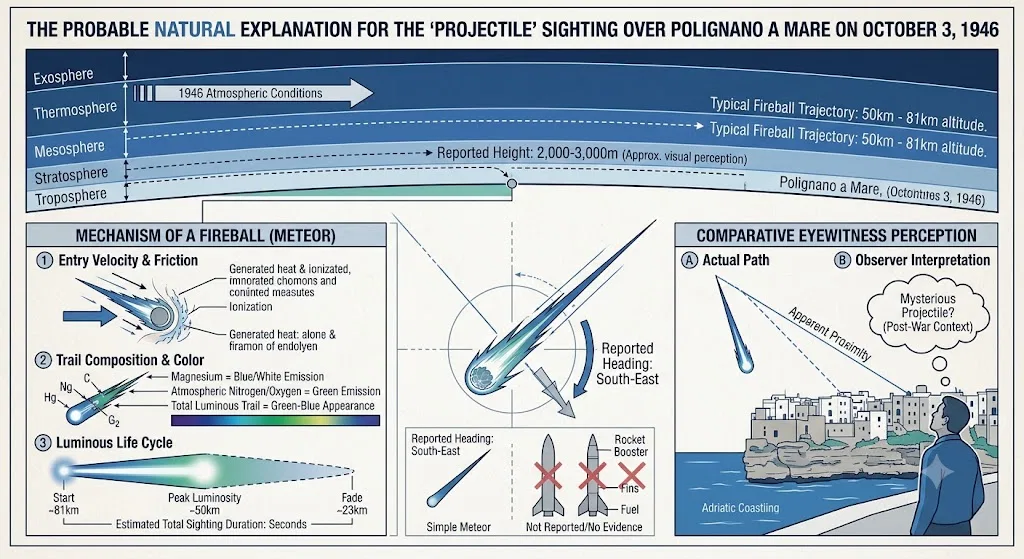
On the evening of 3 October 1946, people in Polignano a Mare saw a bright body cross the sky from the direction of the Adriatic. It travelled towards the south-east, followed an apparently straight course and left a conspicuous green-blue trail. A local newspaper report published two days later asked whether it was one of the “mysterious flying projectiles” then being reported elsewhere in Italy.[Aeritel]aeritel.comAvvistameti UFOAvvistameti UFO - Polignano a Mare…
The surviving description fits a bright meteor, or fireball, more comfortably than a missile or unknown aircraft. Its colour, luminous trail and brief linear passage are all familiar features of meteors. Yet the case cannot be closed with complete confidence because no photograph, measured trajectory, duration, sound report or astronomical observation has been preserved. Polignano’s “projectile” is therefore best treated as probably explained, but poorly documented. Its real importance in Apulia’s UFO history lies in showing how a natural light could be interpreted through the military fears of the immediate post-war period.
What newspapers called mysterious projectiles
The principal surviving record is a short item attributed to La Gazzetta del Mezzogiorno, issue 272, dated 5 October 1946. It reported an observation made at 9.05 pm on 3 October. According to the article, the luminous body came from the sea, moved in a straight line towards the south-east and appeared to travel at a “relatively moderate” speed. Witnesses estimated its altitude at between 2,000 and 3,000 metres and described a sizeable green-blue luminous trail.[Aeritel]aeritel.comAvvistameti UFOAvvistameti UFO - Polignano a Mare…
Those details are useful, but they are not measurements. An observer watching an isolated light at night has no reliable way to calculate its altitude without knowing its true size and distance. A meteor tens of kilometres above the ground can seem low, nearby and slow, particularly when its path is close to the horizon or angled partly towards the observer. Modern research comparing eyewitness reconstructions with instrumentally measured fireball paths has found sizeable errors in estimates of speed, direction and height, even when several accounts are available.[PMC]pmc.ncbi.nlm.nih.govSeveral parameters were used as metrics, including the meteor’s starting and ending height, apparent radiant, average speed, and an avera…
The language of the article is equally revealing. It did not simply describe an unexplained light. It connected the sighting with other “mysterious flying projectiles” allegedly seen in several Italian localities during the preceding days. The witnesses’ interpretation was therefore not formed in isolation: a ready-made explanation was already circulating through newspapers and public conversation.[Aeritel]aeritel.comAvvistameti UFOAvvistameti UFO - Polignano a Mare…
There is no surviving indication in the accessible account that anything landed, exploded or caused damage near Polignano. Nor does it report a smoke cloud, engine noise, manoeuvring, repeated passes or a physical object recovered afterwards. The entire case rests on a brief visual observation and the newspaper’s comparison with a wider projectile scare.
The meteor explanation and its limits
A bright meteor is the strongest explanation because it accounts for the sighting’s most distinctive features without requiring an experimental weapon or extraordinary craft. Fireballs are exceptionally bright meteors produced when natural material enters the atmosphere at high speed. They can cross a large section of sky, appear to move horizontally and leave a glowing train behind them. The International Meteor Organization notes that even a fireball ending about 50 kilometres above Earth can remain visible to an observer hundreds of kilometres away.[International Meteor Organization]imo.netColors that are produced by swift fireballs usually are the result of ionization of high altitude molecules…. We regard meteors of at…
The green-blue colour is also compatible with a meteor. Fireball colours can arise from glowing meteoric material and from ionised gases in the surrounding atmosphere. Magnesium commonly contributes blue-white light, while other elements and atmospheric effects may produce green tones. Colour alone cannot identify a meteor’s composition, but a green or blue trail is not evidence of rocket propulsion.[NASA]nasa.govinteresting fact of the month 2021Can you see fireballs in daylight, and will a fireball leave a trail?… It entered Earth’s atmosphere at a speed of 15 kilometers per s…
The description of “relatively moderate” speed does not rule out this explanation. A meteor’s true velocity is extremely high, but its apparent movement depends on viewing geometry. A long, shallow trajectory near the horizon may look slower than a short streak crossing directly overhead. Comparable modern fireballs have been described by witnesses as unusually slow, low-flying or aircraft-like before instrumental observations established that they were natural atmospheric entries.[British Astronomical Association]britastro.orgBritish Astronomical Association Very bright fireball on Friday, Sept 21British Astronomical AssociationSeptember 23, 2012 — ## Very bright fireball on Friday, Sept 21…. Hundreds of eyewitness reports are…
Polignano’s reported height of 2,000–3,000 metres is particularly doubtful. Well-observed fireballs typically begin glowing many tens of kilometres above the surface. An Italian fireball recorded by cameras in 2017, for example, became visible at about 81 kilometres and faded at roughly 23 kilometres. The Polignano estimate was therefore almost certainly an impression of proximity rather than a calculated altitude.[arXiv]arxiv.orgA Case Study of the May 30th, 2017 Italian Fireball…
What prevents a firm identification
The meteor interpretation remains an assessment, not a demonstrated reconstruction. Several crucial details are missing:
- The article gives no duration in seconds.
- It does not state where in the sky the light first and last appeared.
- There is no angular size or brightness comparison.
- No named witnesses or separate statements are preserved in the accessible version.
- There is no record of delayed thunder, fragmentation or a persistent smoke train.
- The related sightings elsewhere in Italy are not identified precisely enough to test whether they followed one common trajectory.
These omissions make it impossible to calculate a radiant, altitude or ground path. They also prevent a meaningful check against aircraft movements, military exercises or a particular meteor shower.
October 1946 did include notable meteor activity. The Giacobinid, now generally called Draconid, meteor shower produced an exceptional display around 9 October that year. However, the Polignano observation occurred on 3 October, nearly a week earlier. The timing makes a direct connection possible only in a broad sense, not established. It would be misleading to label the object a Draconid without observational data linking it to that shower’s radiant.[arXiv]arxiv.orgThe 2011 October Draconids outburst. I. Orbital elements, meteoroid fluxes and 21P/Giacobini-Zinner delivered mass to EarthApril 29…
How post-war fears shaped the interpretation
The phrase “mysterious projectiles” belonged to a much larger European story. During 1946, newspapers carried numerous reports of so-called ghost rockets over Sweden, Finland, Norway and neighbouring countries. Witnesses described luminous balls, cigar-shaped forms and objects with fiery tails. Some officials and commentators suspected tests of captured German rocket technology, possibly conducted by the Soviet Union from territory under its control. British archival material shows that contemporary intelligence discussions explicitly considered meteorites alongside possible V-2-style experiments.[National Archives]media.nationalarchives.gov.ukOpen source on nationalarchives.gov.uk.
That context matters because the Second World War had recently demonstrated that revolutionary weapons could appear with little warning. Germany’s V-1 flying bombs and V-2 ballistic missiles had made the idea of an unidentified projectile in the sky frighteningly credible. By 1946, Soviet control of former German research sites encouraged speculation that further missile development was under way. A luminous object did not need to resemble a rocket closely to be fitted into that story.
Contemporary ghost-rocket reports were not all identical, and it would be too simple to claim that every one was a meteor. Some included alleged manoeuvres, radar observations or reports of objects entering lakes. Nevertheless, meteors were recognised from the beginning as an explanation for many sightings. British records noted the repeated “meteor-like glow”, while contemporary newspapers sometimes reported that supposed ghost rockets had subsequently been identified as meteorites.[National Archives]media.nationalarchives.gov.ukOpen source on nationalarchives.gov.uk.
The Polignano report appears to be a local expression of this international atmosphere rather than evidence that Apulia was involved in a secret missile programme. The newspaper’s wording moved rapidly from observation to interpretation: a luminous body became a possible flying projectile because similar objects were already being discussed elsewhere. The witnesses may genuinely have agreed with that conclusion, but agreement within a group is not independent confirmation when everyone has been exposed to the same public narrative.
Later Apulian UFO researcher Arcangelo Cassano made essentially this distinction. Reviewing the newspaper account, he judged a fireball with a green-blue trail to be the most probable cause while acknowledging that the available information was insufficient for certainty.[Barinedita]barinedita.itn1115 gli ufo in puglia tra falsi allarmi e fenomeni inspiegabili. come nel 1963n1115 gli ufo in puglia tra falsi allarmi e fenomeni inspiegabili. come nel 1963
Why the case belongs in Apulia’s UFO history
Polignano’s 1946 mystery predates the familiar flying-saucer era that developed after Kenneth Arnold’s widely publicised American sighting in June 1947. The original witnesses did not describe a disc, extraterrestrial visitors or a spacecraft. Their conceptual model was a weapon: an unidentified projectile linked, at least indirectly, to reports of Soviet or experimental rockets.[Barinedita]barinedita.itn1115 gli ufo in puglia tra falsi allarmi e fenomeni inspiegabili. come nel 1963n1115 gli ufo in puglia tra falsi allarmi e fenomeni inspiegabili. come nel 1963
This makes the event valuable as an example of how UFO reports change with history. The unexplained stimulus may remain broadly similar—a bright object moving across the night sky—but the proposed identity reflects whatever technology or threat seems plausible at the time. In wartime, mysterious lights had been interpreted as enemy devices. In 1946, rockets dominated the discussion. In later decades, comparable lights were more likely to be called flying saucers, satellites, secret aircraft or alien craft.
The case also illustrates an important distinction within regional sighting archives. Polignano was unidentified to the people watching it, but that does not mean it remained inexplicable after analysis. Its reported characteristics point strongly towards a natural event, while the dramatic “projectile” label came from interpretation rather than observed mechanical detail.
A balanced classification is therefore:
Most likely cause: a bright meteor or fireball.
Evidence supporting that view: a straight luminous passage, green-blue trail, lack of reported manoeuvres and compatibility with known fireball appearances.
Evidence against certainty: no original witness files, precise duration, instrumental record, photograph or triangulation.
Status within Apulia’s record: historically significant but evidentially weak; probably explained rather than genuinely unresolved.
The later reporting has weakened, rather than strengthened, the weapon interpretation. No recovered projectile, military confirmation or additional technical evidence has emerged from the accessible record. What has survived most clearly is the newspaper report itself—and with it, a compact example of how an unfamiliar meteor could become a mystery missile in the anxious skies of 1946.

Amazon book picks
Further Reading
Books and field guides related to Meteor, Missile or Mystery Over Polignano?. Use these as the next step if you want deeper reading beyond the article.
The UFO Experience: A Scientific Inquiry
Cited by the New York Review of Books as "the best brief for visitation," this classic study presents an analysis of UFO reports and conc...
The Report on Unidentified Flying Objects
The Report on Unidentified Flying Objects is a book by Edward J. Ruppelt which described the study of UFOs by United States Air Force fro...
UFOs and Government: A Historical Inquiry
Governments around the world have had to deal with the UFO phenomenon for a good part of a century. How and why they did so is the subjec...
eBay marketplace picks
Marketplace Samples
Live-tested eBay searches with available results related to this page.
Selected frommeteor poster oneBay.co.uk.

Endnotes
1.
Source: aeritel.com
Title: Avvistameti UFO
Link:https://www.aeritel.com/ADIA/ufo/avvistamenti%20ufo%202004%20polignano%20a%20mare.html
Source snippet
Avvistameti UFO - Polignano a Mare...
2.
Source: pmc.ncbi.nlm.nih.gov
Link:https://pmc.ncbi.nlm.nih.gov/articles/PMC7357168/
Source snippet
Several parameters were used as metrics, including the meteor’s starting and ending height, apparent radiant, average speed, and an avera...
3.
Source: nasa.gov
Title: interesting fact of the month 2021
Link:https://www.nasa.gov/space-science-and-astrobiology-at-ames/interesting-fact-of-the-month-current/interesting-fact-of-the-month-2021/
Source snippet
Can you see fireballs in daylight, and will a fireball leave a trail?... It entered Earth’s atmosphere at a speed of 15 kilometers per s...
4.
Source: arxiv.org
Link:https://arxiv.org/abs/1911.09555
Source snippet
A Case Study of the May 30th, 2017 Italian Fireball...
5.
Source: arxiv.org
Link:https://arxiv.org/abs/1304.7635
Source snippet
The 2011 October Draconids outburst. I. Orbital elements, meteoroid fluxes and 21P/Giacobini-Zinner delivered mass to EarthApril 29...
6.
Source: barinedita.it
Title: n1115 gli ufo in puglia tra falsi allarmi e fenomeni inspiegabili. come nel 1963
Link:https://www.barinedita.it/storie-e-interviste/n1115-gli-ufo-in-puglia-tra-falsi-allarmi-e-fenomeni-inspiegabili.-come-nel-1963
7.
Source: tg24.sky.it
Title: bolide immacolata video
Link:https://tg24.sky.it/scienze/2025/12/09/bolide-immacolata-video
8.
Source: ufo.se
Link:https://www.ufo.se/index.php/102-afu
9.
Source: ufo.se
Title: 1188 spokraketerna
Link:https://www.ufo.se/index.php/s/1188-spokraketerna
10.
Source: imo.net
Link:https://www.imo.net/observations/fireballs/fireballs/
Source snippet
Colors that are produced by swift fireballs usually are the result of ionization of high altitude molecules.... We regard meteors of at...
11.
Source: britastro.org
Title: British Astronomical Association Very bright fireball on Friday, Sept 21
Link:https://britastro.org/2012/very-bright-fireball-on-friday-sept-21
Source snippet
British Astronomical AssociationSeptember 23, 2012 — ## Very bright fireball on Friday, Sept 21.... Hundreds of eyewitness reports are...
Published: September 23, 2012
12.
Source: media.nationalarchives.gov.uk
Link:https://media.nationalarchives.gov.uk/index.php/the-truth-is-in-here-ufos-at-the-national-archives/
13.
Source: trove.nla.gov.au
Link:https://trove.nla.gov.au/newspaper/article/133168177
14.
Source: space.com
Link:https://www.space.com/stargazing/meteor-showers/when-is-a-double-fireball-not-a-double-fireball-wild-meteor-videos-explained-by-a-trick-of-the-light
15.
Source: Wikipedia
Title: Ghost rockets
Link:https://en.wikipedia.org/wiki/Ghost_rockets
16.
Source: imo.net
Link:https://www.imo.net/observations/fireballs/observations/
17.
Source: historic-newspapers.com
Title: 1946 newspapers
Link:https://www.historic-newspapers.com/pages/old-newspapers/1946-newspapers?srsltid=AfmBOopjkLrMpb3oy8XRkgEUEWznZA4bJ1TRxv2XqcRlPE07tPOOJ2IR
18.
Source: cufos.org
Title: Ghost Rockets
Link:https://cufos.org/types-of-ufos/ghost-rockets/
19.
Source: space.com
Title: greatest meteor storms in history
Link:https://www.space.com/greatest-meteor-storms-in-history
20.
Source: military-history.fandom.com
Title: Ghost rockets
Link:https://military-history.fandom.com/wiki/Ghost_rockets
21.
Source: digitallibrary.regione.puglia.it
Link:https://digitallibrary.regione.puglia.it/search?configuration=discoverablesemanticcollections&f.genre=Oggetto+fisico%2Cequals
22.
Source: nhinewsnetwork.com
Link:https://nhinewsnetwork.com/newsletters/ghost-rockets/
Additional References
23.
Source: amsmeteors.org
Title: American Meteor Society Fireball FAQs
Link:https://www.amsmeteors.org/fireballs/faqf/
Source snippet
Can you see fireballs in daylight, and will a fireball leave a trail?... For example, sodium produces a bright yellow color, nickel show...
24.
Source: youtube.com
Title: The Ghost Rockets Mystery Explained | Close Encounters 108
Link:https://www.youtube.com/watch?v=q65QNWMj_fk
Source snippet
The Tunguska Blast of 1908: The Century's Greatest Mystery, Finally Solved...
25.
Source: youtube.com
Link:https://www.youtube.com/watch?v=GzyP5mIwa5M
Source snippet
Did Aliens Really Visit This Small Town in 1974?...
26.
Source: assobersaglieri.it
Link:https://www.assobersaglieri.it/4-reparto-comando-e-supporti-tattici-bersaglieri/
27.
Source: facebook.com
Link:https://www.facebook.com/PassioneAstronomia/posts/ultimora-avvistato-bolide-luminoso-in-tutta-italia/1228521192638574/
28.
Source: instagram.com
Link:https://www.instagram.com/antonio_decaro/?hl=en
29.
Source: museomitag.it
Link:https://museomitag.it/en/heritage/objects/bombs-and-projectiles/
30.
Source: researchgate.net
Link:https://www.researchgate.net/publication/346851057_Cavezzo_the_first_Italian_meteorite_recovered_by_the_PRISMA_fireball_network_Orbit_trajectory_and_strewn-field
31.
Source: facebook.com
Link:https://www.facebook.com/planetariounionesarda/videos/domenica-8-ottobre-alle-ore-2253-un-bolide-luminoso-ha-solcato-i-cieli-della-sar/999136144676808/
32.
Source: facebook.com
Link:https://www.facebook.com/FocusCanale35/videos/oggetti-non-identificati-anomalie-nel-cielo-non-sono-solo-leggende-sono-visitato/1014817377602850/