Within Lombardy
How Lombardy's Landscape Can Distort the Sky
Haze, cloud, terrain and long viewing distances can make planets, aircraft and luminous clouds appear unfamiliar across Lombardy.
On this page
- Po Valley haze and reduced depth perception
- Alpine terrain, lakes and unusual sightlines
- Common celestial and atmospheric explanations
Page outline Jump by section
Introduction
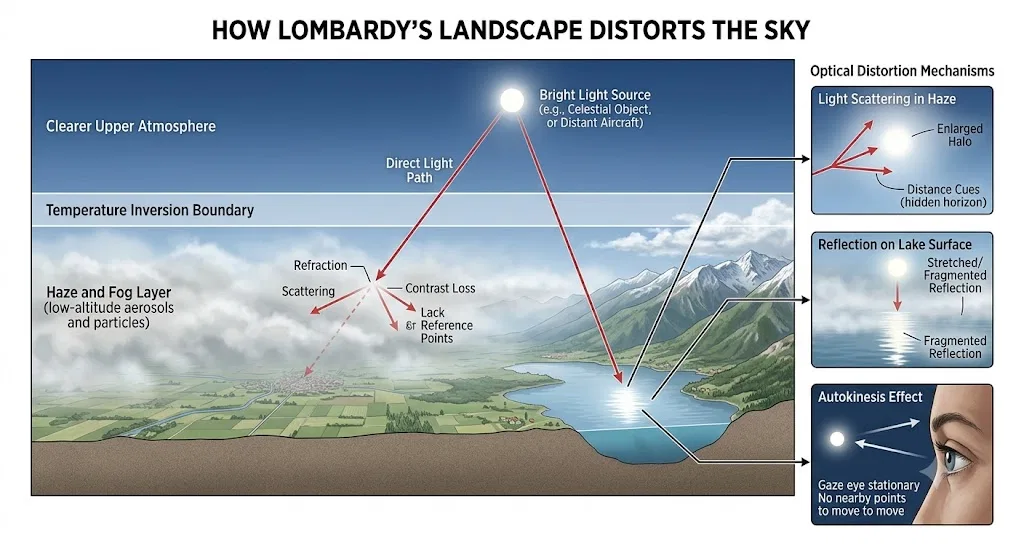
Lombardy’s landscape can make ordinary lights look extraordinary. Across the Po Valley, haze, fog and temperature inversions erase distance cues, enlarge halos and leave bright objects suspended against a nearly featureless sky. Farther north, mountains conceal horizons, lakes duplicate lights through reflection, and cloud layers form at sharply different heights. In these conditions, Venus, a distant aircraft, a mountaintop lamp or a patch of illuminated cloud may appear to hover, change colour, move unpredictably or occupy the wrong part of the sky.
This does not explain every Lombard UFO report. It does explain why reports consisting mainly of a remote light, especially one observed near the horizon without reliable size or distance estimates, are difficult to assess. The region’s mixture of a stagnant lowland basin, densely lit settlements, major air routes, lakes and Alpine relief creates several illusion mechanisms at once. For investigators, weather and sightline reconstruction are therefore not minor details: they are often the difference between a genuinely unresolved report and an unfamiliar view of something conventional.
Po Valley haze removes the scale of the sky
The Po Valley is enclosed by the Alps and Apennines, a geography that restricts ventilation and encourages stagnant air. During settled autumn and winter weather, temperature inversions commonly trap moisture and airborne particles near the surface. Fog and low cloud can then cover large parts of the basin, while haze may remain even where visibility is technically better. Satellite observations show this material pooled across northern Italy, sometimes below clearer air at higher elevations.[esa.int]esa.intEuropean Space Agency ESAEuropean Space AgencyESA - Air pollution fluctuations over the Po Valley13 Feb 2024 — The unique geographical and meteorological conditio…
For a UFO witness, the important effect is not simply that the sky looks murky. Haze weakens contrast and hides the ordinary reference points used to judge distance: hills, buildings, cloud edges and the true horizon. A bright light may remain visible after its surroundings have disappeared, creating the impression of an isolated object in empty space. Because the observer cannot tell whether it is a small nearby light or a powerful source many kilometres away, estimates of size, height and speed become unreliable.
This problem is strongest near the horizon. There, the line of sight passes through much more atmosphere than it does overhead. Aerosols scatter light, soften outlines and spread brightness around lamps, planets and aircraft lights. Research in the Po basin has found that aerosol layers are concentrated mainly within the lower few kilometres of the atmosphere, precisely where long, shallow viewing paths accumulate the greatest optical interference.[EUMETSAT User Portal]user.eumetsat.intEUMETSAT User PortalHaze and smoke over the Po ValleyThe haze is less visible at 8:15 UTC when the relative angle between the Sun and the…
A witness may therefore report a “glowing sphere” when the underlying source is point-like. A halo that expands or contracts as fog density changes can be interpreted as an object growing, approaching or altering shape. If thin cloud passes unevenly across the line of sight, the light may pulse without the source itself changing intensity.
Fog can also separate observers only a short distance apart into very different visual environments. One person may see a diffuse luminous patch, another a sharp aircraft light above the fog, and a third nothing at all. Such differences sometimes sound suspicious in later testimony, but they are fully compatible with patchy low cloud and local variations in visibility. The Po Valley’s winter atmosphere is known for frequent mist, fog and low stratus, with cloud depth and persistence strongly influenced by wind, temperature, humidity and aerosol loading.[wiley.com]agupubs.onlinelibrary.wiley.comAGU PublicationsSynoptic Scale Controls and Aerosol Effects on Fog and Low…by E Pauli · 2024 · Cited by 3 — Here, we analyze the role…
Why stationary lights seem to manoeuvre
Some of the most persuasive light reports involve apparent motion: a star-like point seems to drift, stop, reverse direction or respond to the observer. Yet motion is particularly difficult to judge when the background is dark or obscured.
A well-established visual effect called autokinesis occurs when a person stares at a single stationary light in darkness without nearby reference points. Tiny involuntary eye movements are interpreted by the brain as movement of the light itself. Aviation authorities train pilots to recognise the effect because a fixed star or ground lamp may seem to wander or approach the aircraft.[FAA]faa.govSpatial Disorientation: Visual IllusionsSpatial Disorientation: Visual Illusions
Po Valley haze can reproduce the same basic conditions for someone on the ground. A planet remains visible through thin mist while stars, ridgelines and buildings vanish. The observer fixes attention on it, especially after deciding that it may be unusual. Apparent short movements become more noticeable, while ordinary evidence of stability is missing.
Movement can also be created by the observer rather than the light. A slow change in viewpoint from a car, train or lakeside road produces parallax: nearby trees, buildings or slopes shift against a distant object. A light may appear to follow the vehicle because its bearing changes very little compared with closer scenery. When terrain repeatedly hides and reveals it, the same source may seem to extinguish, reappear and jump position.
Aircraft add another layer of ambiguity. A plane approaching almost directly towards an observer can show little sideways motion for several minutes. Its landing lights may appear brighter while remaining nearly fixed in the sky, giving the impression of a hovering object that later turns abruptly. When the aircraft changes heading, the intense forward-facing lights may disappear and be replaced by weaker navigation or anti-collision lights. To a witness without flight-path information, that change can resemble instantaneous acceleration, transformation or disappearance.
None of these mechanisms proves that a particular report had a mundane cause. They do show why descriptions such as “it hovered”, “it came towards us” or “it moved when we moved” require independent timing, compass bearings, photographs or radar data before they can be treated as strong evidence.
Alpine terrain creates false horizons and hidden distances
Northern Lombardy replaces the open plain with steep valleys, layered ridges and narrow strips of visible sky. This produces a different set of errors. A light seen between mountains may lack any visible connection to the ground, even when it belongs to a house, cableway, road, refuge or vehicle on a distant slope. Darkness removes the contour of the mountain but leaves the lamp exposed, making a terrestrial source appear airborne.
Overlapping ridges also disrupt distance judgement. A light that appears to sit above a nearby summit may actually be far beyond it. Conversely, a source on a dark mountainside can seem to occupy the sky because the slope beneath it is invisible. Small movements by the observer can cause intervening rock or trees to cover and uncover the light, producing apparent blinking that does not match an aircraft’s regular lighting pattern.
Aviation research treats false horizons and ambiguous ground lighting as serious hazards. Sloping cloud banks, rising terrain, isolated lights and dark featureless ground can all give a misleading impression of orientation. Roads, trains and rows of lamps may be confused with aerial or runway lights when the surrounding terrain cannot be seen.[FAA]faa.govOpen source on faa.gov.
The Alpine skyline can further distort celestial observations. A planet may emerge suddenly from behind a ridge rather than rising gradually from a level horizon. As the observer travels along a winding road, the planet appears to move relative to peaks and valley walls, vanish around a bend and return in another opening. That sequence can be remembered as purposeful manoeuvring, although the celestial source has followed its normal path.
Atmospheric refraction can alter the apparent position and shape of objects close to the horizon. Layers of air at different temperatures bend light by different amounts, sometimes raising, lowering, stretching or duplicating distant images. Under inversion conditions, mountains and lights may appear higher or nearer than they really are, while turbulence can make them shimmer.[metoffice.gov.uk]digital.nmla.metoffice.gov.ukOpen source on metoffice.gov.uk.
These effects are usually subtle, not spectacular cinematic mirages. Their investigative importance lies in shifting a distant light just enough to break the witness’s intuitive match with a known road, town or ridge.
Lakes can duplicate and displace lights
Lombardy’s large lakes create long, dark sightlines bordered by illuminated settlements and steep mountains. At night, calm water may reflect lamps, vehicle headlights, the Moon or bright planets. Broken by ripples, a single reflection can stretch into a vertical trail, fragment into several points or flash as the viewing angle changes.
Reflection is not always recognised as such. The far shore may be invisible, and the reflected light may occupy a dark area beneath an equally invisible horizon. From an elevated road or terrace, it can be difficult to tell where the mountain ends, where the lake begins and whether a light lies above or below the true horizon. Mist over the water further blends reflected and direct light.
Temperature differences over lakes can also create refractive layers. Light from a distant shore may be displaced vertically or made visible beyond its usual geometric range. Reports from other large lakes have documented superior-mirage conditions in which distant buildings or lights appear raised above the horizon; the underlying optics are relevant to Lombardy even when no dramatic mirage is present.[ubc.ca]eoas.ubc.caOpen source on ubc.ca.
A convincing lake report therefore needs more than a direction such as “over the water”. Investigators need the observer’s elevation, the exact shoreline position, weather over the full viewing path and the locations of settlements, ferries, roads and mountain installations. A source tens of kilometres away may be viewed through a succession of air layers that differs greatly from conditions at the witness’s position.
Clouds that resemble objects or carry distant light
Mountains generate distinctive clouds, especially when stable moist air flows across ridges and forms standing atmospheric waves. Lenticular clouds develop near the crests of these waves and can retain a smooth, lens-like outline while air continually passes through them. Their apparent stillness and rounded profile explain why they have long been compared with saucers.[Geographical]geographical.co.ukGeographical What are leticular clouds and how they are formedGeographical What are leticular clouds and how they are formed
In daylight, a clearly visible lenticular cloud is unlikely to remain mysterious for long. At dawn, dusk or night, however, only part of the cloud may be illuminated. Sunlight below the observer’s local horizon can strike high cloud after the ground is dark, creating a bright, apparently self-luminous form. Moonlight, urban lighting or a hidden aircraft can produce smaller glowing patches. The cloud may appear fixed while its brightness changes rapidly as thinner and thicker sections form.
Ice crystals in high cloud produce additional effects around the Sun and Moon, including halos, mock suns and vertical pillars. The World Meteorological Organization’s cloud classifications describe luminous patches roughly level with the Sun or Moon and columns extending above or below them. Thin altocumulus can also show coloured rings or iridescence when droplets diffract light.[International Cloud Atlas]cloudatlas.wmo.intInternational Cloud Atlas
These phenomena are geometrically linked to the illuminating body, which provides a useful test. A suspected halo feature should maintain a predictable position relative to the Sun or Moon rather than travel independently. Photographs with a wide field of view are more informative than tightly cropped images because they retain that relationship.
Cloud can also reveal lights whose sources are hidden. Beams from searchlights, stadiums, industrial sites or events may strike a low cloud base and form bright moving patches. Because the beam between the ground and cloud is invisible in clean air, the illuminated patch can look like a separate object sliding across the sky. Multiple lights may create circles, converging patterns or repeated sweeps, particularly around heavily populated parts of the plain.
Planets, stars and the changing atmosphere
Venus is a frequent source of mistaken aerial-light reports because it can be exceptionally bright, appears during twilight when few other stars are visible and may remain low over the horizon for long periods. Jupiter can play a similar role. Neither looks especially strange in a clear, familiar sky; both can become unfamiliar when haze hides the surrounding stars and terrain.
Near the horizon, turbulent air repeatedly bends and focuses starlight. This scintillation makes stars fluctuate in brightness and colour. Strong red, blue or green flashes can be striking when viewed through binoculars or a zoomed camera, especially if the observer expects navigation lights. Planets usually twinkle less because they present a small disc rather than a true point, but severe low-altitude turbulence can still make them shimmer or change appearance. Atmospheric scintillation is a measurable consequence of optical turbulence, not merely a subjective impression.[arXiv]arxiv.orgOpen source on arxiv.org.
Camera systems can exaggerate the effect. Autofocus hunting turns a bright point into expanding geometric shapes; digital zoom enlarges atmospheric blur; image stabilisation moves the light against the frame; and overexposure removes detail that might distinguish a planet from an aircraft. A colourful, pulsating disc in a video is therefore not necessarily how the source appeared to the unaided eye.
A basic astronomical check can resolve many such reports. The useful information is the exact date and time, observation point, compass direction and angular height above the horizon. “Above the mountains” is not precise enough because the visible ridge may itself occupy several degrees of elevation. When those details match a bright planet, the explanation becomes substantially stronger—particularly where the reported light remained in roughly the same place for many minutes.
How these explanations should be used in Lombardy cases
Weather-based explanations are strongest when they reproduce the main features of a report rather than merely naming a possible phenomenon. Saying “it was probably haze” is inadequate if the object crossed a large part of the sky, passed in front of known terrain or was recorded simultaneously by independent instruments. Conversely, a distant light should not be labelled unexplained simply because the witness did not recognise it.
For Lombardy reports, the most useful reconstruction asks:
- Was fog, low cloud, haze or an inversion present along the entire line of sight?
- Could a ridge, lake horizon or invisible slope have removed the normal connection between a light and the ground?
- Were Venus, Jupiter, the Moon or a bright star in the reported direction?
- Did aircraft routes, airport approaches or helicopter operations cross that bearing?
- Was the reported motion measured against fixed landmarks, or perceived against a dark and featureless sky?
- Did photographs preserve the wider landscape, or only a magnified point of light?
- Could illumination of cloud, reflection from water or atmospheric refraction account for the apparent height and shape?
The fairest conclusion is not that Lombardy’s skies generate false reports automatically. It is that the region is unusually good at destroying the visual information on which confident identification depends. Po Valley haze removes depth; Alpine relief hides origins and creates false horizons; lakes extend sightlines and duplicate light; mountain clouds form smooth or luminous shapes; and isolated points can appear to move through autokinesis.
Reports that remain anomalous after accurate positional, meteorological, astronomical and aviation checks deserve attention. Reports lacking those checks remain weakly resolved rather than positively mysterious. In Lombardy’s UFO history, that distinction is essential: an unidentified light may reflect an unusual event, but it may equally reflect an unusually difficult sky.

Amazon book picks
Further Reading
Books and field guides related to How Lombardy's Landscape Can Distort the Sky. Use these as the next step if you want deeper reading beyond the article.
Light and Color in the Outdoors
All of science springs from the observation of nature. In this classic book, the late Marcel Minnaert accompanies the reader on a tour of...
The UFO Handbook: A Guide to Investigating, Evaluating, and R...
An explanation of the usual reasons for confusing IFOs (identified flying objects) with UFOs and a survey of the tools used to investigat...
The Weather Book: Why It Happens and Where It Comes From
The Nature Book is your one-stop guide to reconnecting and appreciating nature once more.
eBay marketplace picks
Marketplace Samples
Live-tested eBay searches with available results related to this page.
Selected fromLombardy map print oneBay.co.uk.
Endnotes
1.
Source: science.nasa.gov
Title: a hazy foggy day in italys po valley 153599
Link:https://science.nasa.gov/earth/earth-observatory/a-hazy-foggy-day-in-italys-po-valley-153599/
Source snippet
NASA ScienceA Hazy, Foggy Day in Italy's Po Valley22 Nov 2024 — The valley is also one of the country's foggiest and haziest regions. In...
2.
Source: user.eumetsat.int
Link:https://user.eumetsat.int/resources/case-studies/haze-and-smoke-over-the-po-valley
Source snippet
EUMETSAT User PortalHaze and smoke over the Po ValleyThe haze is less visible at 8:15 UTC when the relative angle between the Sun and the...
3.
Source: faa.gov
Title: Spatial Disorientation: Visual Illusions
Link:https://www.faa.gov/pilots/safety/pilotsafetybrochures/media/spatiald_visillus.pdf
Published: September 15, 2016
4.
Source: faa.gov
Link:https://www.faa.gov/sites/faa.gov/files/regulations_policies/handbooks_manuals/aviation/airplane_handbook/12_afh_ch11.pdf
5.
Source: faa.gov
Link:https://www.faa.gov/sites/faa.gov/files/2022-01/Spatial%20Disorientation.pdf
6.
Source: faa.gov
Link:https://www.faa.gov/sites/faa.gov/files/regulations_policies/handbooks_manuals/aviation/phak/19_phak_ch17.pdf
7.
Source: faa.gov
Title: FAA Safety Briefing
Link:https://www.faa.gov/sites/faa.gov/files/2022-01/SepOct2015.pdf
8.
Source: digital.nmla.metoffice.gov.uk
Link:https://digital.nmla.metoffice.gov.uk/download/file/IO_31ea0d19-1cd8-4476-abcd-0c53e045f2a6
9.
Source: hyperphysics.phy-astr.gsu.edu
Link:https://hyperphysics.phy-astr.gsu.edu/hbase/atmos/mirage.html
10.
Source: eoas.ubc.ca
Link:https://www.eoas.ubc.ca/courses/atsc113/sailing/met_concepts/10-met-local-conditions/10f-optical-phenomena/
11.
Source: yahoo.com
Title: why see michigan lights across 095031535
Link:https://www.yahoo.com/news/why-see-michigan-lights-across-095031535.html
12.
Source: cloudatlas.wmo.int
Title: International Cloud Atlas
Link:https://cloudatlas.wmo.int/docs/ICA1930-optimized-for-web.pdf
13.
Source: arxiv.org
Link:https://arxiv.org/abs/1903.01060
Published: March 4, 2019
14.
Source: arxiv.org
Title: arXiv Atmospheric Scintillation in Astronomical Photometry
Link:https://arxiv.org/abs/1506.06921
15.
Source: faa.gov
Link:https://www.faa.gov/sites/faa.gov/files/2022-01/NovDec2015.pdf
16.
Source: faa.gov
Link:https://www.faa.gov/sites/faa.gov/files/about/office_org/headquarters_offices/avs/MP-086-20.pdf
17.
Source: faa.gov
Title: pilot handbook
Link:https://www.faa.gov/sites/faa.gov/files/pilots/pilot_handbook.pdf
18.
Source: faa.gov
Link:https://www.faa.gov/sites/faa.gov/files/21_phak_glossary.pdf
19.
Source: faa.gov
Link:https://www.faa.gov/sites/faa.gov/files/MayJun2024.pdf
Published: May 2024
20.
Source: esa.int
Title: European Space Agency ESA
Link:https://www.esa.int/Applications/Observing_the_Earth/Air_pollution_fluctuations_over_the_Po_Valley
Source snippet
European Space AgencyESA - Air pollution fluctuations over the Po Valley13 Feb 2024 — The unique geographical and meteorological conditio...
21.
Source: agupubs.onlinelibrary.wiley.com
Link:https://agupubs.onlinelibrary.wiley.com/doi/full/10.1029/2024GL111490
Source snippet
AGU PublicationsSynoptic Scale Controls and Aerosol Effects on Fog and Low...by E Pauli · 2024 · Cited by 3 — Here, we analyze the role...
22.
Source: publications.jrc.ec.europa.eu
Link:https://publications.jrc.ec.europa.eu/repository/handle/JRC67749
Source snippet
fog and low stratus, as the Po valley in winter. Sensitivity of...Read more...
23.
Source: geographical.co.uk
Title: Geographical What are leticular clouds and how they are formed
Link:https://geographical.co.uk/news/what-are-leticular-clouds-and-how-they-are-formed
Published: April 20, 2024
24.
Source: cloudatlas.wmo.int
Link:https://cloudatlas.wmo.int/search-image-gallery.html
25.
Source: cloudatlas.wmo.int
Link:https://cloudatlas.wmo.int/docs/wmo_407_en-v1.pdf
26.
Source: cloudatlas.wmo.int
Title: ICA 1956 Vol I low res
Link:https://cloudatlas.wmo.int/docs/ICA_1956-Vol_I_low_res.pdf
Additional References
27.
Source: atmosphere.copernicus.eu
Title: extreme episode particulate matter air pollution across italys po valley
Link:https://atmosphere.copernicus.eu/extreme-episode-particulate-matter-air-pollution-across-italys-po-valley
Source snippet
Extreme episode of particulate matter air pollution across...22 Feb 2024 — The Po Valley experiments since a long time such particulate...
28.
Source: acp.copernicus.org
Link:https://acp.copernicus.org/articles/18/5371/2018/
Source snippet
Vertical distribution of aerosol optical properties in the Po...by S Bucci · 2018 · Cited by 17 — Results show that, in the Po Valley...
29.
Source: pubmed.ncbi.nlm.nih.gov
Link:https://pubmed.ncbi.nlm.nih.gov/17750317/
30.
Source: pmc.ncbi.nlm.nih.gov
Link:https://pmc.ncbi.nlm.nih.gov/articles/PMC9557994/
31.
Source: mwis.org.uk
Title: mountain mirage
Link:https://www.mwis.org.uk/blog/post/mountain-mirage
32.
Source: sciencedirect.com
Link:https://www.sciencedirect.com/science/article/abs/pii/S1352231014007043
33.
Source: agenzianova.com
Link:https://www.agenzianova.com/en/news/lestate-lombarda-sempre-piu-calda-e-con-piu-temporali-verso-la-tropicalizzazione-del-clima/
34.
Source: bencraven.org.uk
Title: Atmospheric refraction
Link:https://bencraven.org.uk/tag/atmospheric-refraction/
35.
Source: dictionary.cambridge.org
Link:https://dictionary.cambridge.org/dictionary/english/low
36.
Source: resources.eumetrain.org
Link:https://resources.eumetrain.org/data/7/728/AirQualityTM/663/navmenu.php?page=1.0.0&tab=4