Within Friuli UFO Files
Why Did UFO Reports Cluster Around Pordenone?
Five reports in three years made the Pordenone area Friuli's strongest modern concentration of officially unresolved sightings.
On this page
- The sequence from Cordenons to Gonars
- Shared colours, movements and witness estimates
- Whether the cases reveal one pattern or several
Page outline Jump by section
Introduction
Between December 2010 and August 2012, a compact run of reports around Pordenone produced Friuli-Venezia Giulia’s strongest modern concentration of officially unresolved aerial sightings. The sequence began with a stationary white object over Cordenons, intensified during three evening incidents in 2011 around Pordenone and Pinzano al Tagliamento, and ended with a yellow-orange light over Gonars. Italian Air Force records state that the reports could not be matched to known flying or radiosonde activity.[Aeronautica Militare]aeronautica.difesa.itAeronautica MilitareAeronautica Militare
That finding makes the cluster historically important, but it does not establish that the witnesses saw exotic craft. The surviving files are summary tables based mainly on civilian testimony. They contain no published radar tracks, photographs, instrument readings or precise measurements from which the reported heights and speeds can be independently reconstructed. The most defensible conclusion is therefore narrower: several unusual lights were reported within a limited area and period, conventional aviation and weather-balloon matches were not found, and the available evidence remains too thin to decide exactly what caused every sighting.
The sequence from Cordenons to Gonars
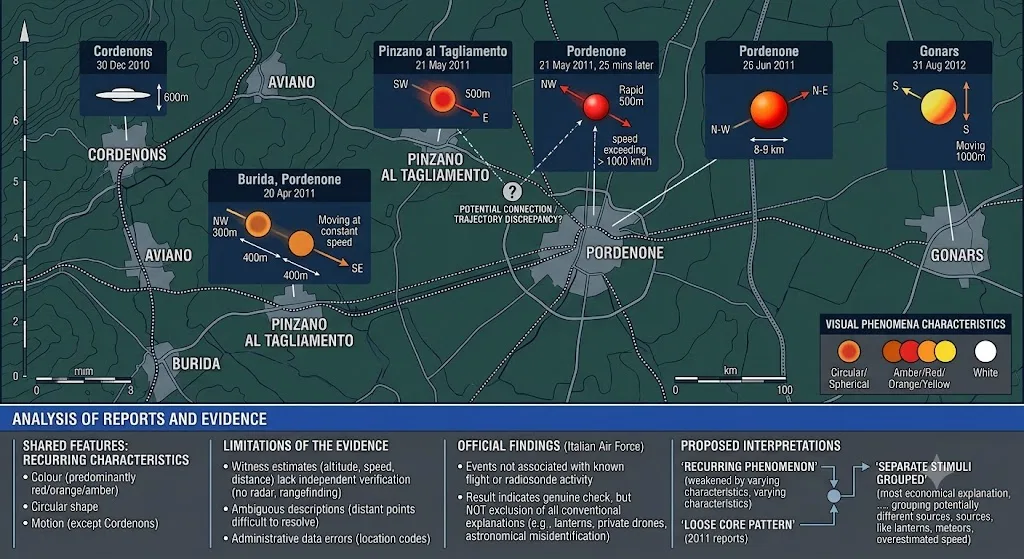
The cluster is sometimes described as five cases, although the Air Force tables contain six local entries. The difference arises because two reports on 21 May 2011—one from Pinzano and another from Pordenone 25 minutes later—may represent either two sightings or two observations of the same stimulus. Regional reporting generally combined them into one episode, producing the often-repeated total of five.[Congedati Folgore]congedatifolgore.comOpen source on congedatifolgore.com.
30 December 2010 — Cordenons. At 5.55 am, private witnesses reported a flat, white object apparently stationary to the south-east at an estimated altitude of about 600 metres. The sky was described as slightly veiled. The Air Force recorded that the event could not be associated with known flight or radiosonde activity. This official entry differs slightly from later press summaries, some of which called the object star-like, gave an altitude of roughly 700 metres or dated it to 31 December. The original table supports 30 December, 5.55 am, and about 600 metres.[Aeronautica Militare]aeronautica.difesa.itAeronautica MilitareAeronautica Militare
The Cordenons report is the least similar to the later events. It occurred before dawn rather than in the evening, involved a white stationary object rather than a red-orange moving light, and described a flat form rather than a sphere or circle. Its inclusion in the cluster depends mainly on geography and timing, not on a close match in appearance or behaviour.
20 April 2011 — Burida, Pordenone. At 9.15 pm, witnesses reported three circular orange-amber objects moving at constant speed from north-west to south-east. The table gives an estimated height of 300 metres and a distance of 400 metres, under a clear sky. Once again, the Air Force reported no known aviation or radiosonde association.[Aeronautica Militare]aeronautica.difesa.itAeronautica Militare
This is the most obvious candidate for a mundane explanation. Three orange lights moving steadily together resemble the appearance commonly produced by sky lanterns, especially when viewed at night without reliable distance cues. Contemporary regional reporting says that lanterns were proposed shortly afterwards, although no release was identified and the explanation remained unconfirmed.[Congedati Folgore]congedatifolgore.comOpen source on congedatifolgore.com.
21 May 2011 — Pinzano al Tagliamento and Pordenone. At 9 pm, witnesses at Pinzano reported a circular red-orange object moving rapidly in a straight line from south-west towards the east, at an estimated 500 metres. At 9.25 pm, a separate Pordenone entry described a red spherical object at the same estimated altitude, moving from north-west to south-west at a claimed speed exceeding 1,000 kilometres per hour. Both reports came from private citizens under clear skies, and neither was matched to known flight or radiosonde operations.[Aeronautica Militare]aeronautica.difesa.itAeronautica Militare
The close timing, shared colour and identical altitude estimate make a connection plausible. Yet the recorded directions do not form an obvious continuous course: the Pinzano object was said to travel towards the east, while the Pordenone object moved towards the south-west. That discrepancy could reflect two separate lights, imprecise directional estimates, or the effects of observers viewing the same distant object from different positions. Without exact observation points, durations and bearings, the two entries cannot be reliably joined into a single trajectory.
The reported speed above 1,000 kilometres per hour is often treated as the strongest reason to reject lanterns. It is also one of the least secure data points. A witness observing a light against an empty sky normally lacks a known distance, size or altitude; without those values, apparent angular movement cannot be converted confidently into true speed. The Air Force table records the estimate but does not show how it was calculated. It therefore strengthens the report’s dramatic appearance more than its evidential weight.[Aeronautica Militare]aeronautica.difesa.itAeronautica Militare
26 June 2011 — Pordenone. At 10.26 pm, another private witness reported a spherical object changing from orange to intense red. It was described as moving slowly from north-west to north-east, at an estimated distance of 8–9 kilometres; no altitude was supplied. The sky was clear, and the standard Air Force check again found no known flight or radiosonde connection.[Aeronautica Militare]aeronautica.difesa.itAeronautica Militare
This report closely resembles the Burida sighting in colour and low speed, but not in number: one sphere rather than three. Its long estimated distance also matters. At eight or nine kilometres, an ordinary airborne light could appear silent and structureless, while atmospheric haze and human depth perception would make its true range difficult to judge. The record supplies too little information about duration, brightness or wind direction to test a lantern, aircraft or astronomical explanation.
31 August 2012 — Gonars. The final entry occurred east of the Pordenone concentration, in the province of Udine. At 8.25 pm, witnesses reported one circular object, yellow with orange and red shading, travelling in a straight line from south towards the north-west. Its altitude was estimated at about 1,000 metres and the sky was clear. The Air Force again found no association with known flying or radiosonde activity.[Aeronautica Militare]aeronautica.difesa.itAeronautica Militare
Gonars extends the episode geographically and chronologically, but it is not evidence that the same object or mechanism persisted for nearly two years. Its strongest connection to the 2011 reports is visual: a circular warm-coloured light moving steadily across a clear evening sky. That description is common to several ordinary sources as well as to unexplained reports.
Shared colours, movements and witness estimates
The most striking recurring feature is colour. Four of the five commonly counted episodes involved red, orange, amber or yellow lights. Only Cordenons was recorded as white. Most were also described as circular or spherical, and all except Cordenons involved motion. These similarities give the cluster a recognisable visual identity.[Aeronautica Militare]aeronautica.difesa.itAeronautica MilitareAeronautica Militare
Yet those same characteristics are not very distinctive. At night, a distant light often appears round because the eye cannot resolve the object producing it. Warm colours can come from flame-based lanterns, aircraft lights seen through haze, illuminated balloons, fireworks at distance or bright astronomical objects low in the atmosphere. A circular red-orange point is therefore easier to misidentify than a clearly observed structured object with visible surfaces, edges or markings.
The witness estimates also show a recurring weakness. Altitudes of 300, 500, 600 and 1,000 metres appear precise, but the files do not record triangulation, rangefinding or known-size comparisons. One Pordenone report gives a speed above 1,000 kilometres per hour, while another gives a distance of 8–9 kilometres, yet no supporting calculations are published. Such estimates should be read as impressions supplied by observers, not as measured flight data.[Aeronautica Militare]aeronautica.difesa.itAeronautica MilitareAeronautica Militare
The May 2011 pair illustrates the problem particularly well. If the Pinzano and Pordenone witnesses saw the same object, its path, speed and distance might in principle have been reconstructed from two observation points. The archive does not publish the necessary bearings, exact locations or sighting durations. What could have become the cluster’s best multi-witness case remains only two brief table entries.
What the Air Force finding does—and does not—mean
The official wording is consistent throughout the cluster: from information gathered through the relevant Air Force bodies, investigators could not associate the event with known flight or radiosonde activity. This is a genuine investigative result. It indicates that the reports were checked against at least those categories rather than merely collected as local anecdotes.[Aeronautica Militare]aeronautica.difesa.itAeronautica MilitareAeronautica Militare
The wording is nevertheless narrower than “all conventional explanations were excluded”. It does not state that radar detected the objects, that witnesses were independently interviewed in depth, or that investigators ruled out lanterns, private drones, astronomical misidentification, reflections, meteors and every other natural or human source. In the Burida case, for example, later reporting specifically retained sky lanterns as a plausible possibility despite the absence of a confirmed match.[Congedati Folgore]congedatifolgore.comOpen source on congedatifolgore.com.
The official tables also contain signs that they were designed as administrative summaries rather than full case dossiers. Some place abbreviations are mistaken: Pinzano and Pordenone are marked “PD” in parts of the 2011 document, although both are in the Pordenone area and normally abbreviated “PN”. Dates and measurements were also altered slightly when repeated in later journalism. These errors do not invalidate the sightings, but they warn against treating every figure as laboratory-grade data.[difesa.it]aeronautica.difesa.itAeronautica MilitareAeronautica Militare
Nor does proximity to Aviano Air Base provide an evidential shortcut. Military aviation is an obvious contextual factor in Pordenone’s skies, and local residents may naturally interpret unfamiliar lights through that lens. However, the published cluster records contain no stated radar involvement, pilot testimony, air-defence response or direct connection to Aviano. The Air Force’s inability to identify a known flight is not evidence that a secret military aircraft—or anything more extraordinary—was present.
One pattern or several unrelated cases?
The cluster can be interpreted in three broad ways. The strongest version proposes a recurring unidentified phenomenon moving through the same regional airspace. Its support comes from geographical concentration, repeated warm-coloured lights and several formally unresolved checks. The weakness is that the reports vary in time, appearance, number, direction and apparent speed, while no physical or sensor evidence links them.
A more cautious interpretation is that the 2011 reports form a loose pattern but the Cordenons and Gonars cases do not. Burida, Pinzano, Pordenone and the June Pordenone sighting all occurred within about two months and mostly involved red-orange circular lights after dark. That is the cluster’s most coherent core. Even within it, however, one event involved three slow lights, one allegedly moved at very high speed, and another was seen at a claimed distance of several kilometres.[Aeronautica Militare]aeronautica.difesa.itAeronautica MilitareAeronautica Militare
The most economical explanation is that several different stimuli were grouped together because they occurred near Pordenone and entered the same official archive. The Burida trio could plausibly have been lanterns; Cordenons might have involved a bright astronomical or airborne light seen through thin cloud; the fast May sighting could reflect a badly overestimated speed; and Gonars could represent another distant illuminated object. These are possibilities rather than demonstrated solutions, because the records lack the detail needed to test them decisively.
Later reporting has not materially strengthened the extraordinary interpretation. No published radar data, photographs, additional independent witness files or retrospective identifications have emerged in the sources most closely associated with the cases. What later coverage mainly did was gather the scattered entries into a regional narrative and highlight that they remained unmatched to known flights and radiosondes.[congedatifolgore.com]congedatifolgore.comOpen source on congedatifolgore.com.
The cluster’s place in Friuli’s UFO history
Pordenone’s 2010–12 cluster matters because it is unusually concentrated, officially documented and recent compared with the region’s older reports. It shows that Friuli-Venezia Giulia’s modern UFO history is not based entirely on folklore or retrospective storytelling: named places, dates, times, colours, directions and limited investigative conclusions survive in Air Force records.
Its evidential limits are equally important. The reports demonstrate unresolved observations, not confirmed extraordinary vehicles. Their value lies in the pattern of formal reporting and the questions they leave open—not in proof of a single recurring craft. The cluster is best classified as a group of weak-to-moderate unresolved cases: stronger than anonymous rumours because official checks were made, but much weaker than incidents supported by radar, calibrated imagery, multiple independent sensors or detailed contemporaneous investigation.
Seen that way, Pordenone’s cluster is less a solved mystery than a lesson in how regional UFO history is built. Several ambiguous lights, noticed during a short period and entered into an official system, can form a memorable local “flap”. Whether they shared one cause remains unknown. The surviving evidence supports concentration and uncertainty; it does not support certainty about what flew over Pordenone.
Amazon book picks
Further Reading
Books and field guides related to Why Did UFO Reports Cluster Around Pordenone?. Use these as the next step if you want deeper reading beyond the article.
The UFO Experience: A Scientific Inquiry
Cited by the New York Review of Books as "the best brief for visitation," this classic study presents an analysis of UFO reports and conc...
UFOs and Government: A Historical Inquiry
Governments around the world have had to deal with the UFO phenomenon for a good part of a century. How and why they did so is the subjec...
How We Know What Isn't So: The Fallibility of Human Reason in...
Thomas Gilovich offers a wise and readable guide to the fallacy of the obvious in everyday life. When can we trust what we believe—that "...
eBay marketplace picks
Marketplace Samples
Live-tested eBay searches with available results related to this page.
Selected fromufo poster oneBay.co.uk.



Current eBay listing
I Want To Believe UFO Poster Giclée Fine Art Heavyweight Print
Current eBay listing
VINTAGE UFO FLYING SAUCERS COMIC ADVERTISING A2 POSTER PRINT
Endnotes
1.
Source: aeronautica.difesa.it
Title: Aeronautica Militare
Link:https://www.aeronautica.difesa.it/wp-content/uploads/2022/11/OVNI-2010.pdf
2.
Source: aeronautica.difesa.it
Title: Aeronautica Militare
Link:https://www.aeronautica.difesa.it/wp-content/uploads/2022/11/OVNI-2011.pdf
3.
Source: aeronautica.difesa.it
Title: Aeronautica Militare
Link:https://www.aeronautica.difesa.it/wp-content/uploads/2022/11/OVNI-2012.pdf
4.
Source: avvenire.it
Title: gli avvistamenti tra il 2010 e il 2013 14789
Link:https://www.avvenire.it/agora/scienza/gli-avvistamenti-tra-il-2010-e-il-2013_14789
Source snippet
Gli avvistamenti tra il 2010 e il 2013...
5.
Source: manoscrittisbhu.comune.udine.it
Link:https://manoscrittisbhu.comune.udine.it/uploads/PERIODICI/annuario_statistico_provincia_udine/1876/VIA0547460_1876.pdf
6.
Source: congedatifolgore.com
Link:https://www.congedatifolgore.com/it/laeronautica-militare-si-occuoeradi-cinque-casi-di-ufo-in-friuli/
7.
Source: congedatifolgore.com
Link:https://www.congedatifolgore.com/it/author/administrator/page/1720/
Source snippet
Ovni (oggetti volanti non identificati) dall... E chiunque può segnalare un evento correlabile a un Ovni... Il primo è quello del 31 di...
8.
Source: Wikipedia
Link:https://en.wikipedia.org/wiki/Cordenons
9.
Source: nuforc.org
Link:https://nuforc.org/sighting/?id=43628
Additional References
10.
Source: ilfriuli.it
Title: il dossier su ufo e alieni in regione
Link:https://www.ilfriuli.it/territorio/il-dossier-su-ufo-e-alieni-in-regione/
Source snippet
7 Jun 2015 — Pinzano al Tagliamento; Pocenia; Polcenigo; Pontebba; Porcia; Pordenone... 1978, 11 ottobre tra le 22 e le 23.45 Aviano (Pn...
11.
Source: youtube.com
Link:https://www.youtube.com/watch?v=p4AjFIINDxA
Source snippet
UFO Flies in Bizarre and Unexplainable Patterns | The Proof Is Out There...
12.
Source: youtube.com
Link:https://www.youtube.com/watch?v=QuesA4_J5fQ
Source snippet
Cigar-Shaped UFO SHOCKS Pilot (S4, E15) | The Proof Is Out There | The UnXplained Zone...
13.
Source: youtube.com
Title: Fascist UFOs
Link:https://www.youtube.com/watch?v=ojvSWFiJiec
Source snippet
UFO Sightings Terrify Italy | The Proof Is Out There | History...
14.
Source: youtube.com
Title: UFO Sightings Terrify Italy | The Proof Is Out There | History
Link:https://www.youtube.com/watch?v=ybDQGcZjJWI
Source snippet
Did a Fighter Jet Really Chase a UFO in 1979?...
15.
Source: turismofvg.it
Link:https://www.turismofvg.it/events/19th-clanfe-olympics
16.
Source: academia.edu
Link:https://www.academia.edu/107283258/A_Probability_Assessment_On_Six_Responses_To_the_Extraterrestrial_Hypothesis
17.
Source: bufora.org.uk
Link:https://www.bufora.org.uk/sightings/analysis-of-ufo-photographs
18.
Source: facebook.com
Link:https://www.facebook.com/livescience/posts/bizarre-ufo-like-halo-of-red-light-appears-over-small-italian-town-for-the-secon/1219530610036977/
19.
Source: mycordenons.com
Link:https://mycordenons.com/contacts/