Within Umbria
Why a Motionless Light Can Look Like a UFO
The autokinetic effect, hand movement and atmospheric distortion can make a fixed point of light seem to stop, dart or change colour.
On this page
- The autokinetic effect in dark skies
- Binocular shake and involuntary eye movement
- Colour changes caused by the atmosphere
Page outline Jump by section
Introduction
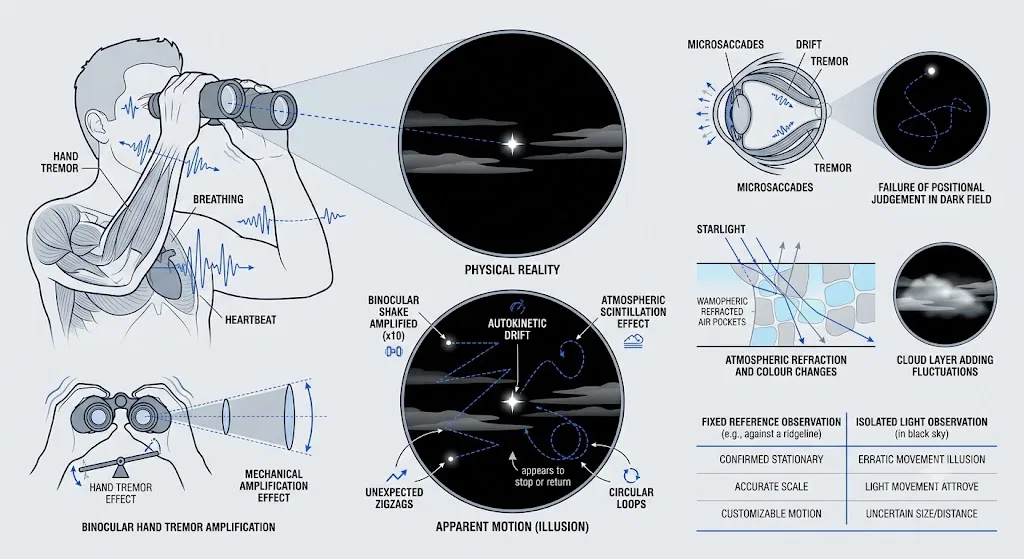
A bright light does not need to travel across the sky to look as though it is manoeuvring. When a star, planet, distant aircraft light or hilltop lamp is seen against a dark, nearly featureless background, the visual system may lose the fixed references it normally uses to judge position. The light can then appear to drift, stop, dart sideways or reverse direction. Hand-held binoculars magnify small body movements, while unstable air can make the same light tremble, brighten, fade and flash different colours.
These effects are especially relevant to reports from Umbria’s rural roads, valleys and hill country, where observers may face dark horizons with few buildings or landmarks. They cannot explain every unusual-light report automatically. They do, however, show why eyewitness descriptions of dramatic movement are not, by themselves, proof that a distant object performed dramatic manoeuvres.
The autokinetic effect in dark skies
The most important mechanism is the autokinetic effect: the illusion that a small, stationary light is moving when it is viewed for several seconds against a dark or featureless field. The United States Federal Aviation Administration treats it as a recognised night-flying hazard, warning that a fixed star or ground light can appear to move and may even seem to be approaching an aircraft’s path.[Federal Aviation Administration]faa.govFederal Aviation Administration Spatial DFederal Aviation Administration Spatial D
Ordinary vision usually measures movement in relation to something else. A car is seen to move past trees; an aircraft crosses a cloud; a lamp remains aligned with the corner of a building. A solitary light in a black sky offers no comparable frame. Its distance, size and exact position become uncertain, leaving the brain to interpret an incomplete visual scene. After prolonged staring, the point may seem to wander irregularly even though its real position has not changed.[Skybrary]skybrary.aeroAutokinetic EffectThe autokinetic effect (also referred to as autokinesis) is a phenomenon of visual perception in which a statio…
The eye is not mechanically still during this process. Even when a person attempts to fix their gaze on one object, the eyes continually make miniature movements known as microsaccades, drift and tremor. Microsaccades may occur once or twice a second, with slower drifts between them. These movements normally help maintain clear vision and prevent a fixed image from fading, but they also mean that the image of a distant light is continually shifting by tiny amounts across the retina.[Frontiers]frontiersin.orgOpen source on frontiersin.org.
It would nevertheless be too simple to say that every apparent jump is merely a direct copy of an eye movement. Experimental research has produced several competing accounts of autokinesis, involving the brain’s estimate of eye position, the absence of stable visual references and the processing of motor signals associated with fixation. Some studies have found no straightforward correlation between the direction of small eye movements and the direction in which the light is perceived to travel. The illusion is therefore best understood as a failure of positional judgement under poor visual conditions, with eye movements contributing to the problem rather than supplying a complete explanation on their own.[arvojournals.org]jov.arvojournals.orgFixational eye movements and the autokinetic illusion | JOVby M Rucci · 2009 · Cited by 5 — According to extraretinal theories, the il…
For an Umbrian witness, this can create a persuasive sequence. A bright light above a dark ridge appears stationary at first. After several seconds of concentrated observation, it seems to slide left. When the witness shifts position or looks away and back, it appears to stop or return towards its original point. Because there is no visible structure connecting the light to the landscape, these changes may be interpreted as controlled hovering and acceleration rather than instability in perception.
The effect can also influence estimates of scale. A star or distant lamp has no visible body from which its dimensions can be judged. Once it appears to move, the observer may unconsciously treat it as a nearer object crossing a shorter distance rather than a remote point shifting through a tiny apparent angle. A movement that exists only within a small patch of sky can consequently be remembered as a substantial sideways dash.
Binocular shake and involuntary movement
Binoculars often strengthen a sighting by revealing a light that was difficult to see with the naked eye. They can also make its apparent movement far more dramatic. Magnification enlarges not only the target but every tremor of the observer’s hands, arms, head and body. Jodrell Bank’s observing guidance notes that increasing binocular magnification makes the image appear to jump about more, while specialist astronomy guidance similarly warns that body tremors cause sky images to bounce and shake.[J.B. Man]jb.man.ac.ukOpen source on man.ac.uk.
No one can hold conventional binoculars perfectly still. Breathing moves the upper body; muscles tire; the heartbeat introduces subtle vibration; and looking upwards places strain on the arms and neck. At ten-times magnification, a slight angular movement of the instrument becomes a conspicuous leap within the field of view. Larger or more powerful binoculars generally worsen the instability unless they are supported or image-stabilised.[nikon.com]imaging.nikon.comOpen source on nikon.com.
A point light makes this particularly noticeable because it contains almost no internal detail. When a building shakes in the field of view, the viewer can still recognise its walls and windows as a single stationary structure. When an isolated light jumps against blackness, there is no visible object around it to reveal that the entire image moved. The motion is easily attributed to the light itself.
Several apparent UFO behaviours can result:
- Rapid zigzags may follow small alternating movements of the hands.
- Short vertical jumps may be caused by breathing, arm fatigue or an adjustment of stance.
- Circular or looping paths may arise when the binoculars wobble through a small arc.
- Sudden departures may occur when the target is briefly lost from the narrow field of view.
- Reappearances in a different position may follow an unsuccessful attempt to reacquire the same light.
The observer may sincerely report that the object moved while nearby stars remained fixed. This distinction is not always reliable. Attention tends to remain on the brightest point, while dimmer reference stars may be overlooked, fall outside the binocular field or disappear whenever the instrument shifts. Differences in brightness and focus can also make one object seem to lag behind the background during a shake, particularly when the image is blurred or the binoculars are not correctly adjusted.
Binocular evidence becomes more useful when witnesses stabilise the instrument against a wall, vehicle roof or tripod and compare the target with several nearby stars or a visible ridgeline. If the erratic manoeuvres cease when the binoculars are supported, movement of the instrument is a stronger explanation. If the light continues to change position consistently against the same background references, genuine motion becomes more plausible, although its distance and speed may remain unknown.
Colour changes caused by the atmosphere
A stationary celestial light may also look active because Earth’s atmosphere continually distorts the light reaching the observer. Pockets of air at different temperatures and densities bend incoming rays by slightly different amounts. Astronomers call the resulting rapid changes in brightness and apparent position scintillation, commonly known as twinkling. NASA describes shifting atmospheric pockets as small, unpredictable lenses that disturb otherwise steady starlight.[NASA Science]science.nasa.govScience Why Have a Telescope in Space?Science Why Have a Telescope in Space?
Scintillation does more than make a star brighten and fade. It can produce tiny changes in apparent position, giving the impression that the light is trembling or skipping. Atmospheric cells can also separate parts of the visible spectrum, causing a bright star to flash momentarily red, blue, green or white. These effects are usually more pronounced when the object is low above the horizon because its light passes through a longer and often more turbulent path in the atmosphere.[Astronomy Magazine]astronomy.comMagazine Simply Scintillating | Astronomy.comMagazine Simply Scintillating | Astronomy.com
This combination readily resembles descriptions of a luminous craft. A low star may seem to hover over an Umbrian ridge, pulse rhythmically, change colour and make small sideways movements. Thin cloud layers can add slower fluctuations, hiding and revealing the light or producing a halo whose shape changes as the cloud moves. The witness sees one apparently active object, although several separate processes may be operating at once: atmospheric refraction, changing transparency, autokinesis and movement of the observer.
Stars are especially susceptible because, at ordinary viewing distances, they appear as unresolved points. Their light reaches the eye through a very narrow apparent source and is therefore strongly affected by small atmospheric disturbances. Planets usually scintillate less because their visible discs cover a slightly wider angle, allowing some fluctuations to average out, although bright planets near the horizon can still appear unstable under poor conditions.[Wikipedia]WikipediaOpen source on wikipedia.org.
Colour testimony must consequently be interpreted with care. Repeated red, green and blue flashes do not necessarily imply coloured lamps mounted on a structured object. Investigators need to know the light’s elevation, weather conditions and relationship to known stars or planets. A strongly scintillating celestial object should remain in approximately the same astronomical position over short periods even while its brightness, colour and apparent fine movement vary.

Why several illusions can feel like one manoeuvre
Real observations rarely isolate a single mechanism. A person may first notice a bright star while walking or driving, stop to watch it, then use binoculars. Each stage introduces a different source of apparent motion.
While the observer is moving, nearby trees, hills or roadside objects shift against the distant light through parallax. After the observer stops, the loss of those changing references may encourage autokinesis. Raising binoculars then magnifies hand tremor. Atmospheric scintillation continues throughout, altering brightness, colour and apparent position. The final recollection may be of a single light that moved, halted, darted and flashed, even though no one mechanism produced the entire sequence.
Expectation can shape the description without implying dishonesty. Once a light is interpreted as an aircraft or unknown craft, each visual change is likely to be understood as purposeful behaviour: fading becomes acceleration into the distance; brightening becomes approach; an autokinetic drift becomes a controlled turn. The witness is reporting a genuine perceptual experience, but the experience is not a direct measurement of the object’s physical path.
Multiple witnesses do not automatically eliminate these possibilities. People standing together usually share the same dark background and turbulent atmosphere, and their attention may be directed towards the same interpretation. However, precise independent descriptions can help. If observers positioned apart record the same movement against identifiable stars at the same moment, an actual moving object is more likely. If they disagree about direction or the size of the excursions, a subjective illusion becomes more plausible.
Reading Umbrian light reports more carefully
These mechanisms are most relevant to Umbrian reports dominated by a single bright point, especially when the observation occurred at night over hills, open countryside or an unlit valley. They are less persuasive when a case includes a clearly resolved shape, sustained movement across several fixed landmarks, reliable radar data or photographs containing stable reference points.
A useful assessment should ask:
- Was the light compared with a ridge, building, star pattern or other fixed reference?
- Did the apparent movement begin after prolonged staring?
- Was the witness walking, driving or changing head position?
- Were binoculars hand-held, supported or mounted?
- Did the movement remain visible to the naked eye?
- Was the object low enough for strong atmospheric scintillation?
- Did its colours flash rapidly in a way typical of a twinkling star?
- Did it maintain the expected position of a bright planet or star?
- Did separate witnesses describe the same path independently?
Video does not settle the matter unless the camera is steady and the frame contains reliable references. A bright dot recorded by a hand-held, highly zoomed camera may trace loops or zigzags created entirely by camera shake. Automatic focus, exposure and digital zoom can additionally make it swell, contract, change shape or disappear. Conversely, a stable wide-angle recording that shows the light moving consistently relative to the horizon carries more evidential value than a tightly cropped image of an isolated glow.
The central lesson for Umbria’s UFO history is not that witnesses imagined everything they saw. It is that a sincere observation of movement does not necessarily establish physical movement. Dark landscapes, prolonged fixation, magnifying optics and turbulent air can transform a motionless point into an apparently agile object. Cases built mainly on a light that “darted”, “hovered” or “changed colour” therefore remain weak unless those impressions are supported by fixed visual references, independent measurements or other evidence capable of separating an object’s behaviour from the behaviour of the observer, the instrument and the atmosphere.
Amazon book picks
Further Reading
Books and field guides related to Why a Motionless Light Can Look Like a UFO. Use these as the next step if you want deeper reading beyond the article.
The UFO Handbook: A Guide to Investigating, Evaluating, and R...
An explanation of the usual reasons for confusing IFOs (identified flying objects) with UFOs and a survey of the tools used to investigat...
The Demon-Haunted World: Science as a Candle in the Dark
NEW YORK TIMES BESTSELLER • From the renowned astronomer and author of Cosmos comes a “powerful [and] stirring defense of informed ration...
Bad Astronomy: Misconceptions and Misuses Revealed, from Astr...
A clever, thought-provoking guide that attacks common astronomical misconceptions What is Bad Astronomy? Anything that accidentally or in...
The Invisible Gorilla: How Our Intuitions Deceive Us
NEW YORK TIMES BESTSELLER • Our minds don’t work the way we think they do. Two renowned psychologists explain how and why our intuitions...
eBay marketplace picks
Marketplace Samples
Live-tested eBay searches with available results related to this page.
Selected fromUFO poster oneBay.co.uk.

Current eBay listing
VINTAGE UFO FLYING SAUCERS COMIC ADVERTISING A2 POSTER PRINT
Current eBay listing
I Want To Believe UFO Poster Giclée Fine Art Heavyweight Print

Endnotes
1.
Source: skybrary.aero
Link:https://skybrary.aero/articles/autokinetic-effect
Source snippet
Autokinetic EffectThe autokinetic effect (also referred to as autokinesis) is a phenomenon of visual perception in which a statio...
2.
Source: jov.arvojournals.org
Link:https://jov.arvojournals.org/article.aspx?articleid=2135849
Source snippet
Fixational eye movements and the autokinetic illusion | JOVby M Rucci · 2009 · Cited by 5 — According to extraretinal theories, the il...
3.
Source: imaging.nikon.com
Link:https://imaging.nikon.com/sport-optics/best/star/
4.
Source: space.com
Link:https://www.space.com/stargazing/skywatching-kit/why-binoculars-are-best-for-beginner-astronomers-to-stargaze
5.
Source: space.com
Link:https://www.space.com/how-to-hold-binoculars-steady
6.
Source: science.nasa.gov
Title: Science Why Have a Telescope in Space?
Link:https://science.nasa.gov/mission/hubble/overview/why-have-a-telescope-in-space/
7.
Source: science.nasa.gov
Title: Science Hubble Glossary
Link:https://science.nasa.gov/mission/hubble/multimedia/hubble-glossary/
8.
Source: astronomy.com
Title: Magazine Simply Scintillating | Astronomy.com
Link:https://www.astronomy.com/science/simply-scintillating/
9.
Source: Wikipedia
Link:https://en.wikipedia.org/wiki/Twinkling
10.
Source: astronomy.com
Link:https://www.astronomy.com/observing/why-do-some-stars-appear-to-twinkle-while-others-dont/
11.
Source: space.com
Title: Are image-stabilized binoculars good for stargazing? | Space
Link:https://www.space.com/stargazing/are-image-stabilized-binoculars-good-for-stargazing
12.
Source: science.nasa.gov
Title: mysterious flash on jupiter left no debris cloud 2
Link:https://science.nasa.gov/missions/hubble/mysterious-flash-on-jupiter-left-no-debris-cloud-2/
13.
Source: science.nasa.gov
Title: symphony of stars the science of stellar sound waves
Link:https://science.nasa.gov/universe/exoplanets/symphony-of-stars-the-science-of-stellar-sound-waves/
14.
Source: science.nasa.gov
Title: the history of hubble
Link:https://science.nasa.gov/mission/hubble/overview/the-history-of-hubble/
15.
Source: pwg.gsfc.nasa.gov
Title: Star FAQ14
Link:https://pwg.gsfc.nasa.gov/stargaze/StarFAQ14.htm
16.
Source: pwg.gsfc.nasa.gov
Title: Star FAQ7
Link:https://pwg.gsfc.nasa.gov/stargaze/StarFAQ7.htm
17.
Source: ntrs.nasa.gov
Link:https://ntrs.nasa.gov/api/citations/19800018761/downloads/19800018761.pdf
18.
Source: nightsky.jpl.nasa.gov
Title: 00Planet Quest Manual
Link:https://nightsky.jpl.nasa.gov/docs/00PlanetQuestManual.pdf
19.
Source: nasa.gov
Link:https://www.nasa.gov/wp-content/uploads/2020/12/not_yet_imagined_tagged.pdf
20.
Source: swift.gsfc.nasa.gov
Title: Gehrels ARAA 47 567 2009
Link:https://swift.gsfc.nasa.gov/results/publist/Gehrels_ARAA_47_567_2009.pdf
21.
Source: Wikipedia
Title: Autokinetic effect
Link:https://en.wikipedia.org/wiki/Autokinetic_effect
22.
Source: faa.gov
Title: Federal Aviation Administration Spatial D
Link:https://www.faa.gov/pilots/safety/pilotsafetybrochures/media/spatiald_visillus.pdf
23.
Source: faa.gov
Title: The disoriented pilot could lose control of the aircraft
Link:https://www.faa.gov/sites/faa.gov/files/regulations_policies/handbooks_manuals/aviation/airplane_handbook/12_afh_ch11.pdf
Source snippet
Federal Aviation AdministrationAirplane Flying Handbook (3C) Chapter 11Autokinesis In the dark, a stationary light will appear to move ab...
24.
Source: frontiersin.org
Link:https://www.frontiersin.org/journals/integrative-neuroscience/articles/10.3389/fnint.2014.00052/full
25.
Source: pubmed.ncbi.nlm.nih.gov
Title: Eye Movements Fixation, Ocular Humans Illusions*
Link:https://pubmed.ncbi.nlm.nih.gov/4566651/
Source snippet
Autokinetic illusion: a systematic review of theories...by J Levy · 1972 · Cited by 52 — Autokinetic illusion: a systematic revie...
26.
Source: jb.man.ac.uk
Link:https://www.jb.man.ac.uk/astronomy/nightsky/binoculars.html
27.
Source: nuforc.org
Link:https://nuforc.org/sighting/?id=76101
28.
Source: faa.gov
Link:https://www.faa.gov/sites/faa.gov/files/regulations_policies/handbooks_manuals/aviation/phak/19_phak_ch17.pdf
29.
Source: faa.gov
Link:https://www.faa.gov/sites/faa.gov/files/2022-01/Spatial%20Disorientation.pdf
30.
Source: faa.gov
Link:https://www.faa.gov/sites/faa.gov/files/2022-01/NovDec2015.pdf
31.
Source: faa.gov
Link:https://www.faa.gov/sites/faa.gov/files/about/office_org/headquarters_offices/avs/MP-086-20.pdf
32.
Source: faa.gov
Link:https://www.faa.gov/sites/faa.gov/files/MayJun2024.pdf
33.
Source: faa.gov
Link:https://www.faa.gov/sites/faa.gov/files/21_phak_glossary.pdf
34.
Source: faa.gov
Title: pilot handbook
Link:https://www.faa.gov/sites/faa.gov/files/pilots/pilot_handbook.pdf
35.
Source: faa.gov
Link:https://www.faa.gov/data_research/research/med_humanfacs/oamtechreports/media/AM63-30pt04.pdf
36.
Source: pubmed.ncbi.nlm.nih.gov
Link:https://pubmed.ncbi.nlm.nih.gov/1245899/
37.
Source: pubmed.ncbi.nlm.nih.gov
Link:https://pubmed.ncbi.nlm.nih.gov/1297984/
Additional References
38.
Source: scholarship.richmond.edu
Title: UR Scholarship Repository”Autokinetic Effect” by Donelson R
Link:https://scholarship.richmond.edu/jepson-faculty-publications/162/
Source snippet
Forsythby DR Forsyth · 2008 — The autokinetic effect is an optical illusion. It occurs when a perceiver staring at a stationary pinpoint...
39.
Source: youtube.com
Title: Spatial Disorientation Explained: Deadly Flight Illusions Every Pilot Must Know
Link:https://www.youtube.com/watch?v=6BD9fyyIJzY
Source snippet
Autokinetic effect night vision visual illusion Night Vision Illusion Explained in 54 Seconds مفكرة الطيران...
40.
Source: youtube.com
Title: Illusions In Flight Spaitial Disorientation Mzero A com
Link:https://www.youtube.com/watch?v=fIZpxEOsTg0
Source snippet
Spatial Disorientation Explained: Deadly Flight Illusions Every Pilot Must Know...
41.
Source: sciencedirect.com
Link:https://www.sciencedirect.com/science/article/am/pii/S0306452224000514
Source snippet
Autokinesis Reveals a Threshold for Perception of Visual...by Y Liu · 2024 — Prior studies have found no correlation betwee...
42.
Source: youtube.com
Title: WHY Stare At A Star And It Moves (Even Though It’s Not Moving)
Link:https://www.youtube.com/watch?v=FxuyV3gorHg
Source snippet
Night Illusions (Private Pilot Lesson 15d)...
43.
Source: arxiv.org
Title: arXiv How achromatic is the stellar scintillation on large telescopes?
Link:https://arxiv.org/abs/1106.5516
44.
Source: primitiveproton.com
Link:https://primitiveproton.com/atmospheric-scintillation-why-stars-twinkle-and-planets-dont/
45.
Source: encyclopedia.com
Link:https://www.encyclopedia.com/social-sciences/applied-and-social-sciences-magazines/autokinetic-effect
46.
Source: researchgate.net
Link:https://www.researchgate.net/publication/330962983_Binocular_Eye_Movements_Are_Adapted_to_the_Natural_Environment
47.
Source: seattleeyecaredoctor.com
Link:https://seattleeyecaredoctor.com/eye-movement/