Within Lazio UFO Files
What Could Explain Lazio's UFO Reports?
Aircraft, balloons, satellites, drones and photographic defects can explain many reports, while others remain unresolved because evidence is incomplete.
On this page
- Aircraft, balloons and controlled airspace
- Satellites, drones and modern light formations
- Photographic defects and mistaken impressions
Page outline Jump by section
Introduction
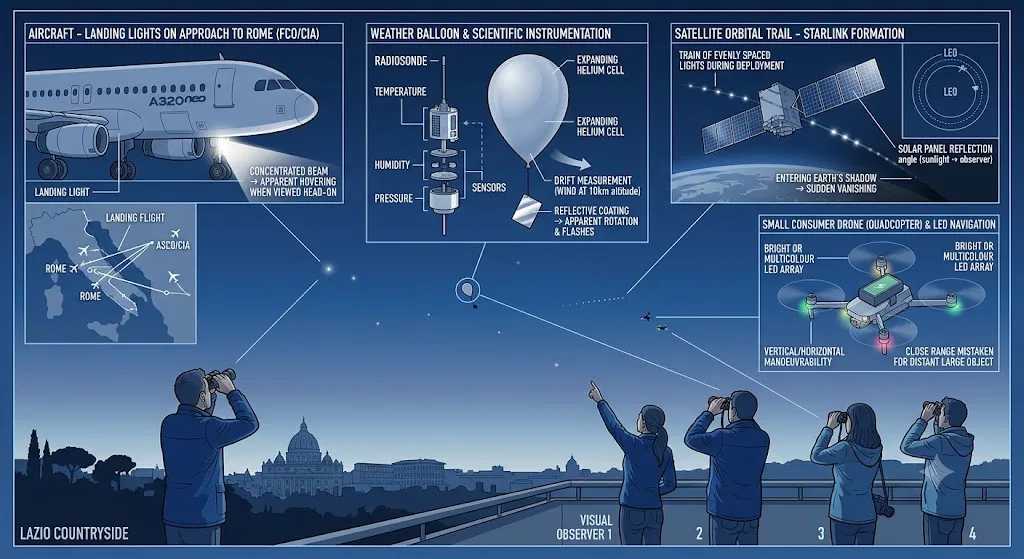
Many UFO reports from Lazio are likely to have ordinary causes: aircraft approaching Rome’s airports, balloons drifting with the wind, satellites reflecting sunlight, drones carrying bright LEDs, and defects created by cameras or image processing. Lazio is especially prone to such confusion because Rome sits beneath exceptionally busy and complex airspace, while modern observers increasingly record brief lights with phones that provide little reliable information about distance, size or speed.
This does not mean every Lazio report has been solved. An incident can remain officially or informally “unidentified” simply because investigators lack an exact time, direction, original photograph, flight track or weather record. The important distinction is therefore not between “alien” and “debunked”, but between reports that can be matched to a known cause, reports that strongly resemble ordinary phenomena, and cases whose evidence is too incomplete to support any firm conclusion.[difesa.it]aeronautica.difesa.itAeronautica Militare OVNIAeronautica MilitareOVNI - Aeronautica Militare…
Aircraft, balloons and controlled airspace
Aircraft are an unavoidable starting point when examining unusual lights over Lazio. Rome is served by Fiumicino and Ciampino, alongside Urbe and military or mixed-use airfields including Pratica di Mare and Guidonia. ENAV, Italy’s air-navigation provider, has said that the Rome Area Control Centre manages around 60 per cent of Italian airspace and provides approach services for five airports in the Rome area. At the time of its published figures, the centre handled roughly 800,000 movements annually, with daily peaks above 3,000 flights.[Enav]enav.itThe ICAO Secretary-General's visit | EnavThe ICAO Secretary-General's visit | Enav…
This density matters because an aircraft does not always look like an aircraft. Seen almost head-on during an approach, its landing lights may appear nearly stationary. A turn can make a light seem to accelerate, stop or change direction sharply, even though the aircraft is following a routine curved route. Thin cloud can hide navigation lights and leave only a bright glow. Atmospheric haze can enlarge that glow, while an observer without a visible horizon may misjudge its altitude and distance.
The Rome area also contains civil, state, emergency and military traffic. Temporary airspace restrictions illustrate this complexity. During major events, Italian aviation authorities may prohibit most flights over parts of Rome while specifically exempting scheduled services to Fiumicino and Ciampino, state aircraft and emergency operations. A witness who assumes that a “no-fly zone” means an entirely empty sky may therefore treat an authorised aircraft as anomalous.[moduliweb.enac.gov.it]moduliweb.enac.gov.itComunicati stampaè istituita una NO-FLY ZONE per tutto il traffico aereo, compresi i droni, per un’area circolare estesa per 6.5 miglia, avente come centr…
Aircraft become a particularly strong explanation when a report describes:
- a white or yellow light apparently hovering near a known approach corridor;
- red and green lights becoming visible as the object turns;
- steady movement followed by an apparent change in speed;
- repeated appearances at similar times on successive evenings;
- disappearance into cloud rather than a clearly observed instant acceleration.
None of these features proves an aircraft identification on its own. A convincing resolution requires comparison with flight-tracking, radar or air-traffic information for the correct time and viewing direction. Historical Lazio cases are often difficult precisely because those details were never recorded or are no longer available.
Balloons create a different but equally persistent class of reports. Weather balloons, advertising balloons, research platforms and smaller party balloons can all look metallic, spherical or irregular as they rotate. Their movement may seem purposeful when winds at different altitudes carry them in directions that do not match conditions at ground level. Sunlight can cause sudden bright flashes, followed by apparent disappearance when the reflective surface turns away.
Modern military analysis provides a useful comparison. In several European cases examined by the US All-domain Anomaly Resolution Office, infrared objects initially reported as anomalous were assessed with high confidence as balloons because their shapes resembled other balloon imagery and their motion followed wind speed and direction. These were not Lazio cases, but they demonstrate the diagnostic value of drift: apparently mysterious movement may become ordinary once upper-air winds are checked.[AARO]aaro.milAARO UAP ImageryAARO UAP Imagery…
A balloon explanation is strongest when an object changes altitude slowly, drifts without independent manoeuvring, repeatedly changes brightness as it rotates, or has no detectable heat, exhaust or aircraft-like structure. It remains only a hypothesis when the report gives no reliable duration, wind data or angular movement.

Satellites, drones and modern light formations
Satellite constellations have changed what an ordinary night sky looks like. A recently launched group of low-Earth-orbit satellites can appear as a procession of evenly spaced lights, while individual satellites may brighten dramatically when their surfaces reflect sunlight towards an observer. Such formations can seem coordinated because they genuinely are coordinated human-made objects travelling along related orbits.
Starlink is the best-known example. Researchers have reconstructed a commercial aviation incident in which five pilots on two aircraft reported unusual lights, supported by phone photographs and video. By combining satellite orbital data with aircraft tracking information, the investigators concluded that a recently launched Starlink group could reproduce the observations. The case is important because professional witnesses and multiple observations did not prevent an ordinary misidentification; the unusual viewing geometry made familiar technology look unfamiliar.[arXiv]arxiv.orgEnhancing Space Situational Awareness to Mitigate Risk: A Single-Case Study in the Misidentification of a Recently-Launched Starlink…
Other research has shown that Starlink satellites can produce exceptionally bright flares when sunlight reflects from their structures. Their visibility can change quickly, causing lights to appear, intensify and vanish without any physical acceleration. Wide-field astronomical surveys have recorded thousands of Starlink trails, with twilight images especially affected because satellites high above Earth may remain sunlit after the ground is dark.[arXiv]arxiv.orgarXiv Extreme Flaring of Starlink SatellitesExtreme Flaring of Starlink SatellitesMay 21, 2024…
For Lazio observers, this creates several recognisable patterns:
- A straight chain of lights: often a recently deployed satellite group.
- A single “star” moving steadily: commonly a satellite or the International Space Station.
- Several lights appearing one after another in the same patch of sky: potentially satellites brightening at a similar reflection angle.
- A luminous cloud or spiral: sometimes an illuminated rocket plume or fuel vent rather than a solid object.
- A light that vanishes without fading: frequently a satellite entering Earth’s shadow or turning away from the observer.
Checking an orbital prediction is much more reliable than judging appearance alone. The necessary details are exact time, location, direction, elevation and duration. A report saying only “lights above Rome last night” cannot be tested properly, especially when different observers may have been looking in different directions.
Drones complicate the picture at lower altitude. Consumer and professional unmanned aircraft can hover, reverse direction, rise vertically and carry intensely bright or programmable lights. Several drones flying together can produce geometric formations that would have been far harder to create during Lazio’s twentieth-century sighting waves.
Italy regulates drone operations through geographical zones in which flights may be limited, prohibited or subject to specific conditions. Operations conflicting with local restrictions can require aviation-authority or military approval. These rules show that drones share increasingly managed airspace with conventional aviation, but restrictions do not guarantee that every visible drone is authorised or correctly operated.[ENAC]enac.gov.itENACZone geografiche e U-SpaceENACZone geografiche e U-Space
A drone is most plausible when the object is visibly below cloud, remains within a relatively small area, produces buzzing or rotor noise, moves against the wind, or performs repeated vertical and lateral movements. Yet darkness makes scale extremely difficult to judge. A nearby small drone may be mistaken for a large distant craft, while a distant aircraft may be mistaken for a nearby drone.
The date of a report is therefore crucial. A manoeuvring light seen in 1954 cannot be explained by a modern quadcopter. The same description recorded after consumer drones became widespread should be assessed very differently. Ordinary explanations must fit the technology available at the time, not merely resemble the witness’s wording.

Photographic defects and mistaken impressions
A photograph can strengthen a report, but it can also manufacture the mystery. Lazio’s historical catalogue contains an unusually clear warning. An entry from Rome in October 1954 describes a photograph taken on Monte Mario, then adds that the supposed object was “very probably” only a mark on the image. The catalogue’s own qualification shows why a photographed shape should not automatically be treated as an object present in the sky.[Centro Ufologico Nazionale]centroufologiconazionale.netCentro Ufologico Nazionalewww.centroufologiconazionale.netCentro Ufologico Nazionalewww.centroufologiconazionale.net
Film photographs were vulnerable to dust, scratches, chemical marks, processing errors and damage to negatives or prints. A defect might appear as a dark disc, bright blob or elongated streak. Without the original negative, it can be impossible to determine whether a mark existed in the photographed scene, entered during development or appeared later on a copied print.
Digital cameras remove some old problems but add new ones. Common sources of misleading shapes include:
- lens flare from the Sun, street lights or aircraft lights;
- internal reflections between lens elements;
- motion blur caused by moving the phone during a long exposure;
- digital noise in dark skies;
- overexposure that enlarges a small point of light;
- autofocus hunting, which turns a star or planet into a pulsating disc;
- compression artefacts around bright objects;
- stabilisation or frame-blending errors in video;
- insects, dust or birds close to the lens but apparently positioned in the distant sky.
NASA’s guidance on identifying unusual aerial objects explicitly includes lens flare and optical aberration among common sources of UFO photographs. Its technical explanations of space-camera imagery show how bright objects can saturate detectors, produce streaks, spread into artificial patterns or generate shapes caused by diffraction. The instruments involved are more specialised than a mobile phone, but the underlying lesson is the same: an image records the interaction between light, optics, sensors and software, not an unfiltered copy of reality.[NASA Science]science.nasa.govScience Identifying UFOs and UAPsNASA ScienceIdentifying UFOs and UAPs - NASA Science…
Single-frame photographs deserve particular caution. A small object captured in one image but unseen by the photographer may be a bird, insect or defect rather than a distant craft. Multiple consecutive frames are more useful because they can reveal a consistent path. Original files are also preferable to social-media copies, which may have been cropped, enlarged, sharpened or recompressed until artefacts resemble physical edges.
Video is not automatically decisive. A zoomed point of light may seem to change shape because autofocus, digital zoom and atmospheric turbulence are constantly altering the image. Camera movement can make a stationary planet appear to dart across the frame. Without stable foreground references, the movement of the camera may be mistaken for movement of the object.
Human perception adds another layer. A witness looking at a bright light in darkness has few reliable clues to distance. The brain nevertheless tries to assign size, speed and shape. Once the light is interpreted as a nearby object, ordinary angular movement can seem like tremendous acceleration. A star or planet may also appear to move when stared at against a featureless background, an effect intensified by involuntary eye movements.
NASA notes that Venus, Jupiter and bright stars are frequently mistaken for unusual aerial objects, particularly near the horizon, where atmospheric distortion and poor depth cues are strongest. Planets aligned near the horizon may even appear to form a group of unexplained lights.[NASA Science]science.nasa.govScience Identifying UFOs and UAPsNASA ScienceIdentifying UFOs and UAPs - NASA Science…

Why some Lazio cases remain unresolved
An unresolved report is not necessarily a report that resisted every ordinary explanation. More often, it is one for which the information needed to choose between explanations is missing. Investigators may know that a witness saw a light near Rome, but not the precise minute, compass bearing, elevation, weather, flight activity or camera settings. Several ordinary candidates may remain possible, with none provable.
The Italian Air Force’s public role is to collect reports and conduct checks concerning unidentified flying objects. Its use of an unidentified classification should be understood administratively: no recognised aircraft or known phenomenon was matched through the available checks. It does not certify extraordinary performance or an extraterrestrial origin.[Aeronautica Militare]aeronautica.difesa.itAeronautica Militare OVNIAeronautica MilitareOVNI - Aeronautica Militare…
Recent official military casework elsewhere shows how limited data affects conclusions. AARO has published European reports in which imagery depicted a real physical object but lacked enough information for a specific attribution. In another case, a short recording showed performance consistent with an ordinary aircraft, yet the exact type could not be determined. Infrared contrasts have also remained unresolved because analysts could not establish whether they came from a physical object, a thermal reflection, an environmental difference or a sensor-display error.[AARO]aaro.milAARO UAP ImageryAARO UAP Imagery…
That distinction is directly relevant to Lazio’s archival record. A report may be:
- Resolved: positively matched to an aircraft, balloon, satellite, drone, astronomical object or image defect.
- Plausibly explained: strongly consistent with an ordinary cause, although no decisive record survives.
- Weakly sourced: repeated in catalogues or later articles without the original statement, photograph or operational file.
- Unresolved: sufficiently documented to establish that something was observed, but not enough to identify it.
- Potentially significant: supported by independent witnesses, instrument data or contemporary records that rule out common alternatives.
Most Lazio reports do not reach the final category. Historical catalogue entries are often only a sentence long, while modern social-media clips commonly omit the original file and basic observational details. That evidential weakness should not be confused with proof that nothing happened; it means only that the surviving material cannot reliably distinguish a remarkable event from an ordinary one viewed under poor conditions.
The most useful test is reconstruction
The best way to evaluate a Lazio report is to reconstruct the sky rather than debate how strange the object looked. A useful investigation compares the witness account with aircraft routes, satellite positions, drone restrictions, weather, wind at altitude, astronomical objects and the properties of the recording device.
Exact timing is especially powerful. A difference of only a few minutes may determine whether a light matches an approaching aircraft, a satellite pass or a rocket stage. Direction and elevation can separate a planet near the horizon from traffic aligned with a runway. Consecutive original images can reveal whether a “disc” travelled consistently or remained fixed to the same part of the camera frame.
Ordinary explanations are not excuses added after the event. They are testable mechanisms with expected behaviour. Aircraft follow routes and display regulated lights. Balloons drift with atmospheric winds. Satellites follow predictable orbits and brighten under particular illumination. Drones have limited endurance and characteristic low-altitude movement. Camera artefacts often repeat in relation to a bright light or sensor position.
A Lazio case becomes genuinely harder to explain only when good evidence contradicts those expectations: accurately timed observations from separate locations, preserved original imagery, reliable distance information, radar or flight records, and movement that cannot be reproduced by perspective, wind or camera motion. Without that foundation, the most responsible conclusion is often neither “solved” nor “extraordinary”, but “insufficiently documented”.
Amazon book picks
Further Reading
Books and field guides related to What Could Explain Lazio's UFO Reports?. Use these as the next step if you want deeper reading beyond the article.
The UFO Experience
Cited by the New York Review of Books as “the best brief for visitation,” this classic study presents an analysis of UFO reports and conc...
UFOs: Generals, Pilots, and Government Officials Go on the Re...
NEW YORK TIMES BESTSELLER • Impeccably researched, this riveting journalistic investigation separates fact from fiction, and documents th...
The Demon-Haunted World
NEW YORK TIMES BESTSELLER • From the renowned astronomer and author of Cosmos comes a “powerful [and] stirring defense of informed ration...
The Believing Brain
Synthesizing thirty years of research, psychologist and science historian, Michael Shermer upends the traditional thinking about how huma...
eBay marketplace picks
Marketplace Samples
Live-tested eBay searches with available results related to this page.
Selected fromufo poster oneBay.co.uk.
Current eBay listing
VINTAGE UFO FLYING SAUCERS COMIC ADVERTISING A2 POSTER PRINT

Current eBay listing
I Want To Believe UFO Poster Giclée Fine Art Heavyweight Print
Endnotes
1.
Source: science.nasa.gov
Title: Science Identifying UFOs and UAPs
Link:https://science.nasa.gov/solar-system/skywatching/night-sky-network/identifying-ufos-and-uaps/
Source snippet
NASA ScienceIdentifying UFOs and UAPs - NASA Science...
2.
Source: aaro.mil
Title: AARO UAP Imagery
Link:https://www.aaro.mil/UAP-Cases/Official-UAP-Imagery/
Source snippet
AARO UAP Imagery...
3.
Source: enav.it
Title: The ICAO Secretary-General’s visit | Enav
Link:https://www.enav.it/en/sites/public/en/Media/Notizie/Traduzione-di-icao-visita-enav.html
Source snippet
The ICAO Secretary-General's visit | Enav...
4.
Source: moduliweb.enac.gov.it
Title: Comunicati stampa
Link:https://moduliweb.enac.gov.it/applicazioni/comunicati/comunicato.asp?NumCom=74&selpa1=2746
Source snippet
è istituita una NO-FLY ZONE per tutto il traffico aereo, compresi i droni, per un’area circolare estesa per 6.5 miglia, avente come centr...
Published: October 27, 2021
5.
Source: moduliweb.enac.gov.it
Link:https://moduliweb.enac.gov.it/Applicazioni/comunicati/comunicato.asp?NumCom=21&selpa1=2331
Source snippet
#### Maggiori dettagli e informazioni sono riportati nei relativi NOTAM (Notice to Airmen - avviso ai naviganti)...
6.
Source: arxiv.org
Link:https://arxiv.org/abs/2403.08155
Source snippet
Enhancing Space Situational Awareness to Mitigate Risk: A Single-Case Study in the Misidentification of a Recently-Launched Starlink...
7.
Source: arxiv.org
Title: arXiv Extreme Flaring of Starlink Satellites
Link:https://arxiv.org/abs/2405.13091
Source snippet
Extreme Flaring of Starlink SatellitesMay 21, 2024...
Published: May 21, 2024
8.
Source: arxiv.org
Link:https://arxiv.org/abs/2201.05343
9.
Source: enac.gov.it
Title: ENACZone geografiche e U-Space
Link:https://www.enac.gov.it/sicurezza-aerea/droni/zone-geografiche-space/
10.
Source: enac.gov.it
Title: ENACVoli con droni (UAS): limitazioni e riserve dello spazio aereo
Link:https://www.enac.gov.it/sicurezza-aerea/droni/zone-geografiche-space/voli-con-droni-uas-limitazioni-riserve-dello/
11.
Source: science.nasa.gov
Title: Science Artifacts and Other Imaging Anomalies Taken by NASA’s Solar Imagers
Link:https://science.nasa.gov/blogs/the-sun-spot/2019/02/08/artifacts-and-other-imaging-anomalies-taken-by-nasas-solar-imagers/
12.
Source: enac.gov.it
Title: ordinanza 30 2026 lazio
Link:https://www.enac.gov.it/la-normativa/normativa-enac/ordinanza-30-2026-lazio/
Published: June 30, 2026
13.
Source: enac.gov.it
Title: ordinanza 28 2026 lazio
Link:https://www.enac.gov.it/la-normativa/normativa-enac/ordinanza-28-2026-lazio/
Published: June 17, 2026
14.
Source: enac.gov.it
Title: ordinanza 26 2026 lazio
Link:https://www.enac.gov.it/la-normativa/normativa-enac/ordinanza-26-2026-lazio/
Published: May 29, 2026
15.
Source: science.nasa.gov
Title: great balls of fire
Link:https://science.nasa.gov/earth/earth-observatory/great-balls-of-fire/
Published: May 18, 2026
16.
Source: enav.it
Link:https://www.enav.it/en/node/18567
Published: March 23, 2026
17.
Source: enac.gov.it
Title: ordinanza 14 2026 lazio
Link:https://www.enac.gov.it/la-normativa/normativa-enac/ordinanza-14-2026-lazio/
Published: March 17, 2026
18.
Source: enac.gov.it
Title: ordinanza 11 2026 lazio
Link:https://www.enac.gov.it/la-normativa/normativa-enac/ordinanza-11-2026-lazio/
Published: March 3, 2026
19.
Source: enac.gov.it
Title: ordinanze lazio 2026
Link:https://www.enac.gov.it/la-normativa/normativa-enac/ordinanze-lazio-2026/
Published: January 8, 2026
20.
Source: enav.it
Link:https://www.enav.it/node/18287
Published: November 14, 2024
21.
Source: enac.gov.it
Title: Circolare ATM-09A
Link:https://www.enac.gov.it/la-normativa/normativa-enac/circolari/serie-atm/circolare-atm-09a/
Published: February 15, 2024
22.
Source: stereo-ssc.nascom.nasa.gov
Title: artifacts camera.shtml
Link:https://stereo-ssc.nascom.nasa.gov/artifacts/artifacts_camera.shtml
Published: December 9, 2021
23.
Source: enav.it
Title: Urban Air Mobility: Lettera di Intenti ENAC – ENAV – Aeroporti di Roma | Enav
Link:https://www.enav.it/node/16091
Published: June 18, 2021
24.
Source: soho.nascom.nasa.gov
Link:https://soho.nascom.nasa.gov/hotshots/2003_01_17/
Published: July 27, 2020
25.
Source: enav.it
Title: La visita del Segretario Generale di ICAO | Enav
Link:https://www.enav.it/sites/public/it/Media/Notizie/icao-visita-enav.html
Published: June 26, 2017
26.
Source: enav.it
Link:https://www.enav.it/en/sites/public/en/Media/Comunicati/Traduzione-di-scaramella-icao-acc-roma-giugno-dici.html
Published: June 26, 2017
27.
Source: nasa.gov
Title: NAS A’s EPIC View Spots Flashes on Earth
Link:https://www.nasa.gov/science-research/earth-science/nasas-epic-view-spots-flashes-on-earth/
Published: May 15, 2017
28.
Source: comunicati.enac.gov.it
Title: enac chiusura dello spazio aereo martedi 8 dicembre 2015
Link:https://comunicati.enac.gov.it/it/announcement/show/enac-chiusura-dello-spazio-aereo-martedi-8-dicembre-2015
Published: December 5, 2015
29.
Source: nasa.gov
Title: The Anatomy of a Black Hole Flare
Link:https://www.nasa.gov/image-article/anatomy-of-black-hole-flare/
Published: October 27, 2015
30.
Source: enav.it
Title: Completata la ristrutturazione della Torre di Fiumicino | Enav
Link:https://www.enav.it/sites/public/it/Media/Notizie/Ristrutturazione-Torre-di-controllo-Fiumicino.html
Published: October 27, 2015
31.
Source: science.nasa.gov
Title: how to interpret a false color satellite image
Link:https://science.nasa.gov/earth/earth-observatory/how-to-interpret-a-false-color-satellite-image/
Published: March 14, 2014
32.
Source: stereo-ssc.nascom.nasa.gov
Link:https://stereo-ssc.nascom.nasa.gov/artifacts/artifacts.shtml
Published: June 22, 2011
33.
Source: ntrs.nasa.gov
Link:https://ntrs.nasa.gov/citations/20090020469
Published: March 1, 2008
34.
Source: science.nasa.gov
Title: its not a bird or a plane
Link:https://science.nasa.gov/photojournal/its-not-a-bird-or-a-plane/
Published: May 31, 2005
35.
Source: apod.nasa.gov
Link:https://apod.nasa.gov/apod/ap990601.html
Published: June 1, 1999
36.
Source: onlineservices2.enav.it
Title: it Page 9
Link:https://onlineservices2.enav.it/enavWebPortalStatic/cleared/CLEARED_092021/files/basic-html/page9.html
37.
Source: enav.it
Link:https://www.enav.it/en/what-we-do/we-manage-italian-airspace/flight-managing
38.
Source: onlineservices2.enav.it
Title: it Page 5
Link:https://onlineservices2.enav.it/enavWebPortalStatic/cleared/CLEARED_10_2025_YT/files/basic-html/page5.html
39.
Source: onlineservices2.enav.it
Title: it Page 4
Link:https://onlineservices2.enav.it/enavWebPortalStatic/cleared/CLEARED_03_2023_YT/files/basic-html/page4.html
40.
Source: onlineservices2.enav.it
Title: it Page 2
Link:https://onlineservices2.enav.it/enavWebPortalStatic/cleared/CLEARED_05_2025_YT/files/basic-html/page2.html
41.
Source: arxiv.org
Link:https://arxiv.org/pdf/2303.17103
Published: February 2023
42.
Source: aeronautica.difesa.it
Title: Aeronautica Militare OVNI
Link:https://www.aeronautica.difesa.it/ovni/
Source snippet
Aeronautica MilitareOVNI - Aeronautica Militare...
43.
Source: centroufologiconazionale.net
Title: Centro Ufologico Nazionalewww.centroufologiconazionale.net
Link:https://www.centroufologiconazionale.net/avvistamenti/lazio.htm
44.
Source: centroufologiconazionale.net
Title: Archivio Newsavvistamenti U.F.O. NEWS UFO in Lazio
Link:https://www.centroufologiconazionale.net/news/newarchive.htm
45.
Source: centroufologiconazionale.net
Link:https://www.centroufologiconazionale.net/news/new.htm
Additional References
46.
Source: cia.gov
Link:https://www.cia.gov/readingroom/document/cia-rdp81r00560r000100010002-9
47.
Source: artangel.org.uk
Link:https://www.artangel.org.uk/project/witness/ufo-sightings-from-around-world/
48.
Source: business.esa.int
Title: int AROB S Alert Box | ESA Space Solutions
Link:https://business.esa.int/projects/arobs-alertbox
Published: October 30, 2025
49.
Source: business.esa.int
Title: int Digital Engineer | ESA Space Solutions
Link:https://business.esa.int/projects/digital-engineer
Published: October 20, 2022
50.
Source: esa.int
Link:https://www.esa.int/Enabling_Support/Operations/Anatomy_of_a_debris_incident
Published: February 1, 2017
51.
Source: esa.int
Link:https://www.esa.int/Space_Safety/Asteroid_grazes_path_of_satellites_in_geostationary_ring
Published: April 30, 2020
52.
Source: esa.int
Link:https://www.esa.int/Science_Exploration/Human_and_Robotic_Exploration/iriss/Blue_jets_studied_from_Space_Station
Published: February 8, 2017
53.
Source: esa.int
Link:https://www.esa.int/Space_Safety/ESA_spacecraft_dodges_large_constellation
Published: September 3, 2019
54.
Source: esa.int
Link:https://www.esa.int/Space_in_Member_States/Germany/ESA-Satellit_Aeolus_weicht_grosser_Konstellation_aus
Published: September 3, 2019
55.
Source: esa.int
Link:https://www.esa.int/ESA_Multimedia/Images/2019/09/Predicted_near_miss_between_Aeolus_and_Starlink_44
Published: September 3, 2019