Within Basilicata UFOs
Why Low Flying UFO Estimates Are Often Unreliable
Without a known size or distance, observers cannot reliably estimate whether a night-time object is low, fast or unusually large.
On this page
- The missing size and distance problem
- How darkness removes visual reference points
- What stronger witness measurements require
Page outline Jump by section
Introduction
Witnesses can describe where a light appeared, how it moved across their field of view and how long it remained visible. They usually cannot determine its true height or speed from sight alone, especially at night. Without knowing an object’s distance or physical size, the same visual impression may fit a small nearby drone, a distant aircraft, a high-altitude balloon, a satellite or a meteor tens of kilometres above the ground.
This distinction matters in Basilicata because several regional UFO reports rely on phrases such as “low over the rooftops”, “moving faster than an aircraft” or “hundreds of metres high” without radar, triangulation or another independent range measurement. Such statements may faithfully record what the witness perceived, but they are not measurements. France’s official aerospace investigation body, GEIPAN, explicitly warns that the distance and speed of an unidentified object cannot normally be assessed when the object itself is unrecognised.[Geipan]geipan.frThe GEIPAN uses a reproducible methodology for each survey…. If the testimony is very easy to explain without investigation a quick re…
The missing size and distance problem
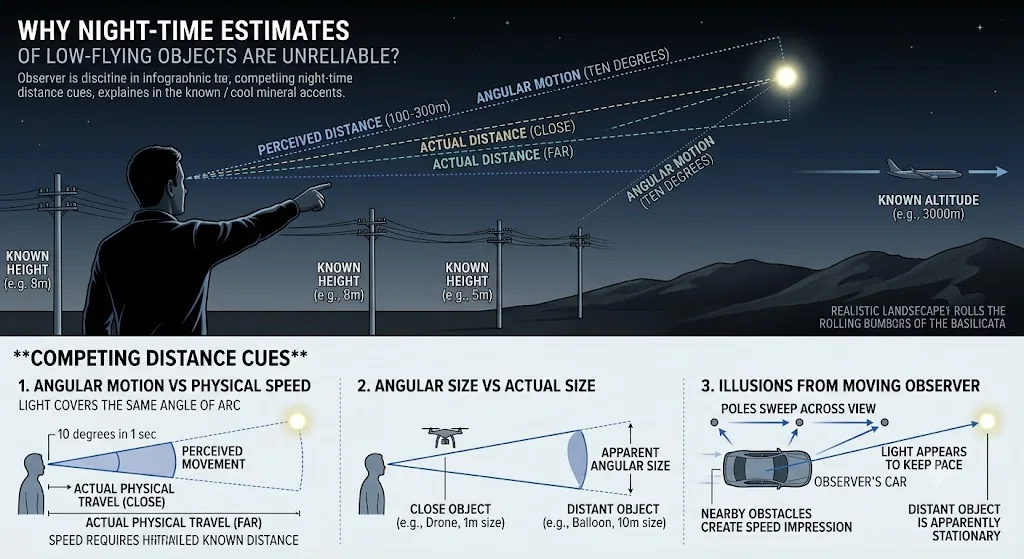
The central difficulty is simple: apparent movement is not the same as physical movement. The eye registers an object’s angular motion—the angle through which it appears to travel—not the number of metres or kilometres it actually covers.
A light crossing ten degrees of sky in one second could therefore have very different speeds:
- At 100 metres away, it would travel roughly 17 metres.
- At one kilometre, it would travel about 175 metres.
- At ten kilometres, it would cover roughly 1.75 kilometres.
All three movements would look broadly similar to the unaided eye. Choosing between them requires a reliable distance, yet distance is precisely what is usually missing in a night-time UFO observation. Laboratory research confirms that perceived speed depends partly on distance cues rather than retinal movement alone. Experiments with approaching objects have also found that observers struggle to compensate correctly for differences in distance when judging speed.[PubMed]pubmed.ncbi.nlm.nih.govPub Med Speed constancy and the perception of distanceThe perceived speed of a stimulus depends not only on the physical speed of the stimulus but also on non-motion cues, some of which are d…
Size creates the same circular problem. Witnesses may say that an object was “as large as a car” or “the size of a house”, but that judgement already assumes a distance. A ten-centimetre light nearby and a ten-metre object one hundred times farther away can occupy the same angle in the sky. Unless the object passes in front of or behind a landmark whose distance is known, its apparent diameter does not reveal its true diameter.
This is why comparisons with familiar objects must be recorded carefully. “The size of a football” is ambiguous: it may mean the witness believed the object was physically football-sized, or merely that it covered as much of the view as a football held at some unstated distance. A more useful description is angular—such as “half the apparent width of the Moon” or “covered by the tip of a finger at arm’s length”—although even this provides only apparent size, not actual size.
Why “low over Matera” may be an impression
A recent Matera report illustrates the evidential problem. An account published by the Italian Ufological Federation described white-yellow lights seen moving from south to north on 18 May, with an estimated altitude of between 100 and 300 metres. The published account regarded the objects as unidentified pending further investigation, but it did not report triangulation, radar ranging or a known object dimension from which that altitude could be calculated. The figure therefore appears to be a witness estimate rather than an independently established height.[federazioneufologicaitaliana.org]federazioneufologicaitaliana.orgMistero nei Cieli di Matera – Federazione Ufologica ItalianaMistero nei Cieli di Matera – Federazione Ufologica Italiana
That does not make the observation worthless. The direction of travel, colour, number of lights, weather, viewing position and recorded video may all help test possible explanations. The altitude claim, however, should not be treated as though an instrument measured it. If the lights were actually several kilometres away, their corresponding physical separation and speed would be much greater. If they were nearby, both would be smaller.
A convincing low-altitude judgement usually needs a clear depth cue. Examples include an object being visibly obscured by a known ridge, passing behind a church tower, illuminating nearby terrain or moving beneath a measured cloud base. Merely appearing close to a roofline is not enough. A distant object can line up with a nearby roof because the witness sees a two-dimensional projection of both.
Basilicata’s terrain can complicate such impressions. From a hillside settlement or a road crossing uneven ground, a witness may not know whether a light is over the next valley, beyond a ridge or high above a distant plain. Darkness removes much of the terrain information that would resolve the geometry during daylight.
How darkness removes visual reference points
Human depth perception is strongest when several cues work together: binocular vision, familiar size, texture, perspective, shadows, overlap and changes in viewpoint. A small isolated light against a dark sky supplies almost none of these. The witness sees brightness and direction, but not a visible body with edges, surface detail or a recognisable scale.
An isolated light may also seem to wander even when it is stationary. This is the autokinetic effect, a recognised visual illusion in which a fixed point of light appears to move when viewed against a featureless dark background. Aviation guidance treats the effect as a practical night-flying hazard and recommends visual scanning rather than prolonged staring at the light.[Skybrary]skybrary.aeroII!!I~ II II IIII Iliil IIII!!I~ II II IIII Iliil II - DTICby RE Miller · 1992 · Cited by 49 — The autokinetic effect can be reduced by maintaining good vi…
Autokinesis does not explain every report of an erratically moving light. It is most relevant when the object is a solitary point, the background is dark and the claimed movement is slight or wavering. It becomes less persuasive when movement is recorded against stars, buildings or terrain, or when separate cameras show the same displacement. Nevertheless, it offers an ordinary explanation for some reports in which a light appears to hover, drift, reverse or make small abrupt movements.
The witness’s own movement can add another illusion. A light observed from a moving car may seem to keep pace with the vehicle because a distant object changes direction very little relative to the observer. Conversely, nearby trees, poles and buildings sweep rapidly across the field of view, encouraging the impression that the light is moving independently. GEIPAN includes mistaken reconstruction of a path and errors caused by the observer’s changing viewpoint among the perceptual issues considered during investigations.[Geipan]geipan.frThe GEIPAN uses a reproducible methodology for each survey…. If the testimony is very easy to explain without investigation a quick re…
Clouds can further disguise distance. A light seen through thin cloud may appear diffuse and therefore large, although the glow is caused by scattered light rather than the dimensions of a solid object. A source disappearing as it enters cloud can also be remembered as accelerating away or “switching off”. Without a visible outline, it may be impossible to distinguish physical enlargement from increasing glare, camera bloom or changing atmospheric transparency.
Why ordinary objects can appear extraordinarily fast
Descriptions such as “too fast to be an aircraft” often compare an unidentified light with the observer’s mental image of a passenger jet. That comparison may be misleading because aircraft do not present a fixed visual speed. A nearby aircraft moving across the observer’s line of sight can sweep rapidly through the sky, while a faster but distant aircraft travelling towards the witness may appear almost stationary.
Aircraft type also affects judgement. GEIPAN gives the example of a large airliner whose unusual apparent size and lighting can make it seem to move strangely. Observers may estimate motion by watching how quickly the tail appears to reach the former position of the nose. Because a larger aircraft takes longer to move by one body length, it can appear slower than a smaller aircraft even when their actual speeds are comparable.[GEIPAN]cnes-geipan.fr* Perception mistakes due to the brain short-term processing (autokinetic effect) or due to psychological constructs (distance and speed…
The reverse error occurs when a witness assumes that a light is nearby. A distant object covering a modest angle may then be assigned an extreme calculated speed: the observer pictures it racing just above the landscape, although the same angular movement might be normal for a much more distant aircraft or satellite.
Sudden disappearance can also be mistaken for sudden acceleration. An aircraft may turn so that its landing lights no longer face the observer. A satellite may enter the Earth’s shadow. A lantern or balloon may pass into cloud. A meteor may extinguish within a fraction of a second. None of these requires the source to accelerate beyond visual range, yet the subjective impression can be that it “shot away”.
Meteors show why instruments change the story
Meteors provide a particularly useful Basilicata comparison because they are often described as low, close or travelling over a particular town. A bright meteor can seem to pass just beyond nearby hills even though its luminous path lies many kilometres above the region and may extend across more than one Italian province.
In April 2024, residents reported a loud event associated with a meteoroid over southern Italy. Analysis using Italy’s PRISMA meteor-camera network reconstructed a luminous trajectory lasting 16.5 seconds and extending for about 228 kilometres. The calculated final visible height was about 49.5 kilometres. These figures did not come from a witness judging how low the object looked; they came from coordinated observations and trajectory modelling.[INGVterremoti]ingvterremoti.comTerremoto in Basilicata? No, è un meteoroide – INGVterremotiTerremoto in Basilicata? No, è un meteoroide – INGVterremoti
Research comparing meteor eyewitness accounts with instrumentally observed paths demonstrates the size of the possible error. In one study, eyewitness-derived starting and ending heights were generally higher than the measured values, with some reconstructions becoming physically unrealistic. The researchers found that witness reports could still contribute useful directional information, but not dependable three-dimensional trajectories without careful correction and supporting data.[PubMed Central (PMC)]pmc.ncbi.nlm.nih.govOpen source on nih.gov.
Professional meteor work therefore uses observations from separated stations. Seeing the same event from different locations creates parallax—the apparent shift caused by the observers’ different viewpoints—and allows a three-dimensional path to be calculated. Calibrated timing then makes a defensible speed estimate possible. Double-station camera systems can derive trajectories and speeds with quantified uncertainties, something a single unaided observer cannot reproduce.[arXiv]arxiv.orgOpen source on arxiv.org.
What stronger witness measurements require
A useful UFO report should separate direct observations from later interpretation. “A white light moved from left to right below the Moon in approximately five seconds” is direct observational information. “It was a 20-metre craft at 200 metres travelling at 1,000 kilometres per hour” is a derived claim that requires additional evidence.
The Italian Air Force’s reporting form reflects this distinction by requesting detailed circumstances, including direction, elevation, movement, duration, nearby reference points, weather and information about aircraft activity. Asking for height and speed can help investigators understand the witness’s impression, but the values still need to be tested against the geometry and other records. The Air Force has been the Italian institution designated to collect and examine such reports since the 1978 national sighting wave.[Aeronautica Militare]aeronautica.difesa.itAeronautica Militare OVNIAeronautica Militare OVNI
The most valuable observations include several of the following:
- Precise time: preferably checked against a clock rather than reconstructed later.
- Exact viewing location: including whether the witness or vehicle was moving.
- Azimuth and elevation: the compass direction and angle above the horizon at the beginning and end.
- Angular size: expressed against the Moon, stars or a ruler held at arm’s length.
- Angular path and duration: how many degrees of sky were crossed and in how many seconds.
- Occlusion: whether the object visibly passed behind or in front of a known feature.
- Independent viewpoints: witnesses separated by a meaningful distance who record the event before discussing it together.
- Original files: unedited photographs or video retaining timestamps, exposure settings and other metadata.
- External records: radar, air-traffic information, satellite predictions, meteor-camera data and weather observations.
Sound can sometimes provide a constraint, but only cautiously. Immediate engine noise may support a nearby aircraft interpretation, while a delayed boom can indicate that a fast event occurred much farther away. Absence of sound proves little: distance, wind, terrain, engine orientation and background noise can all prevent an aircraft from being heard.
Video does not automatically solve the range problem. A single camera normally records angles rather than distance, just as the eye does. Digital zoom enlarges the image but does not create missing depth information. Camera shake, autofocus, optical stabilisation and the movement of the person filming can also make a point of light appear to dart or pulse. A video becomes much stronger when the frame includes fixed stars or landmarks, the camera position is known and another recording captures the object from elsewhere.
A better way to read Basilicata’s claims
When a Basilicata case rests on an estimated altitude or speed, the estimate should be treated as a hypothesis, not as a confirmed property of the object. The first question is not whether the reported performance seems extraordinary. It is whether investigators had enough information to calculate performance at all.
A report remains potentially interesting when the basic identity of the phenomenon cannot be established. Yet “unidentified” and “demonstrated to be technologically exceptional” are very different conclusions. An unexplained light with no known range may remain unresolved precisely because the evidence is insufficient, not because conventional objects have been shown incapable of producing its motion.
The strongest regional cases would therefore be those in which witness testimony is supported by fixed reference points, independent observers, original imagery, radar or other instrument records. Where these are absent, vivid claims of treetop height, enormous dimensions or impossible acceleration should be preserved as part of the testimony but excluded from the firm evidential core. That approach neither dismisses witnesses nor accepts visual impressions uncritically. It recognises the central limitation of night-time observation: people can often report what a light appeared to do, while being unable to tell how far away it was—and therefore how high, large or fast it really was.
Amazon book picks
Further Reading
Books and field guides related to Why Low Flying UFO Estimates Are Often Unreliable. Use these as the next step if you want deeper reading beyond the article.
The UFO Handbook: A Guide to Investigating, Evaluating, and R...
An explanation of the usual reasons for confusing IFOs (identified flying objects) with UFOs and a survey of the tools used to investigat...
UFOs Explained
Analyzing several UFO cases, the author exposes the myth of extraterrestrial visitors to earth.
The Invisible Gorilla: How Our Intuitions Deceive Us
NEW YORK TIMES BESTSELLER • Our minds don’t work the way we think they do. Two renowned psychologists explain how and why our intuitions...
Sleights of Mind: What the Neuroscience of Magic Reveals Abou...
What can magic tell us about ourselves and our daily lives? If you subtly change the subject during an uncomfortable conversation, did yo...
eBay marketplace picks
Marketplace Samples
Live-tested eBay searches with available results related to this page.
Selected fromUFO poster oneBay.co.uk.


Current eBay listing
VINTAGE UFO FLYING SAUCERS COMIC ADVERTISING A2 POSTER PRINT

Current eBay listing
I Want To Believe UFO Poster Giclée Fine Art Heavyweight Print
Endnotes
1.
Source: geipan.fr
Link:https://www.geipan.fr/en/node/58788
Source snippet
The GEIPAN uses a reproducible methodology for each survey.... If the testimony is very easy to explain without investigation a quick re...
2.
Source: cnes-geipan.fr
Link:https://www.cnes-geipan.fr/en/missions-methodes-et-resultats
Source snippet
* Perception mistakes due to the brain short-term processing (autokinetic effect) or due to psychological constructs (distance and speed...
3.
Source: federazioneufologicaitaliana.org
Title: Mistero nei Cieli di Matera – Federazione Ufologica Italiana
Link:https://www.federazioneufologicaitaliana.org/mistero-nei-cieli-di-matera/18639/
4.
Source: skybrary.aero
Title: II!!I~ II II IIII Iliil II
Link:https://skybrary.aero/sites/default/files/bookshelf/4078.pdf
Source snippet
II!!I~ II II IIII Iliil II - DTICby RE Miller · 1992 · Cited by 49 — The autokinetic effect can be reduced by maintaining good vi...
5.
Source: cnes-geipan.fr
Link:https://cnes-geipan.fr/en/node/58788
Source snippet
* Perception mistakes due to the brain short-term processing (autokinetic effect) or due to psychological constructs (distance and speed...
6.
Source: geipan.fr
Link:https://www.geipan.fr/en/node/440
7.
Source: ingvterremoti.com
Title: Terremoto in Basilicata? No, è un meteoroide – INGVterremoti
Link:https://ingvterremoti.com/2024/04/24/terremoto-in-basilicata-no-e-un-meteoroide/
8.
Source: arxiv.org
Link:https://arxiv.org/abs/1807.10087
9.
Source: geipan.fr
Link:https://www.geipan.fr/fr/cas/2025-10-51704
10.
Source: geipan.fr
Link:https://www.geipan.fr/fr/cas/2025-06-51675
11.
Source: federazioneufologicaitaliana.org
Title: SFER A LUMINOSA NEI CIELI DI CASALNUOVO – Federazione Ufologica Italiana
Link:https://www.federazioneufologicaitaliana.org/sfera-luminosa-nei-cieli-di-casalnuovo/18510/
12.
Source: geipan.fr
Link:https://www.geipan.fr/fr/cas/2024-09-51568
13.
Source: geipan.fr
Link:https://www.geipan.fr/fr/temoignage/10420
14.
Source: geipan.fr
Link:https://www.geipan.fr/fr/cas/2023-10-51523
15.
Source: geipan.fr
Link:https://www.geipan.fr/fr/cas/2023-10-51478
16.
Source: tg24.sky.it
Title: meteorite san valentino matera
Link:https://tg24.sky.it/cronaca/2023/02/18/meteorite-san-valentino-matera
17.
Source: geipan.fr
Link:https://www.geipan.fr/en/node/61362
18.
Source: geipan.fr
Link:https://geipan.fr/fr/cas/2021-07-51207
19.
Source: geipan.fr
Link:https://geipan.fr/fr/cas/2020-08-51065
20.
Source: federazioneufologicaitaliana.org
Title: UF O: Sfera di luce a Brancaccio, Palermo – Federazione Ufologica Italiana
Link:https://www.federazioneufologicaitaliana.org/ufo-sfera-di-luce-a-brancaccio-palermo/5783/
21.
Source: geipan.fr
Link:https://www.geipan.fr/fr/cas/2018-07-50618
22.
Source: geipan.fr
Link:https://www.geipan.fr/fr/cas/1993-05-01303
23.
Source: geipan.fr
Link:https://www.geipan.fr/fr/cas/1993-05-01299
24.
Source: skybrary.aero
Link:https://skybrary.aero/sites/default/files/bookshelf/2087.pdf
25.
Source: skybrary.aero
Link:https://skybrary.aero/sites/default/files/bookshelf/611.pdf
26.
Source: skybrary.aero
Link:https://skybrary.aero/sites/default/files/bookshelf/3424.pdf
27.
Source: geipan.fr
Link:https://www.geipan.fr/en/node/58792
28.
Source: geipan.fr
Link:https://www.geipan.fr/en/node?page=0
29.
Source: geipan.fr
Link:https://www.geipan.fr/en/faq-page?_x_tr_hl=en&_x_tr_sl=fr&_x_tr_tl=en
30.
Source: pubmed.ncbi.nlm.nih.gov
Title: Pub Med Speed constancy and the perception of distance
Link:https://pubmed.ncbi.nlm.nih.gov/18399244/
Source snippet
The perceived speed of a stimulus depends not only on the physical speed of the stimulus but also on non-motion cues, some of which are d...
31.
Source: pubmed.ncbi.nlm.nih.gov
Link:https://pubmed.ncbi.nlm.nih.gov/19146869/
Source snippet
rushtonsk@cardiff.ac.uk... Objects approaching at the same speed, on the same trajectory, but at different distances from an observer, h...
32.
Source: pmc.ncbi.nlm.nih.gov
Link:https://pmc.ncbi.nlm.nih.gov/articles/PMC7357168/
33.
Source: aeronautica.difesa.it
Title: Aeronautica Militare OVNI
Link:https://www.aeronautica.difesa.it/ovni/
34.
Source: aeronautica.difesa.it
Link:https://www.aeronautica.difesa.it/wp-content/uploads/2022/11/ModuloUFO.pdf
35.
Source: nuforc.org
Link:https://nuforc.org/sighting/?id=199107
36.
Source: fireballs.imo.net
Link:https://fireballs.imo.net/members/imo_view/event/2026/4341?org=imo
37.
Source: fireballs.amsmeteors.org
Link:https://fireballs.amsmeteors.org/members/imo_view/event/2026/4341
38.
Source: aeronautica.difesa.it
Title: it C-130H
Link:https://www.aeronautica.difesa.it/2026/06/09/c-130h/
39.
Source: fireballs.imo.net
Link:https://fireballs.imo.net/members/imo_view/event/2026/4013?org=imo
40.
Source: fireballs.amsmeteors.org
Link:https://fireballs.amsmeteors.org/imo_view/event/2026/4013
41.
Source: fireballs.imo.net
Link:https://fireballs.imo.net/members/imo_view/event/2026/2734?org=imo
42.
Source: fireball.amsmeteors.org
Link:https://fireball.amsmeteors.org/imo_view/event/2026/2639
43.
Source: uapinvestigations.com
Link:https://uapinvestigations.com/cases/
44.
Source: fireballs.amsmeteors.org
Link:https://fireballs.amsmeteors.org/event/2026/299
45.
Source: fireball.imo.net
Link:https://fireball.imo.net/members/imo_view/event/2025/4042
46.
Source: fireballs.imo.net
Link:https://fireballs.imo.net/members/imo_view/event/2025/3821
47.
Source: aeronautica.difesa.it
Title: it Eurofighter Typhoon
Link:https://www.aeronautica.difesa.it/2024/06/21/eurofighter-typhoon/
48.
Source: aeronautica.difesa.it
Title: it Caproni Ca.161
Link:https://www.aeronautica.difesa.it/2023/10/13/caproni_ca_161_/
49.
Source: aeronautica.difesa.it
Title: it De Havilland DH.100
Link:https://www.aeronautica.difesa.it/2023/10/12/de-havilland-dh100-vampire-2/
50.
Source: aeronautica.difesa.it
Title: it M B-339
Link:https://www.aeronautica.difesa.it/en/2023/06/01/mb-339/
51.
Source: aeronautica.difesa.it
Title: it M B-339
Link:https://www.aeronautica.difesa.it/2023/06/01/mb-339/
52.
Source: aeronautica.difesa.it
Title: it G.103 Twin Astir
Link:https://www.aeronautica.difesa.it/2023/05/24/g-103-twin-astir/
53.
Source: aeronautica.difesa.it
Title: it Piaggio P.149
Link:https://www.aeronautica.difesa.it/2023/05/24/p-149/
54.
Source: media.nationalarchives.gov.uk
Title: nationalarchives.gov.uk The Cold War and UFOs | The National Archives
Link:https://media.nationalarchives.gov.uk/index.php/cold-war-ufos/
55.
Source: pubmed.ncbi.nlm.nih.gov
Link:https://pubmed.ncbi.nlm.nih.gov/23750970/
56.
Source: pmc.ncbi.nlm.nih.gov
Link:https://pmc.ncbi.nlm.nih.gov/articles/PMC3895155/
57.
Source: cnes-geipan.fr
Link:https://www.cnes-geipan.fr/en/what-did-i-see/step-1
58.
Source: cnes-geipan.fr
Link:https://www.cnes-geipan.fr/en/node/416
59.
Source: cnes-geipan.fr
Link:https://www.cnes-geipan.fr/en/node/58787
60.
Source: cnes-geipan.fr
Link:https://www.cnes-geipan.fr/en/node
61.
Source: pubmed.ncbi.nlm.nih.gov
Link:https://pubmed.ncbi.nlm.nih.gov/2603393/
62.
Source: assets.publishing.service.gov.uk
Link:https://assets.publishing.service.gov.uk/media/5e18b047ed915d3b0d1b767b/Volume_06_Aviation_Medicine.pdf
63.
Source: imo.net
Link:https://www.imo.net/observations/methods/visual-observation/major/observation/
64.
Source: aeronautica.difesa.it
Title: it Ufficio relazioni con il pubblico
Link:https://www.aeronautica.difesa.it/ufficio-relazioni-con-il-pubblico/
65.
Source: aeronautica.difesa.it
Title: it Pubblicazioni Aeronautiche
Link:https://www.aeronautica.difesa.it/pubblicazioni-aeronautiche/
66.
Source: aeronautica.difesa.it
Title: falcon strike 2025
Link:https://www.aeronautica.difesa.it/falcon-strike-2025/
67.
Source: nationalarchives.gov.uk
Link:https://www.nationalarchives.gov.uk/help-with-your-research/research-guides/ufos/
Additional References
68.
Source: youtube.com
Title: UFO Videos Explained: Mick West’s Expert Analysis
Link:https://www.youtube.com/watch?v=-_4QF__92q0
Source snippet
Quantum physicists REanalyze GOFAST UFO video footage released by the US Navy and Pentagon...
69.
Source: defense.gov
Link:https://www.defense.gov/News/News-Stories/Article/Article/3701297/dod-report-discounts-sightings-of-extraterrestrial-technology/
70.
Source: faa.gov
Link:https://www.faa.gov/sites/faa.gov/files/regulations_policies/handbooks_manuals/aviation/faa-h-8083-21.pdf
71.
Source: faa.gov
Link:https://www.faa.gov/data_research/research/med_humanfacs/oamtechreports/media/AM63-30pt09.pdf
72.
Source: defense.gov
Link:https://www.defense.gov/News/Releases/Release/Article/3700894/statement-by-pentagon-press-secretary-maj-gen-pat-ryder-on-the-historical-recor/
73.
Source: faa.gov
Link:https://www.faa.gov/data_research/research/med_humanfacs/oamtechreports/media/AM63-30pt04.pdf
74.
Source: youtube.com
Title: The SHOCKING Math Error Behind Viral UFO Videos | Mick West
Link:https://www.youtube.com/watch?v=ypfbhfEXnBo
Source snippet
Breakdown of the Pentagon UFO videos with Mick West...
75.
Source: researchgate.net
Link:https://www.researchgate.net/publication/227207184_Perceived_distance_and_the_perceived_speed_of_self-motion_Linear_vs_angular_velocity
76.
Source: gazzettadellavaldagri.it
Link:https://www.gazzettadellavaldagri.it/basilicata-misterioso-avvistamento-nei-cieli-del-potentino-piovono-segnalazioni/
77.
Source: sciencedirect.com
Link:https://www.sciencedirect.com/science/article/abs/pii/S0032063316302288