Within Liguria
How Liguria's Hills Distort Night Sightings
Ridges, forests and winding roads around Torriglia can hide motion, distort distance and make ordinary lights seem close or airborne.
On this page
- Broken sightlines in the Apennine landscape
- Why lights seem nearer than they are
- Reconstructing a sighting from terrain
Page outline Jump by section
Introduction
The hills behind Genoa do not make unusual lights imaginary, but they make them unusually hard to interpret. Around Torriglia, steep slopes, wooded valleys, scattered settlements and winding roads repeatedly interrupt the view. A light may vanish behind a ridge, reappear through trees and seem to have accelerated, climbed or crossed the sky. With no visible structure around it, the same light may also appear much nearer, larger and faster than it really is.
This matters to Ligurian UFO history because the region’s best-known reports, including the events associated with Pier Fortunato Zanfretta near Marzano in December 1978, began with lights observed in precisely this difficult landscape. Terrain effects do not explain every part of those stories, and they do not prove that a particular witness was mistaken. They do, however, weaken confident estimates of an object’s distance, altitude, size and movement unless investigators can reconstruct the exact viewpoint and line of sight.[italia.it]italia.itOneglia, village in Liguria: things to doCentre of the upper Trebbia Valley, it is located in a basin dominated by Mount Prelà and rich in spring waters that give rise to the Lac…
Broken sightlines in the Apennine landscape
Torriglia lies in the upper Trebbia Valley, in a basin dominated by surrounding mountains. Published terrain data place the municipality across a large vertical range, from roughly 427 metres to more than 1,400 metres above sea level. Marzano itself stands well above the valley floor. The wider Antola area is characterised by steep rocky slopes, wooded hillsides, long ridges and deeply cut valleys rather than broad, unobstructed plains.[italia.it]italia.itOneglia, village in Liguria: things to doCentre of the upper Trebbia Valley, it is located in a basin dominated by Mount Prelà and rich in spring waters that give rise to the Lac…
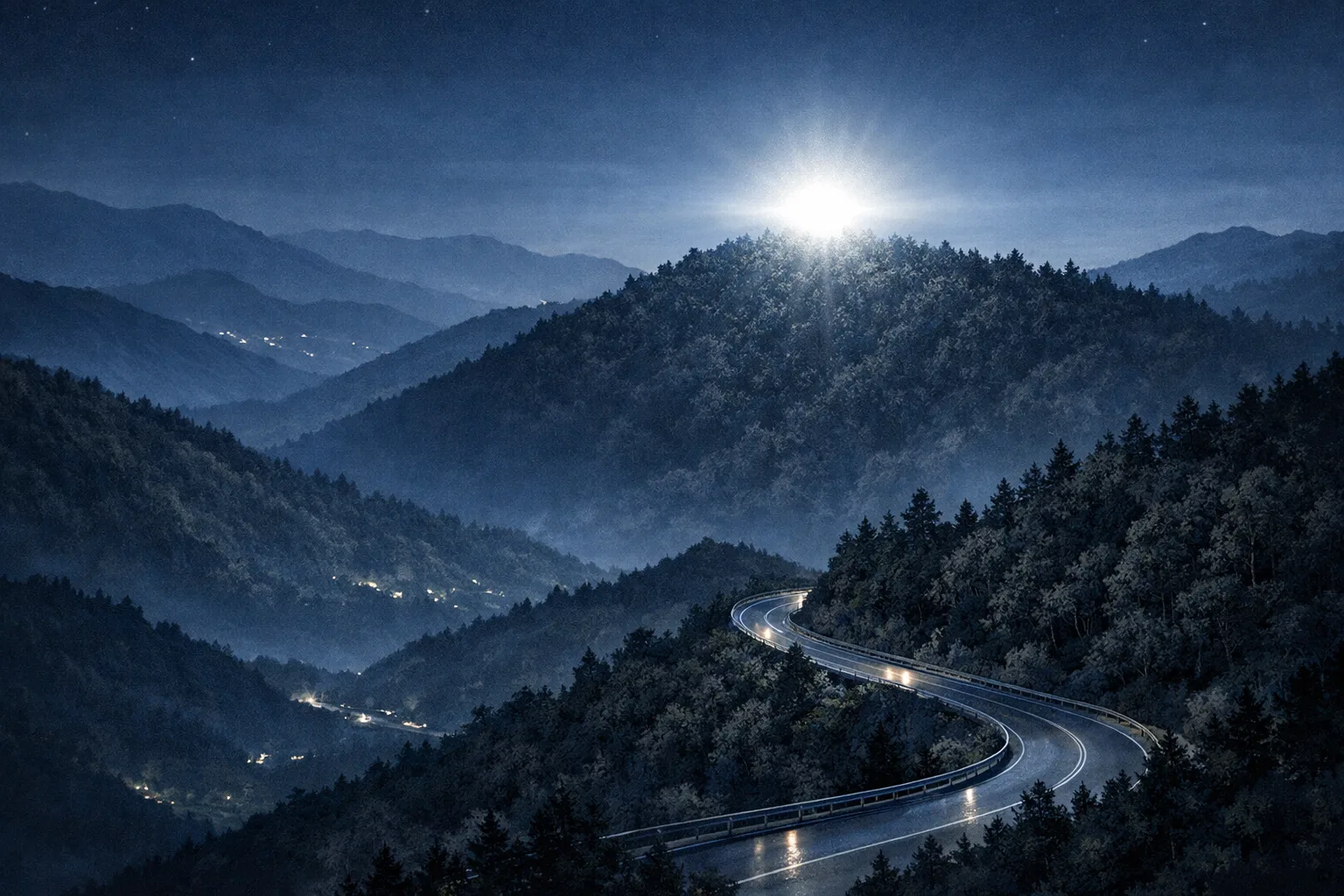
That geography fragments a night-time observation. From a bend in a road, a witness may see only a small portion of another slope. The base of a distant light source can remain hidden while its beam or illuminated mist appears above the skyline. A vehicle following a road on the opposite hillside may be visible for several seconds, disappear behind woodland or rock, and emerge at a different apparent height. To an observer who cannot see the road itself, the sequence can look like a light manoeuvring freely in the air.
Trees add another layer of uncertainty. Branches divide a continuous source into several bright points, while movement by the witness causes openings in the foliage to shift. Headlights seen through gaps may therefore seem to blink, separate or travel sideways. A turn in the road can change both the direction and brightness of the beam without the vehicle making any unusual movement.
The road network is particularly important. Rural routes around Torriglia link settlements positioned at markedly different elevations, frequently doubling back across slopes. A vehicle can consequently appear first below an observer, then vanish and later reappear above the observer’s apparent horizon. The witness sees disconnected segments of its journey, while the hidden road supplies the continuity that is missing from the view.
This is not a special argument invented for Ligurian UFO reports. Reviews of official French investigations have noted cases in which local topography made ordinary vehicle or agricultural lights difficult to recognise. In one discussed example, investigators could not rule out a vehicle turning in a field because the original observation point and terrain had not been documented well enough. The lesson is directly applicable to Torriglia: without a mapped sightline, a light apparently “over the hills” may actually be on them.[Skeptical Inquirer]skepticalinquirer.orgSkeptical InquirerAn Assessment of Thirty Years of Official Studies in Francethe witnesses could have been deceived by the lights of an a…
Why lights seem nearer than they are
A bright point at night contains very little distance information. In daylight, the brain judges range by comparing an object with buildings, trees, surface texture and overlapping features. Darkness removes many of those references. When a witness sees only a light against a dark hillside or sky, there may be no reliable way to decide whether it is a small lamp hundreds of metres away or a powerful source several kilometres away.
Official aviation guidance treats this as a genuine safety problem. The US Federal Aviation Administration warns that a fixed light against a dark, featureless background may appear to move, an effect known as the autokinetic illusion. Small involuntary eye movements are normally interpreted against a stable visual scene. When the scene contains only a single light, the brain can attribute those movements to the light itself.[faa.gov]faa.govOpen source on faa.gov.
Autokinesis does not usually produce the appearance of a detailed craft. It is more relevant to reports of a light hovering, drifting, making short movements or approaching the observer. The effect becomes especially plausible when someone stares at the source for an extended period while trying to decide what it is. A small real movement of the observer’s head or vehicle can reinforce the impression.
Brightness also influences perceived distance. A strong light tends to be interpreted differently from a dim one even when both are equally far away. Colour, haze and glare can further alter that judgement. Transport Canada’s night-flying guidance notes that distance and speed become deceptive when normal ground references disappear, while aviation training materials warn that different brightness levels can make lights at similar ranges appear to occupy different depths.[canada.ca]tc.canada.caHazards Associated with Flying at NightHazards Associated with Flying at Night
This creates a circular problem in UFO testimony. A witness who assumes that a light is close will infer that it is physically small. If the light then crosses a large angle in the field of view, it may appear to be travelling at extraordinary speed. If the witness instead assumes that it is a large object at great distance, the same angular movement implies an even greater velocity. Neither calculation is meaningful until the range has been independently established.
The All-domain Anomaly Resolution Office has illustrated this problem through forced perspective: an unknown featureless object cannot be sized accurately when its distance is also unknown. Comparing it with trees, clouds or buildings does not solve the problem unless investigators first show that the object and the reference feature lie at comparable distances. A light that seems to skim a ridge may actually be far behind it, while one apparently suspended above a valley may be mounted on the opposite slope.[AARO]aaro.milEffect of Forced Perspective and Parallax View on UAPEffect of Forced Perspective and Parallax View on UAP
Roads can manufacture apparent manoeuvres
Movement by the witness is as important as movement by the light. From a travelling car, nearby trees and roadside objects sweep rapidly across the field of view, while distant sources change position much more slowly. This depth cue, called motion parallax, normally helps people understand a scene. When the intermediate landscape is dark or invisible, however, the same effect can make a distant, slow-moving or stationary light appear to move independently.
Modern UAP case analyses have shown how strongly parallax can inflate apparent speed when the observer or camera is moving. Although those studies often concern aircraft sensors rather than motorists, the geometry is the same: the apparent path of a light depends on the motion of the observer, the direction of viewing and the unknown range of the target.[AARO]aaro.milGo Fast Case ResolutionGo Fast Case Resolution
On a winding Ligurian road, the observer’s viewing direction can change sharply even at modest speed. A light that stays fixed over a distant settlement may slide across the windscreen as the car turns. It may appear to pace the vehicle, swing to one side or reverse direction. When the road descends or rises, the source can also seem to climb or drop relative to the ridge.
Several ordinary situations can therefore produce apparently purposeful motion:
- A vehicle rounds a hairpin bend. Its headlights first face the observer, fade as it turns away and later reappear from another direction.
- The observer’s car turns beneath a fixed light. A distant lamp or celestial object shifts across the side window and seems to follow the road.
- A ridge repeatedly masks the source. Disappearance and reappearance are interpreted as rapid departures and returns.
- Moving branches interrupt the beam. Wind or the observer’s motion creates flickering, splitting or sideways jumps.
- Several vehicles use different levels of the same road. Separate lights may be perceived as one object changing position.
None of these possibilities should be assigned automatically. Their importance is that each can be tested against road alignment, timing and the witness’s direction of travel. A claim that a light made impossible turns is much weaker when the route and the sightline were never reconstructed.
Mist, cloud and reflected beams
The Ligurian interior combines high ground, valleys, streams and extensive vegetation—conditions that can favour local fog or low cloud. Italy’s Civil Protection Department notes that fog is encouraged in valleys, basins, humid areas and places close to streams or dense greenery, particularly during autumn and winter.[Rischi Protezione Civile]rischi.protezionecivile.gov.itRischi Protezione Civile Meteo-hydro risk. The phenomenonRischi Protezione Civile Meteo-hydro risk. The phenomenon
Suspended droplets scatter light. A beam that would normally remain invisible can become a luminous cone or diffuse patch, while a lamp behind mist may expand into an apparently large glowing body. As cloud moves across the source, its shape, intensity and edges change. This can make a fixed installation look as though it is pulsing, rotating or changing size.
Broken terrain makes the source still harder to locate. The lamp itself may be screened by a ridge while only the illuminated moisture above it is visible. A witness then sees light where there appears to be no road, house or vehicle. The apparent object can also seem to float clear of the hillside because the dark foreground supplies no scale.
Atmospheric scattering is not a universal explanation for the Torriglia reports, and the surviving public accounts do not provide sufficient weather, visibility and lighting data to test it rigorously for the original Zanfretta incident. It remains a mechanism to examine, not a retrospective solution. The absence of detailed meteorological reconstruction is itself significant: descriptions such as “very bright”, “close” or “above the trees” cannot establish physical position without information about cloud, mist and the local horizon.
Reconstructing a sighting from terrain
A useful investigation begins by separating what the witness directly observed from what was inferred. “A light moved from left to right” is an observation. “A craft flew across the valley at enormous speed” assumes a distance, size and path that may not have been measured.
The first requirement is the precise observing position. Investigators need the relevant road, gate, property or stopping place—not merely “near Torriglia”. Even a shift of a few hundred metres can replace one visible ridge with another. The observer’s height, whether they were standing or seated, and the direction in which a vehicle was facing can also change the reconstructed horizon.
Next comes the line of sight. A reliable field study should record:
- the direction and angular height of the light;
- the ridges, trees, buildings and utility structures visible from that position;
- roads and settlements lying along and behind the sightline;
- the witness’s own movement and every turn made during the observation;
- the times at which the source appeared, vanished or changed direction;
- weather, cloud base, visibility and any wet or reflective surfaces;
- celestial objects, aircraft routes and known ground lighting present at the time.
Photographs taken later are useful only when made from the original position with a known focal length and an unobstructed view. A modern mobile-phone image may help identify the skyline, but it cannot by itself recover where an unidentified point source stood in depth. NASA’s independent UAP study stressed that isolated reports are commonly weakened by absent metadata and non-standardised data collection. GEIPAN, the French official investigation group, similarly uses structured witness questionnaires and supplements testimony with sketches, photographs and other records.[nasa.gov]science.nasa.govScience Independent Study Team ReportScience Independent Study Team Report
The most decisive technique is triangulation. If two independent witnesses saw the same light from well-separated positions and recorded its direction at the same moment, their sightlines may establish its approximate location. Without that separation, distance usually remains uncertain. A large collection of people reporting lights in the same district is therefore less valuable than two properly timed observations with known bearings.
A reconstruction should also repeat the journey under comparable conditions. Driving the route at the same time of night can reveal lamps that appear only at particular bends, headlights on opposite slopes and gaps through which distant settlements become visible. Such a test cannot reproduce every historical condition, but it may show that an apparently airborne trajectory aligns closely with a road or ridge.
What terrain does—and does not—explain
Mountain misperception offers a strong explanation for some recurring features of Ligurian night sightings: lights that hover without a clear outline, objects whose estimated size varies greatly between accounts, sudden disappearances behind woodland and apparently rapid changes of direction observed from moving vehicles. It also explains why witness sincerity and observational accuracy can diverge. A person may accurately remember being frightened by an extraordinary-looking light while remaining mistaken about its distance or motion.
The mechanism is less useful where a report contains independently documented close-range structure, physical interaction or reliable measurements from multiple locations. Terrain cannot by itself explain every claim attached to the Zanfretta narrative, particularly the later descriptions of beings and alleged abduction experiences. Those elements have separate evidential problems involving memory, hypnosis and the growth of the story after the initial incident.
Nor does a plausible mechanism prove that a particular light was a car, lamp, star or aircraft. For the December 1978 event, publicly accessible summaries do not provide a sufficiently detailed terrain-and-light reconstruction to identify the original lights with confidence. The responsible classification is therefore narrower: the mountainous setting makes estimates of range and movement unreliable, and the surviving accounts do not appear to overcome that limitation.
This distinction is central to understanding Liguria’s UFO history. “Unidentified” may describe a genuine failure to determine which ordinary source produced a light. It does not automatically describe an object demonstrating extraordinary technology. Around Torriglia, the landscape itself ensures that some observations will remain uncertain long after the light has disappeared.
Amazon book picks
Further Reading
Books and field guides related to How Liguria's Hills Distort Night Sightings. Use these as the next step if you want deeper reading beyond the article.
The UFO Experience
Cited by the New York Review of Books as “the best brief for visitation,” this classic study presents an analysis of UFO reports and conc...
The Demon-Haunted World
NEW YORK TIMES BESTSELLER • From the renowned astronomer and author of Cosmos comes a “powerful [and] stirring defense of informed ration...
The Believing Brain
Synthesizing thirty years of research, psychologist and science historian, Michael Shermer upends the traditional thinking about how huma...
eBay marketplace picks
Marketplace Samples
Live-tested eBay searches with available results related to this page.
Selected fromUFO poster oneBay.co.uk.
Current eBay listing
I Want To Believe UFO Poster Giclée Fine Art Heavyweight Print

Current eBay listing
VINTAGE UFO FLYING SAUCERS COMIC ADVERTISING A2 POSTER PRINT
Endnotes
1.
Source: italia.it
Title: Oneglia, village in Liguria: things to do
Link:https://www.italia.it/en/liguria/torriglia
Source snippet
Centre of the upper Trebbia Valley, it is located in a basin dominated by Mount Prelà and rich in spring waters that give rise to the Lac...
2.
Source: treccani.it
Link:https://www.treccani.it/enciclopedia/torriglia_%28Enciclopedia-Italiana%29/
Source snippet
s. m., alle sorgenti della Scrivia, in una vallata circondata da una corona di montagne, che offrono numerose escursioni.Torriglia, che è...
3.
Source: faa.gov
Link:https://www.faa.gov/pilots/safety/pilotsafetybrochures/media/spatiald_visillus.pdf
4.
Source: tc.canada.ca
Title: Hazards Associated with Flying at Night
Link:https://tc.canada.ca/en/aviation/publications/system-safety-summer-briefing-kit-tp-14112/hazards-associated-flying-night-powerpoint-presentation
5.
Source: aaro.mil
Title: Effect of Forced Perspective and Parallax View on UAP
Link:https://www.aaro.mil/Portals/136/PDFs/Information%20Papers/AARO_Effect_of_Forced_Perspective_and_Parallax_View_on_UAP_Observations_2024.pdf
6.
Source: aaro.mil
Title: Go Fast Case Resolution
Link:https://www.aaro.mil/Portals/136/PDFs/case_resolution_reports/AARO_GoFast_Case_Resolution_Card_Methodology_Final.pdf
7.
Source: aaro.mil
Title: Puerto Rico UAP Case Resolution
Link:https://www.aaro.mil/Portals/136/PDFs/case_resolution_reports/AARO_Puerto_Rico_UAP_Case_Resolution.pdf
8.
Source: science.nasa.gov
Title: Science Independent Study Team Report
Link:https://science.nasa.gov/wp-content/uploads/2023/09/uap-independent-study-team-final-report.pdf
9.
Source: cnes.fr
Link:https://cnes.fr/en/projects/geipan
10.
Source: geoportale-priv.regione.liguria.it
Title: regione.liguria.it Carta Tipi Forestali
Link:https://geoportale-priv.regione.liguria.it/servizi/rete-gnss-liguria/approfondimenti/item/901-carta-tipi-forestali.html
11.
Source: geoportale-priv.regione.liguria.it
Title: regione.liguria.it Foreste del patrimonio regionale
Link:https://geoportale-priv.regione.liguria.it/component/k2/item/656-foreste-del-patrimonio-regionale.html
12.
Source: dati.regione.liguria.it
Title: regione.liguria.it Open Data
Link:https://dati.regione.liguria.it/dataset/ds-276
13.
Source: dati.regione.liguria.it
Title: regione.liguria.it Open Data
Link:https://dati.regione.liguria.it/en/dataset/ds-276
14.
Source: geoportal.regione.liguria.it
Title: regione.liguria.it Uso del suolo e tipi forestali
Link:https://geoportal.regione.liguria.it/progetti/uso-del-suolo-e-tipi-forestali.html
15.
Source: regione.liguria.it
Link:https://www.regione.liguria.it/homepage-opendata/opendata-per-tipo/opendata-cartografia/item/40801-land-cover.html
16.
Source: regione.liguria.it
Link:https://www.regione.liguria.it/homepage-opendata/opendata-per-tipo/opendata-cartografia/item/43711-tipi-forestali-liguria-2025.html
17.
Source: srvcarto.regione.liguria.it
Link:https://srvcarto.regione.liguria.it/geoviewer2/pages/apps/ambiente-tematiche/index.html?canale=11
18.
Source: geoportale-priv.regione.liguria.it
Title: regione.liguria.it Uso del suolo e tipi forestali
Link:https://geoportale-priv.regione.liguria.it/progetti/uso-del-suolo-e-tipi-forestali.html
19.
Source: aaro.mil
Link:https://www.aaro.mil/UAP-Cases/Official-UAP-Imagery/
20.
Source: italia.it
Title: Torriglia, borgo in Liguria: cosa vedere
Link:https://www.italia.it/it/liguria/torriglia
21.
Source: italia.it
Title: Torriglia, uma aldeia na Ligúria: o que ver
Link:https://www.italia.it/pt/liguria/torriglia
22.
Source: italia.it
Title: Torriglia, village en Ligurie: que voir
Link:https://www.italia.it/fr/ligurie/torriglia
23.
Source: italia.it
Link:https://www.italia.it/de/ligurien/torriglia
24.
Source: en-gb.topographic-map.com
Link:https://en-gb.topographic-map.com/map-8j86z4/Torriglia/
Source snippet
Topographic mapsTorriglia topographic map, elevation, terrainAverage elevation: 858 m. Average elevation: 858 m Minimum elevation: 427 m...
25.
Source: elevationmap.net
Title: Elevation Map Canova, Torriglia, Genova, Italia on the Elevation Map
Link:https://elevationmap.net/canova-torriglia-genova-it-1012673555
Source snippet
Topographic Map of Canova, Torriglia, Genova, Italia.Marzano, Torriglia, Genova Elevation on Map - 2.27 km/1.41 mi - Marzano on map Eleva...
26.
Source: skepticalinquirer.org
Link:https://skepticalinquirer.org/wp-content/uploads/sites/29/2009/01/p47.pdf?ref=thegalacticmind.com
Source snippet
Skeptical InquirerAn Assessment of Thirty Years of Official Studies in Francethe witnesses could have been deceived by the lights of an a...
27.
Source: faasafety.gov
Link:https://www.faasafety.gov/files/events/SO/SO15/2024/SO15134204/YourSensesInTheShadows.pdf
28.
Source: atsb.gov.au
Link:https://www.atsb.gov.au/sites/default/files/2024-05/FAA-H-8083-3B%20Chapter%2010.pdf
29.
Source: lba-openuav.de
Title: human perception
Link:https://lba-openuav.de/en/human-performance/human-perception/
30.
Source: rischi.protezionecivile.gov.it
Title: Rischi Protezione Civile Meteo-hydro risk. The phenomenon
Link:https://rischi.protezionecivile.gov.it/en/meteo-hydro/events/
31.
Source: wikiloc.com
Link:https://www.wikiloc.com/hiking-trails/marzano-torriglia-140507851
32.
Source: geodati.gov.it
Title: r liguri:D.2188
Link:https://geodati.gov.it/resource/id/r_liguri%3AD.2188
33.
Source: Wikipedia
Link:https://en.wikipedia.org/wiki/Torriglia
34.
Source: Wikipedia
Link:https://en.wikipedia.org/wiki/GEIPAN
35.
Source: Wikipedia
Link:https://en.wikipedia.org/wiki/Parallax
36.
Source: parcoantola.it
Link:https://www.parcoantola.it/comuni-dettaglio.php?id=10062
37.
Source: isprambiente.gov.it
Link:https://www.isprambiente.gov.it/it/attivita/museo/regioni/musei/parco-naturale-regionale-dellantola
38.
Source: elevationmap.net
Link:https://elevationmap.net/rossi-lumarzo-genova-it-1012622472
39.
Source: casa.gov.au
Link:https://www.casa.gov.au/sites/default/files/2021-06/safety-behaviours-human-factor-for-pilots-9-human-information-processing.pdf
40.
Source: inalto.org
Link:https://www.inalto.org/en/points-of-interest/Torriglia
41.
Source: cittametropolitana.genova.it
Link:https://www.cittametropolitana.genova.it/it/comune/torriglia
42.
Source: maps.apple.com
Link:https://maps.apple.com/place?auid=11362465239164742785
Additional References
43.
Source: parks.it
Link:https://www.parks.it/parco.antola/Epar.php
Source snippet
* PA Official List: EUAP0965... * Zona Speciale di Conservazione Parco dell'Antola... Antola valleys are also an ideal place to practic...
44.
Source: Wikipedia
Title: Zanfretta UFO Incident
Link:https://en.wikipedia.org/wiki/Zanfretta_UFO_Incident
Source snippet
The Zanfretta UFO incident was an alleged alien encounter that occurred on 6 December 1978 near the town of Torriglia, with an extremely...
Published: December 1978
45.
Source: war.gov
Link:https://www.war.gov/medialink/ufo/release_1/255_413270_ufo%27s_and_defense_what_should_we_prepare_for.pdf
46.
Source: cia.gov
Link:https://www.cia.gov/readingroom/document/cia-rdp81r00560r000100010001-0
47.
Source: academia.edu
Link:https://www.academia.edu/104742302/60_YEARS_OF_NEGLECTED_EVIDENCE_ANALYSIA_OF_GLOBAL_HUMANOID_ENCOUNTER_REPORTS
48.
Source: researchgate.net
Link:https://www.researchgate.net/publication/278390344Instrumented_Monitoring_of_Aerial_Anomalies-_A_Scientific_Approach_to_the_Investigation_On_Anomalous_Atmospheric_Light_Phenomena
49.
Source: researchgate.net
Link:https://www.researchgate.net/publication/23233342_Visual_Misperception_in_Aviation_Glide_Path_Performance_in_a_Black_Hole_Environment
50.
Source: researchgate.net
Link:https://www.researchgate.net/figure/The-halo-effect-of-car-lights-as-seen-through-third-generation-night-vision-goggles_fig5_258183090
51.
Source: facebook.com
Link:https://www.facebook.com/groups/SeeLifeThroughLens/posts/10163070127806113/
52.
Source: instagram.com
Link:https://www.instagram.com/reel/DQZ2mlxkUzB/