Within Aosta Valley
When Bright Sky Events Became UFO Reports
Several dramatic regional sightings fit known fireballs, meteors or falling space debris better than controlled aircraft.
On this page
- The 1947 luminous trail
- The 1967 Cosmos debris explanation
- The likely fireball of December 1985
Page outline Jump by section
Introduction
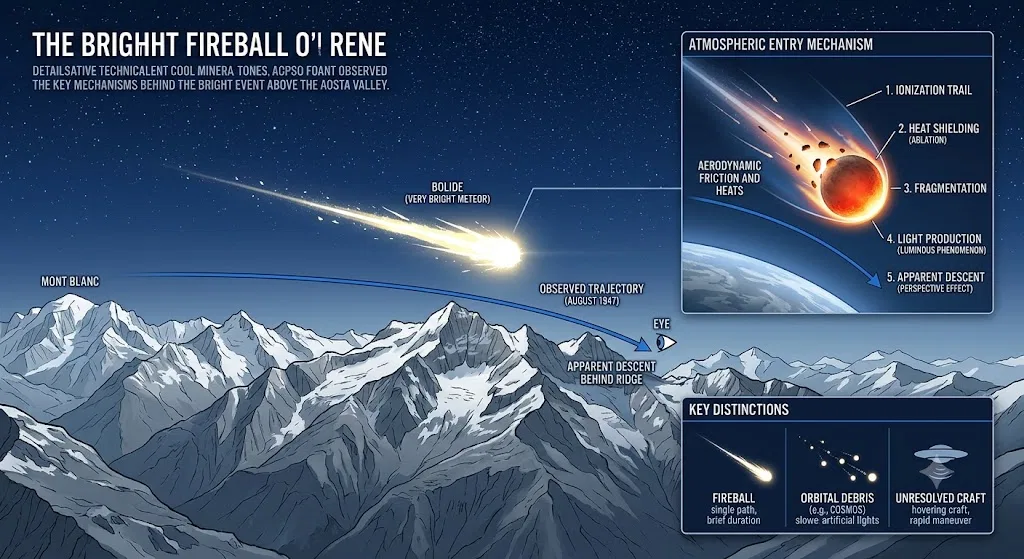
Several of Aosta Valley’s most dramatic “UFO” reports are better understood as bright objects burning through the upper atmosphere than as controlled aircraft. The strongest candidates are the luminous trail recorded in August 1947, an event in 1967 later associated with Soviet Cosmos debris, and a fast, fiery light seen in December 1985. In each case, the surviving descriptions emphasise a trail, glow or apparent fall rather than hovering, repeated manoeuvres or a clearly structured craft.
That distinction matters because meteors and re-entering space hardware can produce exactly the features that witnesses find most extraordinary: intense colours, fragmentation, silent-looking movement followed by delayed sound, and an apparent descent behind a mountain. Aosta Valley’s steep horizons make distance and altitude especially difficult to judge. The available records do not prove a natural explanation in every detail, but they substantially weaken claims that these events demonstrated unusual vehicles operating over the region.[valledaostaglocal.it]valledaostaglocal.itufo dal 1947 ad oggi circa 80 avvistamenti in valleTornando alla Valle d'Aosta, nell'agosto 1947 una grande scia luminosa solcò i cieli da Pont Saint Martin al Monte Bianco transitando in…
The 1947 luminous trail
The earliest incident regularly included in Aosta Valley UFO chronologies occurred in August 1947. According to a regional retrospective published in 2014, a large luminous trail crossed the valley from the direction of Pont-Saint-Martin towards Mont Blanc, travelling broadly east to west. Later summaries associate the observation with technicians connected to the Cogne industrial works, although a detailed contemporary report, precise time and original witness statements are not readily available online.[AostaCronaca]valledaostaglocal.itufo dal 1947 ad oggi circa 80 avvistamenti in valleTornando alla Valle d'Aosta, nell'agosto 1947 una grande scia luminosa solcò i cieli da Pont Saint Martin al Monte Bianco transitando in…
What survives is therefore a description of a trail across a large section of sky, not a close-range object whose shape, construction or movements were clearly observed. That profile is compatible with a fireball: an unusually bright meteor produced when a small natural body enters the atmosphere at high speed. The American Meteor Society defines a fireball as a meteor brighter than Venus; particularly energetic examples, sometimes called bolides, may end in a brilliant flash or visible fragmentation.[American Meteor Society]amsmeteors.orgAmerican Meteor Society FireballsAmerican Meteor SocietyFireballs - American Meteor Society…
A fireball can appear to travel horizontally even while descending through the atmosphere. Its true path may extend for tens or hundreds of kilometres, but perspective compresses that distance against the sky. In a narrow Alpine valley, peaks also hide the lower part of the trajectory, encouraging the impression that the object has crossed between mountains or fallen immediately beyond a ridge.
The reported east-to-west direction is useful but not decisive. Meteors may arrive from almost any apparent direction, whereas most artificial satellites follow more restricted orbital paths. Direction alone cannot identify the 1947 event because the account lacks an exact time, angular positions and observations from separated locations. Those are the measurements needed to reconstruct a trajectory reliably.
The most defensible assessment is therefore plausibly astronomical but not conclusively identified. The surviving evidence does not justify treating the trail as a controlled craft, yet it is too sparse to match confidently with a particular meteor or other atmospheric event. Its importance in the regional story lies partly in its date: 1947 was the year in which “flying saucers” entered international popular culture, making a striking but otherwise familiar sky phenomenon more likely to be remembered retrospectively as a UFO sighting.
The 1967 Cosmos debris explanation
The 1967 case is more significant because later accounts reportedly supplied a technological explanation: debris connected with a Soviet Cosmos space mission. The Cosmos name was applied to a wide range of Soviet spacecraft, including reconnaissance satellites, experimental vehicles and failed missions. Many operated in low Earth orbit, where spacecraft bodies, rocket stages and discarded components eventually returned to the atmosphere.
A regional chronology treats the Aosta Valley event as an example in which an initially unexplained spectacle was subsequently linked to falling space material. However, the accessible summaries do not clearly identify the spacecraft number, the exact date or the documentary chain by which the identification was made. That gap is important. “Cosmos debris” may be a correct conclusion preserved from a contemporary investigation, but without orbital data or an original technical report it should not be repeated as a fully verified match.
The mechanism itself is entirely credible. During re-entry, a satellite or rocket body encounters increasingly dense air at orbital speed. Heating and mechanical stress cause components to break apart, producing a procession of bright fragments. Unlike a compact meteor, which often lasts only a few seconds, artificial debris can cross the sky more slowly and may resemble a formation of separate lights travelling together.
Typical clues favouring re-entry include:
- several luminous pieces following the same track;
- a relatively slow passage lasting tens of seconds or longer;
- repeated fragmentation without sudden changes of direction;
- a broad, shallow path across much of the sky;
- visibility over a wide geographical area.
Modern monitoring organisations can often predict or reconstruct such events from orbital observations. The European Union Space Surveillance and Tracking network, for example, narrows re-entry windows by combining measurements from multiple sensors, while the European Space Agency publishes analyses of major atmospheric entries. Recent monitoring of the Soviet-era Cosmos 482 capsule illustrates how an apparently alarming object can be tracked as an uncontrolled re-entry rather than an unknown vehicle.[esa.int]blogs.esa.intreentry prediction soviet era venera venus lander cosmos 482 descent craftESA BlogReentry prediction Soviet-era Venera Venus lander (Cosmos…7 May 2025 — On 10 May, an uncontrolled reentry will take place of t…
No equivalent public data trail has yet been located for the Aosta Valley report from 1967. Consequently, this case should be described as probably explained in the regional literature, but incompletely documented in accessible sources. It is stronger than a speculative meteor suggestion because a specific category of artificial object was reportedly proposed, yet weaker than a modern re-entry identification supported by radar, orbital elements and observations from several countries.
The episode also corrects a common misconception about UFO reports. An object may genuinely have come from space without being extraterrestrial technology in the sensational sense. By the late 1960s, human space activity had added a new source of extraordinary lights to the night sky. Soviet missions were secretive by design, and information about failures or decaying hardware was not always immediately available to observers in Western Europe. A confusing initial report was therefore unsurprising.
The likely fireball of December 1985
A December 1985 sighting in Aosta Valley has also been interpreted as a likely fireball. The surviving regional reference is again brief, and the absence of an exact date, duration and original witness documentation prevents a firm identification. Even so, a fiery object moving on a continuous path is more consistent with a meteor than with an aircraft, particularly when there is no reliable evidence of hovering or deliberate course changes.
December is a period of substantial meteor activity. The Geminid meteor shower is active during the first half of the month and normally peaks around 13–14 December. Geminids can be bright and strongly coloured, although a single December fireball need not belong to that shower; sporadic meteoroids enter the atmosphere throughout the year. Without a precise date and reconstructed radiant—the point in the sky from which the meteor appeared to originate—linking the Aosta Valley observation specifically to the Geminids would be conjecture.[In-The-Sky.org]in-the-sky.orgGeminid meteor shower 1985December 10, 1985 — 14 Dec 1985 — The Geminid meteor shower will be active from 4 December to 17 December, prod…
Modern Italian observations show how such an incident would be investigated today. The PRISMA fireball network, established in 2016, uses all-sky cameras across Italy to record bright meteors from several locations. By comparing the images, researchers can calculate altitude, speed, atmospheric trajectory and the object’s earlier orbit around the Sun. The network has supported meteorite recoveries, including the Cavezzo fall, and has transformed eyewitness spectacles into measurable events.[unitn.it]pugno.dicam.unitn.itOpen source on unitn.it.
Comparable studies demonstrate why human estimates alone are unreliable. A bright 2017 fireball over north-eastern Italy was reconstructed from camera observations as beginning at roughly 81 kilometres altitude and remaining visible down to about 23 kilometres. A 1993 bolide over northern Italy produced an atmospheric explosion and shock waves detected by seismic stations. Events at such heights can appear close to mountains even when they are actually hundreds of kilometres from an observer.[arXiv]arxiv.orgOpen source on arxiv.org.
The 1985 report is therefore best classified as probably a fireball, but not tied to a confirmed astronomical record. That conclusion is more cautious than calling it solved. It recognises that its reported behaviour fits a well-established natural mechanism while acknowledging that the historical evidence is inadequate for a precise reconstruction.

Why mountains make the events harder to judge
Aosta Valley’s landscape does not create meteors or satellite re-entries, but it strongly affects how they are perceived. Observers usually see only a narrow portion of sky bounded by steep ridges. An object may disappear abruptly behind a summit, creating the impression that it landed nearby. In reality, a fireball can remain tens of kilometres above the ground when it passes beyond the visible horizon.
Distance is especially difficult to estimate at night because there are few familiar reference points. Brightness is easily mistaken for proximity: a very luminous meteor far away can look like a smaller object just above the mountains. Likewise, a long atmospheric trail may be interpreted as exhaust, a beam or the illuminated body of an elongated craft.
Sound can add further confusion. Light from a high-altitude fireball reaches witnesses almost immediately, while a sonic boom or explosion arrives later. If the observer does not connect the delayed noise with the earlier light, the two may be reported as separate events. Conversely, complete silence does not indicate an advanced propulsion system; the object may simply be too distant for sound to have arrived during the observation.
Apparent motion is also deceptive. A meteor approaching partly along the observer’s line of sight can seem unusually slow or almost stationary before suddenly brightening. Fragmentation may resemble multiple objects separating in formation. Satellite debris can produce an even more organised procession, with several glowing pieces maintaining a common direction and speed.
What separates a fireball from a harder UFO case?
Historical reports cannot be assessed by vividness alone. Investigators need details that allow competing explanations to be tested. The Italian Air Force’s present reporting system asks for information that can be checked against natural phenomena and human activity. Reports are investigated for such correlations and remain classified as unidentified only when no technical or natural justification can be established from the available evidence.[Aeronautica Militare]aeronautica.difesa.itAeronautica Militare OVNIAeronautica MilitareOVNI - Aeronautica Militare…
For suspected meteors or re-entries, the most useful questions are concrete:
- How long was it visible? A few seconds commonly favours a meteor; a slow fragmentation lasting much longer may favour orbital debris.
- Did it follow one continuous path? Straight or gently curving motion fits an uncontrolled atmospheric entry better than repeated stops or reversals.
- Was there fragmentation? Both meteors and re-entering spacecraft can break up, but a long train of similarly moving pieces is particularly characteristic of artificial debris.
- How many places reported it? A bright event observed across several regions is probably high and distant, not a local object among the mountains.
- Do the time and direction match orbital or meteor-camera data? Independent measurements can turn a plausible explanation into a strong identification.
- Was the object itself resolved? A point of light or glowing trail provides much less evidence for a craft than a sustained, clearly observed structure.
Applied to Aosta Valley, these criteria place the 1947 and 1985 reports in the plausibly explained category rather than among the region’s stronger unresolved cases. The 1967 event may be closer to an identification, but the public record does not yet provide enough detail to audit the Cosmos attribution fully.
A pattern of misidentification, not fabrication
Explaining these incidents as meteors or space debris does not imply that witnesses invented them. Fireballs are real, rare enough to be memorable and capable of producing genuinely startling displays. Re-entering spacecraft are also real technological objects, sometimes visible over enormous areas. The witnesses may have described unusual sights accurately while lacking the information needed to identify their cause.
This distinction is central to Aosta Valley’s UFO history. The region’s broad sighting chronologies combine unresolved observations with incidents that are weakly documented and others that fit known mechanisms. A report can begin as a UFO in the literal sense—something not immediately identified—and later lose that status when astronomical records, orbital calculations or comparison with similar events provide a better explanation.
The three sky-debris cases therefore do not establish unusual aerial activity over the valley. Instead, they show how spectacular natural and human-made entries into the atmosphere became part of regional UFO memory. The 1947 trail remains suggestive of a meteor but poorly documented; the 1967 event carries a plausible Cosmos debris explanation whose original evidence is difficult to inspect; and the December 1985 light is most reasonably treated as a probable fireball. Together they strengthen the case for careful reconstruction rather than extraordinary interpretation.
Amazon book picks
Further Reading
Books and field guides related to When Bright Sky Events Became UFO Reports. Use these as the next step if you want deeper reading beyond the article.
Meteorites: The Story of Our Solar System
Meteorite tells the fascinating story of the stones from outer space scattered across our planet. From the impact that finished off the d...
The Cambridge Encyclopedia of Meteorites
Beautifully illustrated with over 140 full colour images, The Cambridge Encyclopedia of Meteorites provides a thorough guide to these fas...
The Heavens on Fire: The Great Leonid Meteor Storms
Highly readable account of meteors, especially the spectacular Leonid showers, due in mid-November.
Meteor Showers and their Parent Comets
Meteor Showers and their Parent Comets is a unique handbook for astronomers interested in observing meteor storms and outbursts. Spectacu...
eBay marketplace picks
Marketplace Samples
Live-tested eBay searches with available results related to this page.
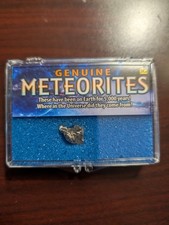
Selected frommeteorite display specimen oneBay.co.uk.


Endnotes
1.
Source: blogs.esa.int
Title: reentry prediction soviet era venera venus lander cosmos 482 descent craft
Link:https://blogs.esa.int/rocketscience/2025/05/07/reentry-prediction-soviet-era-venera-venus-lander-cosmos-482-descent-craft/
Source snippet
ESA BlogReentry prediction Soviet-era Venera Venus lander (Cosmos...7 May 2025 — On 10 May, an uncontrolled reentry will take place of t...
Published: May 2025
2.
Source: in-the-sky.org
Link:https://in-the-sky.org/news.php?id=19851214
Source snippet
Geminid meteor shower 1985December 10, 1985 — 14 Dec 1985 — The Geminid meteor shower will be active from 4 December to 17 December, prod...
Published: December 10, 1985
3.
Source: arxiv.org
Link:https://arxiv.org/abs/1911.09555
4.
Source: arxiv.org
Link:https://arxiv.org/abs/astro-ph/9805124
5.
Source: cosmos.so
Link:https://www.cosmos.so/gingerrulez/f-t-valle-d-aosta
6.
Source: esa.int
Title: ESA analysing fireball over Europe on 8 March 2026
Link:https://www.esa.int/Space_Safety/Planetary_Defence/ESA_analysing_fireball_over_Europe_on_8_March_2026
Published: March 2026
7.
Source: esa.int
Link:https://www.esa.int/ESA_Multimedia/Videos/2026/03/Fireball_over_Europe_8_March_2026
8.
Source: space.com
Title: failed soviet venus lander kosmos 482 crashes to earth after 53 years in orbit
Link:https://www.space.com/space-exploration/launches-spacecraft/failed-soviet-venus-lander-kosmos-482-crashes-to-earth-after-53-years-in-orbit
9.
Source: valledaostaglocal.it
Title: ufo dal 1947 ad oggi circa 80 avvistamenti in valle
Link:https://www.valledaostaglocal.it/2014/03/01/leggi-notizia/argomenti/attualita-2/articolo/ufo-dal-1947-ad-oggi-circa-80-avvistamenti-in-valle.html
Source snippet
Tornando alla Valle d'Aosta, nell'agosto 1947 una grande scia luminosa solcò i cieli da Pont Saint Martin al Monte Bianco transitando in...
10.
Source: amsmeteors.org
Title: American Meteor Society Fireballs
Link:https://www.amsmeteors.org/fireballs/
Source snippet
American Meteor SocietyFireballs - American Meteor Society...
11.
Source: aeronautica.difesa.it
Title: Aeronautica Militare OVNI
Link:https://www.aeronautica.difesa.it/ovni/
Source snippet
Aeronautica MilitareOVNI - Aeronautica Militare...
12.
Source: eusst.eu
Title: its re-entry window to 10 May in the morning
Link:https://www.eusst.eu/newsroom/news/eu-sst-closely-monitors-re-entry-space-object-cosmos-482-descent-craft
Source snippet
EU SSTEU SST closely monitors re-entry of space object Cosmos-...13 May 2025 — Cosmos-482 Descent Craft, a Soviet-era spacecraft launche...
Published: May 2025
13.
Source: pugno.dicam.unitn.it
Link:https://pugno.dicam.unitn.it/NP_PDF/510-MNRAS21-Cavezzo-the-first-Italian-PRISMA-fireball.pdf
14.
Source: imo.net
Title: new year italian meteorite recovered
Link:https://www.imo.net/new-year-italian-meteorite-recovered/
15.
Source: fireball.amsmeteors.org
Title: browse reports
Link:https://fireball.amsmeteors.org/members/imo_view/browse_reports
16.
Source: amsmeteors.org
Title: daylight fireball over central new york
Link:https://www.amsmeteors.org/2020/12/daylight-fireball-over-central-new-york/
Additional References
17.
Source: isprambiente.gov.it
Title: ISPRACosmos 482 spacecraft re-enters the atmosphere
Link:https://www.isprambiente.gov.it/en/news/cosmos-482-spacecraft-re-enters-the-atmosphere
Source snippet
ISPRAThe first orbit will pass over Italy between 5:03 and 5:04 on May 10, flying over portions of Sardinia and the regions of Central It...
18.
Source: youtube.com
Title: Is This Footage Proof That Shapeshifting UFOs Threaten US Military?
Link:https://www.youtube.com/watch?v=NI_UMzXh26k
Source snippet
The Kecksburg UFO Mystery: Secrets, Witnesses and Vanished Evidence...
19.
Source: youtube.com
Title: The Kecksburg UFO Mystery: Secrets, Witnesses and Vanished Evidence
Link:https://www.youtube.com/watch?v=vkZszbMzl3Q
Source snippet
UFO Encounters In Europe | Never-Seen-Before Evidence...
20.
Source: youtube.com
Title: UFO Encounters In Europe | Never-Seen-Before Evidence!
Link:https://www.youtube.com/watch?v=n7FS9BXBa8E
Source snippet
CLEAREST UFO Footage EVER FILMED? Inside The Italian Alien Stalker Case...
21.
Source: youtube.com
Title: Fascist UFOs
Link:https://www.youtube.com/watch?v=ojvSWFiJiec
Source snippet
Is This Footage Proof That Shapeshifting UFOs Threaten US Military?...
22.
Source: ideamagazine.net
Link:https://www.ideamagazine.net/it/news/nmosit_archives.htm
23.
Source: archeologando.com
Link:https://archeologando.com/author/stellavittoria/page/8/
24.
Source: summitpost.org
Link:https://www.summitpost.org/but-the-ufo-are-also-in-mountain/926971
25.
Source: instagram.com
Link:https://www.instagram.com/reel/C7OKabuP129/?hl=en
26.
Source: abcnews.com
Link:https://abcnews.com/Technology/failed-soviet-era-spacecraft-expected-crash-back-earth/story?id=121533765