Within Piedmont UFO Files
How Turin's Archives Changed Piedmont UFO History
Turin's civilian researchers preserved testimony and press records that allowed famous Piedmont cases to be checked rather than merely repeated.
On this page
- The rise of civilian UFO research in Turin
- What the archives preserve
- How old cases changed under re examination
Page outline Jump by section
Introduction
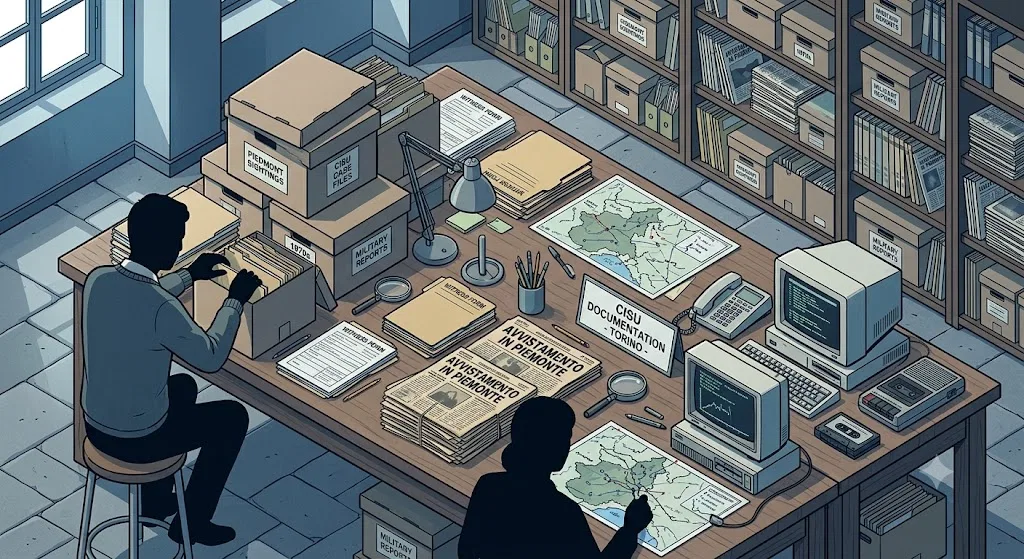
Turin changed Piedmont’s UFO history less by producing spectacular sightings than by preserving the paperwork needed to test them. From a small office opened by local researchers in 1979, the city developed into the headquarters of the Centro Italiano Studi Ufologici (CISU), a volunteer association founded in 1985. Its collections bring together witness statements, investigation reports, newspaper cuttings, books, specialist periodicals, photographs, military material and thematic case files. That documentation allows researchers to compare what witnesses originally said with what newspapers and later UFO literature claimed.[CISU - Centro Italiano Studi Ufologici]cisu.orgCentro Italiano Studi Ufologici Sede ed archivi centraliCentro Italiano Studi UfologiciSede ed archivi centrali - CISU - Centro Italiano Studi Ufologici…
This matters because famous UFO stories often change as they are retold. Separate observations become merged, uncertain details acquire false precision, and an unresolved light may eventually be described as an extraordinary craft. CISU’s contribution has been to retain earlier versions of the evidence, organise reports geographically and thematically, and revisit cases without assuming that “unidentified” means extraterrestrial. Its archive does not prove that the remaining unexplained reports are exotic. It makes clearer which claims are well documented, which have plausible ordinary explanations and which survive only as weakly sourced legends.
The rise of civilian UFO research in Turin
Turin already had an active UFO community before CISU existed. In the 1960s, local researcher Gianni Settimo founded the specialist magazine Clypeus, helping to establish the city as a centre of Italian UFO publishing. A younger generation of investigators became active during the 1970s, when Italy experienced rapid growth in local UFO groups and an exceptional national wave of reports in 1978. Many of those groups enthusiastically collected stories but lacked common investigation standards or durable archives.[Corriere Torino]torino.corriere.itCorriere TorinoTorino, una città di ufologi con i piedi per terra- Corriere.it…
The decisive practical step came in the summer of 1979. Members of the Turin section of the Centro Ufologico Nazionale rented a roughly 35-square-metre office in the south of the city, paying for it themselves. Instead of keeping private collections in individual homes, they pooled books, case reports and press material in one working headquarters. By 1981, the Turin group had taken responsibility for the national organisation’s central documentation bank and secretariat. Investigations, meetings, exhibitions and publications were increasingly organised around the archive rather than around occasional public lectures or sky watches.[CISU - Centro Italiano Studi Ufologici]cisu.orgCentro Italiano Studi Ufologici Sede ed archivi centraliCentro Italiano Studi UfologiciSede ed archivi centrali - CISU - Centro Italiano Studi Ufologici…
This approach reflected a wider change in European UFO research. Researchers influenced by figures such as astronomer J. Allen Hynek and by France’s official GEPAN investigation service argued that the starting point should be structured collection of observations, not an effort to prove that flying saucers were alien spacecraft. The Turin team developed a field-investigation manual intended to standardise interviews and reports, so that basic information such as time, direction, duration, weather, witness position and possible conventional stimuli would not be lost.[CISU - Centro Italiano Studi Ufologici]cisu.orgufology in the 1970sCentro Italiano Studi UfologiciUFOLOGY IN THE 1970s - CISU - Centro Italiano Studi Ufologici…
Disagreements over objectives and organisation led 34 members of the national centre to form CISU in Turin on 15 December 1985. The new association stated that its priorities were to investigate reports, encourage scientifically informed study, circulate information, coordinate data collection and preserve Italian UFO documentation. It also adopted an ethical code stressing respect and privacy for witnesses—a significant issue in a field where publicity can expose people to ridicule or encourage the embellishment of their experiences.[CISU - Centro Italiano Studi Ufologici]cisu.orgCentro Italiano Studi Ufologici Torino ArchiviCentro Italiano Studi UfologiciTorino Archivi - CISU - Centro Italiano Studi Ufologici…
Turin’s physical headquarters gave these aims continuity. Weekly meetings have continued for decades, allowing volunteers to sort incoming reports, compare cases and maintain specialist catalogues. In 2002, the collection moved to much larger premises in Via Rubino. CISU describes the present headquarters as approximately 187 square metres including archive space, with shelving extending for nearly 300 linear metres.[CISU - Centro Italiano Studi Ufologici]cisu.orgCentro Italiano Studi Ufologici Sede ed archivi centraliCentro Italiano Studi UfologiciSede ed archivi centrali - CISU - Centro Italiano Studi Ufologici…
What the archives preserve
The most important point about the Turin archive is not simply its size, but the variety of sources retained for each investigation. A case may include an initial telephone message, a witness questionnaire, correspondence, sketches, photographs, notes from an investigator, astronomical or meteorological checks, newspaper reports and later commentary. Keeping these layers separate makes it possible to see when a dramatic detail first appeared and whether it came from the witness, an investigator or a journalist.
CISU’s published figures, which should be understood as the association’s own current inventory rather than an independent archival audit, indicate the scale of the collection. By late 2025 it reported:
- documentation relating to about 43,000 Italian sighting reports;
- roughly 98,000 newspaper and magazine cuttings or extracts;
- 670 Italian and 1,715 foreign books;
- hundreds of runs of Italian and international UFO periodicals;
- 144 subject dossiers containing about 15,000 pages;
- approximately 710,000 digitised files occupying five terabytes.[UAP Check]uapcheck.comOpen source on uapcheck.com.
The figure of 43,000 reports does not mean 43,000 unexplained objects. A catalogue entry records that a sighting or published claim existed; it is not a judgement that the report was extraordinary or even reliable. Entries can include events later attributed to planets, aircraft, balloons, meteors, satellites, lanterns, publicity stunts and other ordinary causes. Nor are all entries equally complete. Some may rest on detailed interviews and original records, while others preserve only a brief press item or a retrospective account.
This distinction is crucial when statistics are quoted. In a 2024 presentation using a sample of 27,908 Italian reports, CISU researcher Edoardo Russo reported that 76 per cent were classified as nocturnal lights, 14 per cent as daylight objects and 10 per cent as close encounters. Much smaller subsets concerned pilots, alleged physical effects or radar detections. These categories describe the form of the reports, not their final explanation or evidential strength.[CISU - Centro Italiano Studi Ufologici]cisu.orgCentro Italiano Studi Ufologici Microsoft WordCentro Italiano Studi UfologiciMicrosoft Word - RussoEdoardo-EUP presentation draft 4d…
Regional and thematic catalogues
CISU organises cases in two complementary ways. The Regional Catalogues Project assigns researchers to collect and update reports from individual regions and provinces. For Piedmont, this means that an incident near Turin can be examined alongside other local observations from the same date, while still being compared with national activity. This is useful for testing supposed “flaps”: a burst of reports may represent a genuine concentration, but it may also follow intense newspaper coverage of one conspicuous meteor, aircraft exercise or astronomical object.[CISU - Centro Italiano Studi Ufologici]cisu.orgCentro Italiano Studi Ufologici Archivi centrali CISU ArchiviCentro Italiano Studi UfologiciArchivi centrali CISU Archivi - CISU - Centro Italiano Studi Ufologici…
Thematic catalogues cut across regional boundaries. CISU projects have examined pilot observations, reports from before 1900, claimed encounters with occupants, physical effects and unidentified objects associated with water. “Operation Origins” reconstructed Italy’s early post-war UFO history from contemporary sources rather than relying solely on later anthologies. Each project combines a catalogue with supporting documents, allowing researchers to ask whether apparently similar reports really share the same circumstances.[UAP Check]uapcheck.comOpen source on uapcheck.com.
The archive also preserves material beyond sighting reports. Its press collection records how UFO stories were framed for the public, while its specialist journals document arguments, changing terminology and rival interpretations within UFO research. That makes the collection useful to historians of journalism, popular culture and belief as well as to investigators concerned with individual aerial observations. Historian Greg Eghigian of Pennsylvania State University visited the Turin archive in 2018 while researching the global history of UFOs, illustrating its value as a record of a cultural movement rather than merely a store of mysteries.[CISU - Centro Italiano Studi Ufologici]cisu.orgCentro Italiano Studi Ufologici Archivi centrali CISU ArchiviCentro Italiano Studi UfologiciArchivi centrali CISU Archivi - CISU - Centro Italiano Studi Ufologici…
How old Piedmont cases changed under re-examination
The archive’s practical value becomes clearest when a famous story can be compared with its earlier documentation. Re-examination does not always produce a neat solution. More often, it separates a defensible core from later additions.
The 1973 Turin-Caselle airport incident is the strongest example. Later summaries often present it as one object simultaneously watched by pilots, ground personnel and several radar stations while performing extreme manoeuvres. CISU’s reconstruction found a more complicated sequence: a prolonged bright light towards the south-west, intermittent radar returns, and a moving target followed by a private pilot may not all have represented the same stimulus. Some claims about distant radar stations could not be supported by surviving records, while details from separate dates had become mixed in later accounts. Bright Venus and Jupiter were positioned in the general direction of the long-lasting stationary light, making astronomical misidentification plausible for at least that portion of the event. The complete case remains unsettled, but the archival work weakened its most dramatic, tightly integrated version.[CISU - Centro Italiano Studi Ufologici]cisu.orgCentro Italiano Studi Ufologici Torino ArchiviCentro Italiano Studi UfologiciTorino Archivi - CISU - Centro Italiano Studi Ufologici…
A different kind of correction concerns Monte Musinè, near the entrance to the Susa Valley. Popular writing has portrayed the mountain as a UFO hotspot or even the site of a concealed extraterrestrial base. Yet CISU’s systematic regional catalogue did not find an unusually high concentration of reports there. One supposed prehistoric carving of a flying saucer, repeatedly reproduced in books, was reportedly a modern fabrication made by a journalist who later admitted it. A large dossier assembled by Turin researcher Paolo Fiorino helped distinguish a small number of actual sighting reports from the much broader mythology attached to the mountain.[CISU - Centro Italiano Studi Ufologici]cisu.orgCentro Italiano Studi UfologiciTag: Gian Paolo Grassinoleggende del Monte Musinè. Gian Paolo Grassino dedicata a “Il mito del Musi…
This does not show that every Musinè witness invented an experience. It shows that the mountain’s reputation was built from several different ingredients: authentic local observations, older legends, speculative interpretations of rock markings, press invention and repeated retelling. Without a chronological archive, those layers can easily be mistaken for mutually supporting evidence.
The same principle applies to less famous reports. A witness may sincerely describe a strange light, while checks later reveal a bright planet, atmospheric re-entry or aircraft movement. In other cases, insufficient information prevents a firm conclusion. CISU’s stated practice is to classify the report according to what can be established rather than force a spectacular explanation. Its investigators have explicitly encouraged researchers to submit reports even when their work identifies an ordinary cause, arguing that the aim is to understand observations rather than defend impressive anecdotes.[CISU - Centro Italiano Studi Ufologici]cisu.orgCentro Italiano Studi Ufologici CISUA questa…Read more…

What Turin’s archive can and cannot establish
The Turin collection gives Piedmont an advantage that many regional UFO histories lack: investigators can often return to contemporary documents instead of repeating a story from a book written decades later. Press cuttings can establish when publicity began. Original questionnaires can reveal whether a shape or movement was reported at the time. Multiple accounts can expose disagreements over direction or duration. Weather, astronomical and aviation information can then be checked against those early statements.
The archive also helps prevent selective memory. Extraordinary reports receive attention, but explained cases and failed claims remain part of the record. This makes it possible to test whether a supposed hotspot such as Musinè genuinely produced more reports than surrounding districts, or whether its reputation encouraged journalists and witnesses to interpret ordinary lights through an established local legend.
There are nevertheless important limitations. CISU is a private volunteer organisation, not a public records office or university research institute. Much of its numerical information is self-reported, and access to physical or digitised material is not the same as publication of a fully searchable, independently reviewed database. The completeness of older case files depends on what investigators and newspapers preserved. Witness interviews conducted long after an event remain vulnerable to memory distortion, while an unexplained classification may simply reflect missing data.
UFO investigation also faces a broader scientific problem: most observations are unexpected, brief and not recorded by calibrated instruments. Researchers usually work backwards from testimony rather than from repeatable measurements. A carefully organised archive can improve source criticism, identify conventional explanations and measure patterns in reporting, but it cannot turn an anecdote into physical evidence merely by cataloguing it. The scientific value lies principally in disciplined comparison and error correction.
CISU’s own interpretation should therefore be treated as informed analysis, not as a final authority. The organisation openly favours a rational, sceptically minded form of UFO research, which helps counter sensationalism but may also shape which questions its investigators consider most productive. The strongest conclusions are those that readers can follow through dated documents, multiple independent sources and clearly stated reasoning.
Turin’s lasting contribution to Piedmont UFO history
Turin’s chief importance is institutional. The city provided a permanent headquarters, a stable community of volunteers and a documentary system that survived successive fashions in UFO culture. Its archives transformed Piedmont’s sightings from isolated stories into evidence that could be compared across time, location and source type.
That work has generally made the region’s history less sensational but more credible. Caselle remains interesting, yet no longer supports every claim made in its most famous retellings. Monte Musinè retains a powerful cultural mythology, but the catalogue does not confirm it as an exceptional concentration of sightings. Less celebrated cases can be recovered from forgotten dossiers, while apparent UFO waves can be compared with press activity and known aerial events.
The central lesson is that preservation changes interpretation. A headline records what a newspaper chose to emphasise; an original witness statement records something different; a later reconstruction may reveal that the two have drifted apart. By keeping those stages available for comparison, Turin’s researchers made it possible to discuss Piedmont’s UFO history in terms of evidence quality rather than reputation alone.
Amazon book picks
Further Reading
Books and field guides related to How Turin's Archives Changed Piedmont UFO History. Use these as the next step if you want deeper reading beyond the article.
UFOs and Government: A Historical Inquiry
Governments around the world have had to deal with the UFO phenomenon for a good part of a century. How and why they did so is the subjec...
The UFO Book: Encyclopedia of the Extraterrestrial
The UFO Book includes a historical overview of UFO phenomenon, an overview of its terminology roots, and in- depth information regarding...
Doing Oral History
Oral history is vital to our understanding of the cultures and experiences of the past. Unlike written history, oral history forever capt...
From Reliable Sources: An Introduction to Historical Methods
A lively introduction to historical methodology, an overview of the techniques historians must master in order to reconstruct the past.
eBay marketplace picks
Marketplace Samples
Live-tested eBay searches with available results related to this page.
Selected fromUFO poster oneBay.co.uk.

Current eBay listing
I Want To Believe UFO Poster Giclée Fine Art Heavyweight Print

Current eBay listing
VINTAGE UFO FLYING SAUCERS COMIC ADVERTISING A2 POSTER PRINT


Endnotes
1.
Source: cisu.org
Title: Centro Italiano Studi Ufologici Sede ed archivi centrali
Link:https://www.cisu.org/sede-ed-archivi-centrali/
Source snippet
Centro Italiano Studi UfologiciSede ed archivi centrali - CISU - Centro Italiano Studi Ufologici...
2.
Source: cisu.org
Title: Centro Italiano Studi Ufologici Archivi centrali CISU Archivi
Link:https://www.cisu.org/tag/archivi-centrali-cisu/
Source snippet
Centro Italiano Studi UfologiciArchivi centrali CISU Archivi - CISU - Centro Italiano Studi Ufologici...
3.
Source: torino.corriere.it
Link:https://torino.corriere.it/cultura/22_agosto_05/torino-citta-ufologi-piedi-terra-36025ac6-1499-11ed-ba37-430604c4cd74.shtml
Source snippet
Corriere TorinoTorino, una città di ufologi con i piedi per terra- Corriere.it...
4.
Source: cisu.org
Title: ufology in the 1970s
Link:https://www.cisu.org/ufology-in-the-1970s/
Source snippet
Centro Italiano Studi UfologiciUFOLOGY IN THE 1970s - CISU - Centro Italiano Studi Ufologici...
5.
Source: cisu.org
Title: Centro Italiano Studi Ufologici Torino Archivi
Link:https://www.cisu.org/tag/torino/
Source snippet
Centro Italiano Studi UfologiciTorino Archivi - CISU - Centro Italiano Studi Ufologici...
6.
Source: cisu.org
Title: Centro Italiano Studi Ufologici Microsoft Word
Link:https://www.cisu.org/wp-content/uploads/2024/04/RussoEdoardo-EUP-presentation-4d.pdf
Source snippet
Centro Italiano Studi UfologiciMicrosoft Word - RussoEdoardo-EUP presentation draft 4d...
7.
Source: cisu.org
Link:https://www.cisu.org/tag/gian-paolo-grassino/
Source snippet
Centro Italiano Studi UfologiciTag: Gian Paolo Grassinoleggende del Monte Musinè. Gian Paolo Grassino dedicata a “Il mito del Musi...
8.
Source: cisu.org
Title: Centro Italiano Studi Ufologici CISU
Link:https://www.cisu.org/page/30/
Source snippet
A questa...Read more...
9.
Source: cisu.org
Link:https://www.cisu.org/fascist-ufo-files-a-professional-archivists-opinion/
10.
Source: cisu.org
Link:https://www.cisu.org/
11.
Source: cisu.org
Link:https://www.cisu.org/tag/ufo-rivista/
12.
Source: cisu.org
Title: admin, Autore presso CISU
Link:https://www.cisu.org/author/admin/
13.
Source: cisu.org
Link:https://www.cisu.org/page/2/
14.
Source: cisu.org
Title: Fascist UFO Files? No, thank you!
Link:https://www.cisu.org/fascist-ufo-files-no-thank-you/
15.
Source: cisu.org
Link:https://www.cisu.org/author/edoardo/page/8/
16.
Source: archives.gov
Link:https://www.archives.gov/research/topics/uaps
17.
Source: archive.org
Link:https://archive.org/details/ufosscientificde0000unse
18.
Source: uapcheck.com
Link:https://www.uapcheck.com/es/noticias/40-years-of-cisu-in-italy/3254/
19.
Source: Wikipedia
Title: Centro italiano studi ufologici
Link:https://it.wikipedia.org/wiki/Centro_italiano_studi_ufologici
20.
Source: Wikipedia
Title: Centro ufologico nazionale
Link:https://it.wikipedia.org/wiki/Centro_ufologico_nazionale
21.
Source: euroufo.net
Link:https://www.euroufo.net/2011/12/24/cisu/
22.
Source: nationalarchives.gov.uk
Link:https://www.nationalarchives.gov.uk/help-with-your-research/research-guides/ufos/
23.
Source: it.scribd.com
Link:https://it.scribd.com/document/490374032/Ufo
Additional References
24.
Source: arxiv.org
Link:https://arxiv.org/html/2502.06794v1
25.
Source: lastampa.it
Link:https://www.lastampa.it/rubriche/circostanzo/2021/12/11/video/circostanzo_cosa_stavano_cercando_gli_ufo_nel_centro-sud_italia_-1365676/
26.
Source: facebook.com
Link:https://www.facebook.com/groups/838562279633777/posts/2839495766207075/
27.
Source: cnes-geipan.fr
Link:https://www.cnes-geipan.fr/sites/default/files/12_RUSSO_abs.pdf
28.
Source: iapsop.com
Link:https://iapsop.com/archive/materials/mufon_ufo_journal/mufon_ufo_journal_n248_dec_1988.pdf
29.
Source: academia.edu
Link:https://www.academia.edu/69518005/Proceedings_of_the_Sign_Historical_Group_UFO_History_Workshop
30.
Source: upiar.com
Link:https://www.upiar.com/contact.cfm
31.
Source: lastampa.it
Title: gli ufo il 10 per cento delle segnalazioni non e chiaro alla scienza 15149171
Link:https://www.lastampa.it/torinosette/2025/05/16/news/gli_ufo_il_10_per_cento_delle_segnalazioni_non_e_chiaro_alla_scienza-15149171/
32.
Source: news.rice.edu
Title: s archives impossible offer insight and expertise world ufo day
Link:https://news.rice.edu/news/2025/rices-archives-impossible-offer-insight-and-expertise-world-ufo-day
33.
Source: euroufo.net
Link:https://www.euroufo.net/author/edoardo/