Within Apulia UFO Files
What Apulia's UFO Map Can and Cannot Show
CISU's geolocation project makes decades of reports easier to explore while reminding readers that a mapped claim is not a verified craft.
On this page
- How the geolocation archive is organised
- What each mapped entry may contain
- Why location does not prove explanation
Page outline Jump by section
Introduction
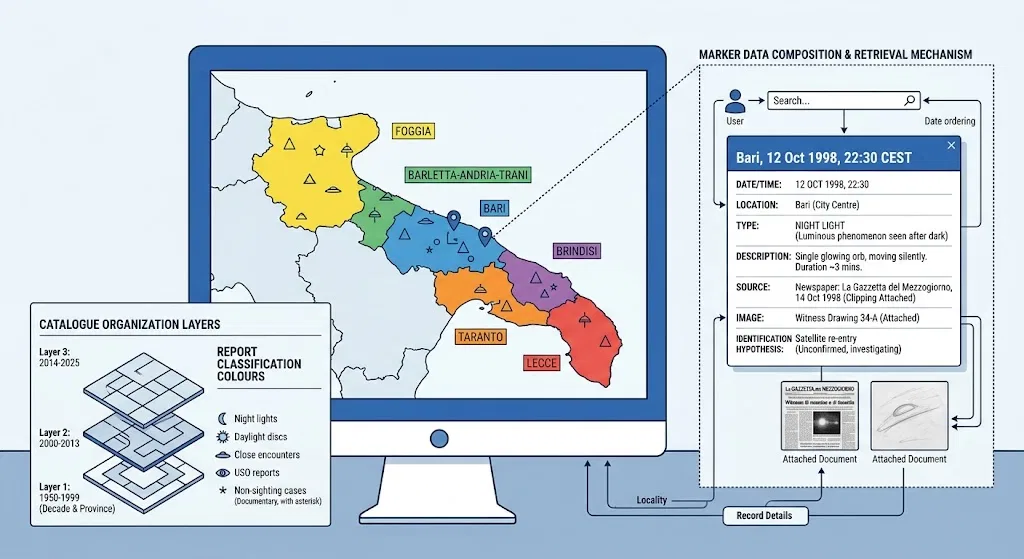
CISU’s interactive map turns decades of Apulian UFO reporting into a place-based archive. A reader can search a town, open a marker and see a short account of what was reported, when and where it happened, which documentary source preserved it and, in some entries, whether investigators suggested an ordinary explanation. Photographs or witness drawings may also be attached. The project is based on the regional catalogue assembled by Arcangelo “Lello” Cassano over nearly forty years and published in book form in 2022. CISU says that almost 1,000 Apulian cases have already been geolocated.[CISU - Centro Italiano Studi Ufologici]cisu.orgCentro Italiano Studi UfologiciUFO in Puglia: geolocalizzazione degli avvistamenti - CISU - Centro Italiano Studi Ufologici…
Its real value is archival, not sensational. The map makes it easier to find reports from Bari, Foggia, Lecce, Taranto and smaller communities that would otherwise remain scattered through newspapers, correspondence and investigation files. But every marker represents a recorded claim or associated document, not proof that an extraordinary object was present. The map shows where stories entered the record; it cannot, by location alone, establish what caused them.
How the geolocation archive is organised
CISU presents the material through a collection of Google My Maps rather than one undifferentiated regional display. For reports from 1950 to 1999, cases are divided by decade and can be viewed either by province or by observation type. Later periods are split into shorter date ranges because the number of collected cases became too large for the earlier decade-by-decade arrangement.[CISU - Centro Italiano Studi Ufologici]cisu.orgCentro Italiano Studi UfologiciUFO in Puglia: geolocalizzazione degli avvistamenti - CISU - Centro Italiano Studi Ufologici…
In the province view, colours distinguish Foggia, Barletta-Andria-Trani, Bari, Brindisi, Taranto and Lecce. A separate classification uses colours for broad report types:
- Night lights: luminous phenomena seen after dark.
- Daylight discs: apparently structured or disc-like objects reported in daylight.
- Close encounters: observations described as occurring at comparatively short range.
- USO reports: alleged unidentified objects associated with water.
- Non-sighting cases: entries marked with an asterisk where the record concerns UFO-related evidence, discussion or documentation without a direct visual sighting.
These are filing categories, not conclusions. A report placed under “night lights”, for example, may eventually be attributed to an aircraft, celestial object, lantern, satellite or other conventional source. “Close encounter” describes the reported circumstances; it does not certify that the witness accurately judged distance or that an unknown craft came close.[CISU - Centro Italiano Studi Ufologici]cisu.orgCentro Italiano Studi UfologiciUFO in Puglia: geolocalizzazione degli avvistamenti - CISU - Centro Italiano Studi Ufologici…
The map’s search function is especially useful for regional research. Entering a locality produces a date-ordered list of associated cases. Selecting an entry identifies the location and opens its short description, cited source and any available image or drawing. This makes it possible to move from a broad question—such as whether reports occurred near Brindisi—to individual records that can be checked against dates, newspapers and proposed explanations.[CISU - Centro Italiano Studi Ufologici]cisu.orgCentro Italiano Studi UfologiciUFO in Puglia: geolocalizzazione degli avvistamenti - CISU - Centro Italiano Studi Ufologici…
The underlying platform also shapes the presentation. Google My Maps is designed for user-created maps containing markers, descriptions, images and customised layers. Individual layers have technical limits, which helps explain why a large historical catalogue may be divided across several maps and time periods rather than loaded into one screen.[Google Support]support.google.comSupport Add places to your mapGoogle SupportAdd places to your map - ComputerClick Add marker Add marker. Select a layer and click where to put the place. A layer can…
What each mapped entry may contain
At its best, an entry functions as a compact archival index. CISU says users may find the date and place of the event, a summary of the observation, documentary references, a possible identification and, in some cases, a photograph or witness sketch. These fields allow a reader to distinguish between a bare anecdote and a report supported by contemporary material.[CISU - Centro Italiano Studi Ufologici]cisu.orgCentro Italiano Studi UfologiciUFO in Puglia: geolocalizzazione degli avvistamenti - CISU - Centro Italiano Studi Ufologici…
The source field is particularly important. Apulian cases have entered UFO catalogues through different routes: direct witness interviews, local newspaper reports, correspondence, photographs, later recollections and investigations conducted by civilian researchers. These sources are not equally strong. A contemporary signed statement containing precise direction, duration and weather details is potentially more useful than a brief newspaper paragraph written years after the event. A photograph with an original file and known camera settings offers more scope for examination than a compressed image copied from social media.
An identification hypothesis also changes how a marker should be read. An entry may remain in the catalogue even when investigators regard a conventional explanation as likely. This is sensible archival practice: removing explained cases would conceal how ordinary phenomena become UFO reports and would make it harder to study recurring causes. A catalogue of reports is therefore broader than a list of unresolved incidents.
Cassano’s role helps explain the map’s depth. He began investigating sightings with a Bari research group in the 1970s, joined CISU in 1986 and later managed regional archives for Apulia and Basilicata. He produced earlier editions of an Apulian catalogue in the 1990s, maintained a regional digital archive between 1999 and 2021 and expanded the work into the 2022 book UFO sulla Puglia. The map is the public-facing continuation of that long cataloguing effort rather than a newly assembled collection of internet stories.[CISU - Centro Italiano Studi Ufologici]cisu.orgCentro Italiano Studi Ufologici Arcangelo CassanoCentro Italiano Studi UfologiciArcangelo Cassano - CISU - Centro Italiano Studi Ufologici…
That history is also a reason to examine entries critically. A database built over several decades may combine records created under different standards. Older cases might survive only through press cuttings or retrospective testimony, while recent entries may include digital images, precise timestamps or rapid follow-up interviews. Two markers on the same map can therefore have very different evidential weight.
Patterns the map can reveal
The clearest contribution of geolocation is that it makes patterns easier to notice. A conventional chronological catalogue may show that many reports occurred in a particular year, but a map can reveal whether they were dispersed across Apulia or concentrated around a few towns. It can also help readers compare coastal reports with inland ones, find repeated observations from the same locality or follow the geographical spread of a regional sighting wave.
This is useful for investigating several kinds of question:
- Did nearby towns report similar phenomena on the same evening?
- Was an apparent cluster confined to one newspaper’s circulation area?
- Do repeated reports come from a heavily populated city rather than an isolated hotspot?
- Are coastal cases associated with observations over the Adriatic or Ionian Sea?
- Does a peak coincide with a well-known national UFO wave, a meteor shower, a satellite event or the growing popularity of sky lanterns?
- Are several markers independent reports, or multiple articles referring to one incident?
The last question matters because maps can visually exaggerate the amount of evidence. Five markers around Bari may represent five separate observations, but they could also arise from one event reported by several witnesses, repeated newspaper coverage or duplicate entries drawn from different sources. Establishing independence requires reading the individual records, not merely counting dots.
The map is also suited to historical comparison. CISU’s broader regional-catalogue project began in 1981 and was designed to preserve local case material before it disappeared. Bringing the Apulian catalogue online allows older newspaper-era reports to be searched alongside cases from the digital period. That continuity can show how the language, volume and documentation of reports changed as cameras, satellites, social media and public awareness changed.[CISU - Centro Italiano Studi Ufologici]cisu.orgCentro Italiano Studi Ufologici Ufo in ItaliaCentro Italiano Studi UfologiciUfo in Italia - CISU - Centro Italiano Studi UfologiciIniziato infatti nel 1981, il “Progetto Catal…
Why location does not prove explanation
A cluster on a map is a starting point for investigation, not evidence of a physical concentration of unknown craft. Report totals are shaped by where people live, how often they watch the sky, whether local media publicise sightings and whether witnesses know where to submit them.
Research using much larger public UFO-report datasets has found that human and environmental factors strongly influence mapped patterns. Population, visibility, seasonal conditions and access to the night sky can all affect the number of reports. One US study found relationships between public sightings and population, light pollution, tree cover and proximity to airports or military areas. Another analysis found a seasonal pattern, with more reports during periods offering better weather for outdoor observation. These studies do not directly explain the Apulian catalogue, but they show why dots cannot be interpreted without accounting for opportunities to observe and report.[Nature]nature.comLooking up the sky: unidentified aerial phenomena and…by N Goldstein · 2024 · Cited by 1 — Figure 1 shows the monthly number of…
A city may appear prominent simply because it contains more potential witnesses and more journalists. A coastal area may generate more entries because residents and visitors have long, unobstructed views of the horizon. Reports near an airport may involve aircraft seen under unusual lighting or approach angles. A military facility can attract attention because unusual aviation activity occurs nearby, but it is also an area where more observers may deliberately watch the sky. None of these factors automatically explains a particular case; they warn against treating geographical correlation as causation.
Reporting culture creates another layer of bias. A well-publicised sighting can prompt other people to reconsider ordinary lights they might previously have ignored. Researchers studying historical UFO-report data have treated such collections partly as records of human reporting behaviour, because publicity, expectation and social attention can affect when people decide that an observation is worth recording.[ScienceDirect]sciencedirect.comOpen source on sciencedirect.com.
The absence of markers is equally ambiguous. It may mean that few unusual observations occurred, but it may also reflect sparse population, poor newspaper preservation, reluctance to report or gaps in the researcher’s sources. The map documents what reached the archive, not every unusual thing ever seen over Apulia.
A civilian archive, not an official finding
CISU is a private research association, and its regional map should not be confused with the Italian Air Force’s official reporting process. CISU’s catalogue is historical and inclusive, drawing together reports and documents for research. The Air Force’s system has a narrower institutional purpose connected to flight and national security. Reports submitted through the official route are passed via the Carabinieri for technical checks against human activity and natural phenomena; only cases without an identified technical or natural explanation are classified officially as unidentified.[Aeronautica Militare]aeronautica.difesa.itAeronautica Militare OVNIAeronautica Militare OVNI
The two collections therefore answer different questions. CISU’s map asks, in effect, “What UFO-related reports have been recorded in this place?” The Air Force record asks, “Which reports entered the official system, were investigated under its procedure and remained without an established explanation?” A town can have several CISU markers and no corresponding official case, without either archive being wrong.
Nor does the term “unidentified” carry the same weight in every entry. It may indicate that investigators exhausted plausible explanations, but it can also mean that a report lacked enough information to decide. A light seen for seconds with no reliable distance, direction or angular size may remain unidentified because the evidence is poor. That is very different from an observation supported by multiple independent witnesses, radar data and calibrated imagery.
The map’s present limits
CISU announced the Apulian geolocation project in February 2026 as the first example of an entire Italian regional case collection being placed online in this form. The announcement states that almost 1,000 cases were already searchable and describes the catalogue as the result of nearly forty years of work.[CISU - Centro Italiano Studi Ufologici]cisu.orgCentro Italiano Studi UfologiciGeo-localizzazione degli avvistamenti: l'esempio della Puglia - CISU - Centro Italiano Studi Ufologici…
The accompanying navigation page, however, shows that the online presentation is still evolving. It says one section covers 1950–2003 and that a second will contain cases from 2004–2025. The visible links are divided into periods up to 2013–2014, despite the broader statement about later coverage. Readers should therefore treat the website as an active publication whose organisation and completeness may change, rather than assume that every case mentioned in the underlying book or archive is equally accessible in the current interface.[CISU - Centro Italiano Studi Ufologici]cisu.orgCentro Italiano Studi UfologiciUFO in Puglia: geolocalizzazione degli avvistamenti - CISU - Centro Italiano Studi Ufologici…
The public map also does not provide, on its main page, a detailed explanation of duplicate control, coordinate precision, confidence grading or the exact criteria used to decide whether a source becomes a separate case. Those details would be necessary for formal statistical work. A marker positioned at a town centre may indicate only the named municipality, not the precise observation point. Counting markers without knowing these rules could produce misleading hotspot claims.
For ordinary readers, the safest approach is to use the map as an index:
- Search for the locality or period of interest.
- Open the individual marker rather than relying on the visual cluster.
- Check the date, source and description.
- Note whether an identification has been proposed.
- Look for independent witnesses or original documentation.
- Separate well-investigated unresolved reports from entries that remain open because information is missing.
What the map ultimately shows
CISU’s project makes Apulia’s UFO history easier to examine at street, town and provincial scale. It can reveal where reports accumulated, help recover overlooked local cases and connect brief sightings with the documents from which they were catalogued. Its strongest achievement is to expose the structure of the archive: not simply strange lights over a region, but decades of witness accounts, press stories, investigations, suspected explanations and unresolved gaps.
What it cannot do is turn concentration into confirmation. A dense patch of markers does not by itself demonstrate unusual aircraft, extraterrestrial activity or even a genuine physical hotspot. It may reflect population, visibility, publicity, repeated coverage or the diligence of local collectors. The map becomes evidentially useful only when its geographical layer is combined with the quality of each underlying report.
Read in that way, it is less a map of unexplained craft than a map of Apulia’s recorded encounters with uncertainty. That distinction does not diminish the project. It is precisely what makes the archive valuable: it allows celebrated cases, weak reports, plausible misidentifications and genuinely unresolved observations to be compared within one regional historical record.
Amazon book picks
Further Reading
Books and field guides related to What Apulia's UFO Map Can and Cannot Show. Use these as the next step if you want deeper reading beyond the article.
The UFO Experience: A Scientific Inquiry
Cited by the New York Review of Books as "the best brief for visitation," this classic study presents an analysis of UFO reports and conc...
UFOs: Generals, Pilots, and Government Officials Go on the Re...
NEW YORK TIMES BESTSELLER • Impeccably researched, this riveting journalistic investigation separates fact from fiction, and documents th...
UFOs and Government: A Historical Inquiry
Governments around the world have had to deal with the UFO phenomenon for a good part of a century. How and why they did so is the subjec...
Passport to Magonia
Over two decades ago, eminent scientist Vallee wrote a provocative book about alleged UFO landings, folklore, and certain unexplained phe...
eBay marketplace picks
Marketplace Samples
Live-tested eBay searches with available results related to this page.
Selected fromUFO map print oneBay.co.uk.
Endnotes
1.
Source: cisu.org
Link:https://www.cisu.org/ufo-in-puglia-geolocalizzazione-degli-avvistamenti/
Source snippet
Centro Italiano Studi UfologiciUFO in Puglia: geolocalizzazione degli avvistamenti - CISU - Centro Italiano Studi Ufologici...
2.
Source: cisu.org
Link:https://www.cisu.org/geo-localizzazione-degli-avvistamenti-lesempio-della-puglia/
Source snippet
Centro Italiano Studi UfologiciGeo-localizzazione degli avvistamenti: l'esempio della Puglia - CISU - Centro Italiano Studi Ufologici...
3.
Source: cisu.org
Title: Centro Italiano Studi Ufologici Arcangelo Cassano
Link:https://www.cisu.org/arcangelo-cassano/
Source snippet
Centro Italiano Studi UfologiciArcangelo Cassano - CISU - Centro Italiano Studi Ufologici...
4.
Source: support.google.com
Title: Support Add places to your map
Link:https://support.google.com/mymaps/answer/3024925?co=GENIE.Platform%3DDesktop&hl=en
Source snippet
Google SupportAdd places to your map - ComputerClick Add marker Add marker. Select a layer and click where to put the place. A layer can...
5.
Source: google.com
Link:https://www.google.com/maps/about/mymaps/
Source snippet
My Maps – AboutEasily create custom maps with the places that matter to you. Search Find places and save them to your map...
6.
Source: cisu.org
Title: Centro Italiano Studi Ufologici Ufo in Italia
Link:https://www.cisu.org/ufo-in-italia/
Source snippet
Centro Italiano Studi UfologiciUfo in Italia - CISU - Centro Italiano Studi UfologiciIniziato infatti nel 1981, il “Progetto Catal...
7.
Source: cisu.org
Title: Centro Italiano Studi Ufologici CISU
Link:https://www.cisu.org/page/2/
Source snippet
Gli ultimi due esempi pubblicati sono UFO in Calabria di Pietro Torre e UFO sulla Puglia di Lello Cassano, due libri corposi, ricchi di i...
8.
Source: nature.com
Link:https://www.nature.com/articles/s41599-024-04182-z
Source snippet
Looking up the sky: unidentified aerial phenomena and...by N Goldstein · 2024 · Cited by 1 — Figure 1 shows the monthly number of...
9.
Source: sciencedirect.com
Link:https://www.sciencedirect.com/science/article/abs/pii/S0378437122005295
10.
Source: cisu.it
Title: Chi siamo
Link:https://www.cisu.it/2026/01/04/chi-siamo/
11.
Source: cisu.org
Title: archivio Archivi
Link:https://www.cisu.org/tag/archivio/
12.
Source: cisu.org
Title: Cat: il catalogo di segnalazioni italiane di avvistamenti UFO
Link:https://www.cisu.org/cisucat2/
13.
Source: ufo.it
Title: Manuale di Indagine UFO
Link:https://ufo.it/2015/11/19/manuale-di-indagine-ufo/amp/
14.
Source: legislature.camera.it
Link:https://legislature.camera.it/_dati/leg13/lavori/stenografici/sed653/s110.htm
15.
Source: cisu.org
Title: segnalazioni recenti sommariva del bosco cuneo 14 giugno
Link:https://www.cisu.org/segnalazioni-recenti-sommariva-del-bosco-cuneo-14-giugno/
16.
Source: cisu.org
Title: ufo in calabria il catalogo dei casi
Link:https://www.cisu.org/ufo-in-calabria-il-catalogo-dei-casi/
17.
Source: cisu.org
Link:https://www.cisu.org/
18.
Source: cisu.org
Link:https://www.cisu.org/author/grassino/
19.
Source: cisu.org
Title: MUFO N Archivi
Link:https://www.cisu.org/tag/mufon/
20.
Source: cisu.org
Link:https://www.cisu.org/tag/caterina-kolosimo/
21.
Source: cisu.org
Title: UF O sulla Puglia
Link:https://www.cisu.org/ufo-in-puglia-prefazione/
22.
Source: cisu.org
Title: Rientri atmosferici Archivi
Link:https://www.cisu.org/tag/rientri-atmosferici/
23.
Source: cisu.org
Title: admin, Autore presso CISU
Link:https://www.cisu.org/author/admin/
24.
Source: cisu.org
Link:https://www.cisu.org/page/4/
25.
Source: cisu.org
Title: Torino Archivi
Link:https://www.cisu.org/tag/torino/
26.
Source: maps.google.com
Link:https://maps.google.com/
27.
Source: mymaps.google.com
Link:https://mymaps.google.com/
28.
Source: aeronautica.difesa.it
Title: Aeronautica Militare OVNI
Link:https://www.aeronautica.difesa.it/ovni/
29.
Source: pugliapress.org
Link:https://www.pugliapress.org/2017/01/19/taranto-strani-avvistamenti-in-cielo-ufo-sul-web-spunta-un-video-guarda/
30.
Source: Wikipedia
Link:https://en.wikipedia.org/wiki/Apulia
31.
Source: Wikipedia
Title: Centro italiano studi ufologici
Link:https://it.wikipedia.org/wiki/Centro_italiano_studi_ufologici
32.
Source: youtube.com
Title: Google My Maps
Link:https://www.youtube.com/watch?v=jlIaZuEs-bc
33.
Source: onthebeach.co.uk
Link:https://www.onthebeach.co.uk/destinations/italy/puglia
Additional References
34.
Source: youtube.com
Link:https://www.youtube.com/watch?v=PiPeptPgLYs
Source snippet
UFO Invasion in Italy 1978 UFO Files #7: Invasione UFO in Italia - 1978 Massimo Polidoro...
35.
Source: youtube.com
Title: Fascist UFOs
Link:https://www.youtube.com/watch?v=ojvSWFiJiec
Source snippet
Ancient Aliens: SHOCKING FLYING SAUCER Crashes in WWII Italy...
36.
Source: youtube.com
Title: UFO Sightings Terrify Italy | The Proof Is Out There
Link:https://www.youtube.com/watch?v=ybDQGcZjJWI
Source snippet
Fascist UFOs - Italian Mass Sightings | Full Documentary...
37.
Source: travelchoreography.com
Link:https://www.travelchoreography.com/things-to-do-in-puglia-italy/
38.
Source: telebari.it
Link:https://www.telebari.it/cronaca/253890-ufo-in-puglia-online-la-piattaforma-degli-avvistamenti-il-90-per-cento-ha-una-spiegazione-logica-video.html
39.
Source: facebook.com
Link:https://www.facebook.com/viceuk/posts/a-new-analysis-of-ufo-reports-found-the-cities-where-people-are-most-likely-to-s/1329936732337739/
40.
Source: instagram.com
Link:https://www.instagram.com/centroitalianostudiufologici/
41.
Source: cunpugliabasilicata.it
Link:https://www.cunpugliabasilicata.it/
42.
Source: euroufo.net
Link:https://www.euroufo.net/page/2/?e=528026079
43.
Source: mufon.com
Link:https://mufon.com/2026/02/13/geo-localization-of-sightings-over-puglia-italy-by-edoardo-russo-mufon-italian-national-director/