Within Umbria
Did Binoculars Strengthen the Polino UFO Case?
Three witnesses watched a coloured light through binoculars, yet magnification may have increased rather than resolved the mystery.
On this page
- What the three witnesses described
- The value and limits of binocular observation
- Astronomical and atmospheric alternatives
Page outline Jump by section
Introduction
The 2001 Polino sighting is one of Umbria’s more interesting modern UFO reports because three people watched the same luminous phenomenon and used binoculars rather than relying only on unaided vision. According to the surviving published account, they saw an oval, star-like light that appeared to stop, accelerate and make sudden movements. Through the binoculars, the glow seemed to contain two colours: a diffuse yellow light and a sharper red one. The local investigators who later presented the case regarded it as unresolved.[Tuttoggi.info]tuttoggi.infoOpen source on tuttoggi.info.
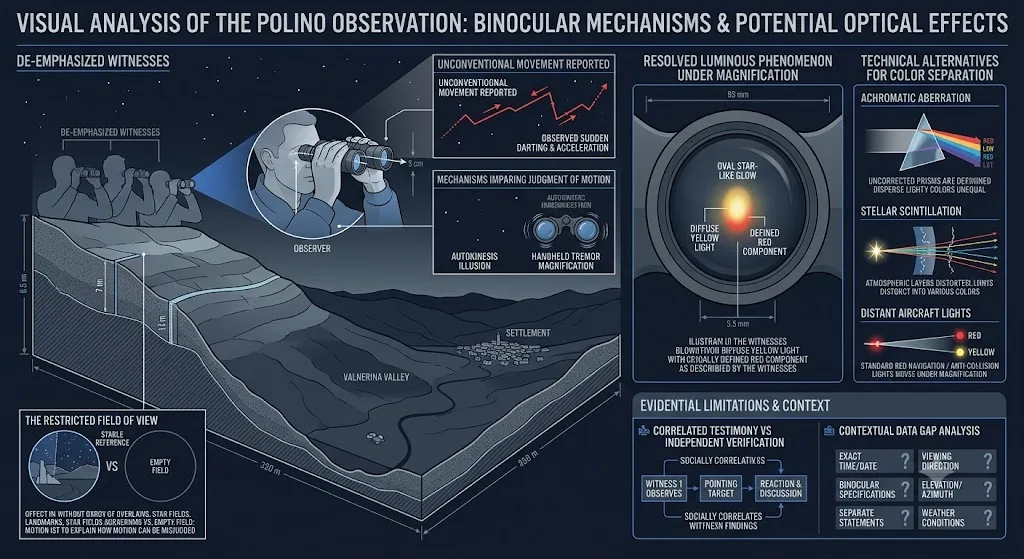
That combination sounds stronger than an ordinary fleeting light report, but binocular magnification does not by itself establish that the witnesses saw a structured craft. It can improve visibility while leaving distance, scale and true motion unknown. It may also make atmospheric colour changes, optical aberrations and small hand movements more noticeable. The Polino case therefore deserves neither dismissal nor dramatic certainty: it is a credible multi-witness observation whose evidential limits remain substantial.
What the three witnesses described
The principal accessible account appeared in 2010, when representatives of the Centro Italiano Studi Ufologici, or CISU, discussed four selected Umbrian cases at a national UFO conference in Terni. Researcher Andrea Bovo described the Polino incident as unusual because three people were present and had the presence of mind to examine the light through binoculars.[Tuttoggi.info]tuttoggi.infoOpen source on tuttoggi.info.
Their reported observations can be reduced to three main features:
- The phenomenon appeared as an oval light resembling a star.
- It seemed to make abrupt movements, alternating between stopping and accelerating.
- Under magnification, the witnesses distinguished a blurred yellow component and a more clearly defined red component within the main glow.[Tuttoggi.info]tuttoggi.infoOpen source on tuttoggi.info.
These details are more informative than a report stating only that “a strange light crossed the sky”. The three observers apparently agreed that something visible was present, and the use of binoculars gave them time to inspect it rather than merely react to a momentary flash.
The published record is nevertheless frustratingly incomplete. The readily available conference report does not provide the exact date, time, viewing duration, compass direction, angular height, weather, binocular specification or identities and separate statements of the witnesses. It also does not reproduce contemporaneous notes, drawings, photographs or a full investigation file. The description reaches the public through an investigator’s summary delivered roughly nine years after the event, rather than through the original testimony itself.[Tuttoggi.info]tuttoggi.infoOpen source on tuttoggi.info.
That distinction affects how confidently the wording can be interpreted. “Sudden movement”, for example, might describe a large displacement across the sky, a small apparent jump within the binocular field or simply an impression shared while the observers passed the instrument between them. Without measurements or individual accounts, these possibilities cannot be separated.
Did three witnesses make the case stronger?
Three witnesses are plainly better than one for establishing that the stimulus was not merely a private visual disturbance. Their agreement makes hallucination, an eye floater or a defect affecting only one observer less persuasive. The binoculars also suggest sustained interest: the phenomenon remained visible long enough for an optical instrument to be found, aimed and used.
However, multiple witnesses do not automatically produce three independent measurements. People observing together normally point out the same target, exchange descriptions and react to one another’s interpretation. If one person says that the light has moved or contains a red centre, the others may then look specifically for that feature. This does not imply dishonesty; it means the testimony may be socially correlated rather than wholly independent.
The strength of the witness evidence therefore depends on questions the public summary does not answer:
- Did all three people see the object through the binoculars, or did some observe it mainly with the naked eye?
- Were their accounts written down separately before they discussed the sighting?
- Did each witness independently report the same colours and movements?
- Was the binocular view steady, or was the instrument handheld and repeatedly passed between observers?
- Were fixed landmarks, stars or the horizon visible alongside the light?
Answers to those questions would matter more than the simple headcount. Three separately documented accounts that agree on direction, timing and movement would carry considerably greater weight than a single collective narrative produced after discussion.
What binoculars genuinely added
Binoculars gather more light and enlarge the apparent angular separation of visual details. In favourable conditions they can reveal whether a distant source is single or multiple, whether it has steady or flashing lights, and whether it moves relative to nearby stars, terrain or other fixed references. Their use at Polino is therefore a legitimate evidential advantage.
Most importantly, the reported yellow and red components were apparently clearer under magnification. If the source was an aircraft, binoculars might have helped separate navigation or anti-collision lights. Night-flying aircraft commonly display red, green and white lights, while anti-collision systems may include flashing red or white beacons.[Federal Aviation Administration]faa.govFederal Aviation Administration Chapter 13: Night OperationsFederal Aviation AdministrationChapter 13: Night OperationsMarch 8, 2019 — While anticollision lights are required for night visual fligh… A distant aircraft viewed at an unfavourable angle can remain almost stationary for a time before its apparent motion becomes obvious, especially when approaching the observer.
Magnification could also have allowed the witnesses to compare the phenomenon with the surrounding star field. A genuine change in position relative to several stars would be much more significant than motion judged against an empty black background. Unfortunately, the published Polino summary does not say whether such a comparison was made.
Nor is it clear that the binoculars actually resolved a solid body. The description remains one of light within light: a diffuse yellow component and a sharper red one. There is no reported outline, surface, symmetry, shadowed area or physical structure connecting the colours. On the available record, the binoculars refined the appearance of the luminosity but did not turn it into an identifiable object.
Why magnification can mislead
The intuitive assumption is that binoculars always remove ambiguity. In reality, magnification may enlarge an uncertain image without supplying the missing information needed to identify it.
Hand movement becomes apparent motion
Handheld binoculars magnify the observer’s own tremor as well as the target. A light that appears fairly steady to the naked eye can jump or wander inside the restricted binocular field when the wrists move, the observer changes stance or the instrument is passed to someone else. A narrow field also removes much of the surrounding landscape that would otherwise help the brain judge whether the source itself has moved.
This matters especially for the reported alternation between rapid motion and stopping. Unless the light was tracked against fixed stars, a ridge or another stable reference, apparent darting cannot safely be converted into extraordinary speed. No distance was known, so even genuine angular movement could not establish velocity.
A solitary light can seem to drift
A well-known night-vision effect called autokinesis occurs when an observer stares at a single point of light against a dark, featureless background. The light can appear to move despite being stationary. Aviation guidance treats this as a practical hazard because stars, distant ground lights and aircraft lights may all generate the illusion.[Federal Aviation Administration]faa.govFederal Aviation Administration Spatial Disorientation: Visual IllusionsFederal Aviation AdministrationSpatial Disorientation: Visual IllusionsSeptember 15, 2016 — The Autokinetic Illusion gives you the impres…
Binoculars do not necessarily eliminate autokinesis. If their field contains only the bright target and darkness, they may further remove the contextual cues needed to judge stability. The restricted field can also make it difficult to relocate the same reference stars after the instrument shifts.
Autokinesis cannot simply be declared the solution to Polino. The witnesses may have observed motion against visible stars, and three people may not experience identical apparent movements at exactly the same moment. It remains a relevant limitation because the surviving account does not explain how the motion was verified.
Optical defects can separate colours
Refracting optics do not bring every wavelength of light to precisely the same focus. Imperfect correction produces chromatic aberration, visible as coloured fringes or unequal red and blue focus around bright, high-contrast targets. Better binoculars reduce the effect but do not always remove it, particularly near the edge of the field or when the focus, eye position or alignment is imperfect.[Astroshop]astroshop.euAberration in binocularsWhen light passes through a convex lens, it is bent towards the optical axis. Due to their different wav…
A red component inside or beside a yellow blur could therefore have several origins. It might have been a real second lamp, atmospheric dispersion, an optical artefact or a combination of these. Without knowing the binocular model, focus condition and whether the colours retained the same arrangement as the instrument moved, the observation cannot distinguish among them.
This does not mean the witnesses imagined the colours. It means colour seen through a handheld optical system is descriptive evidence, not automatic proof that separate illuminated sections existed on a physical craft.
Astronomical and atmospheric alternatives
The comparison with a star in the investigators’ account is important. Bright stars and planets are among the most frequent sources of persistent nocturnal misidentification because they can remain visible for a long time while providing almost no direct information about distance.
Stellar scintillation
Starlight passes through constantly shifting layers of air with different temperatures and densities. Atmospheric turbulence can produce rapid changes in apparent brightness, position and colour, the effect commonly called twinkling or scintillation. It is generally stronger when an object is low in the sky because the light travels through a longer atmospheric path.[oup.com]academic.oup.comOUP AcademicAtmospheric scintillation in astronomical photometryby J Osborn · 2015 · Cited by 130 — Scintillation noise due to the Earth'…
Under unstable conditions, a bright star may flash red, yellow, white or blue and appear to quiver. Magnification can make those variations more conspicuous without resolving the stellar disc, since a star remains effectively a point source for ordinary binoculars. The reported combination of a star-like oval glow, colour separation and abrupt apparent motion is therefore compatible in broad terms with a bright astronomical object affected by turbulence and viewing effects.
Whether that explanation fits Polino specifically cannot be checked without the date, time and viewing direction. Those details would allow investigators to reconstruct the sky and test bright candidates such as Venus, Jupiter, Sirius or another low-altitude star. Their absence is one of the case’s greatest weaknesses.
A planet viewed out of focus
Bright planets usually twinkle less than stars because their apparent discs average out small atmospheric disturbances, but they can still appear distorted when low on the horizon or viewed through poor atmospheric conditions. Slight defocus may spread a bright point into a soft oval or disc, while internal reflections and colour errors create secondary patches. Optical aberrations become particularly visible when a bright astronomical target is examined out of focus.[Sky at Night Magazine]skyatnightmagazine.comSky at Night Magazine Telescope optical aberrations and how to fix themSky at Night Magazine Telescope optical aberrations and how to fix them
Again, this is a viable mechanism rather than a demonstrated identification. The report gives no indication that the witnesses compared the light with known planets, adjusted the focus on a star or checked whether the coloured pattern rotated or shifted with the binoculars.
Atmospheric distortion of a terrestrial light
Polino sits high above the Valnerina, with broad views towards distant settlements and mountainous terrain. Official local descriptions place the village at roughly 835 metres and emphasise its extensive outlook over the surrounding valleys.[Vivi Terni]turismo.comune.terni.itOpen source on terni.it.
From such terrain, distant vehicle lights, tower lamps or lights on an opposite slope may be seen through layers of uneven air. Temperature gradients can distort, displace or intermittently obscure them. A source near a ridge may also appear airborne when the intervening landscape is invisible at night.
This possibility would become more or less persuasive depending on the reported elevation and direction. A light high among clearly visible stars would be difficult to explain as a ground source; one close to a dark horizon would be much easier. The accessible account supplies no such geometry.
Aircraft and other moving sources
A distant aircraft remains another reasonable alternative. Its lamps can present as a compact group at long range, with a red navigation light or beacon appearing within a broader white or yellow glare. Changes in heading can make the lights brighten, disappear or seem to shift position, while an aircraft flying towards the observers may appear almost stationary before moving more obviously across the sky.
The Polino description does not mention regular flashing, engine noise, a green light or a continuous flight path, all of which might support an aircraft identification. Yet absence of reported noise is weak evidence at an unknown distance, particularly in mountainous country where sound can be delayed, masked or redirected. The later conference summary may also have omitted ordinary descriptive details that appeared in the original file.
Balloons carrying lights, helicopters, satellites and meteors fit less comfortably in different ways. An ordinary satellite generally follows a smooth path and would not display separate red and yellow lights. A meteor would be too brief for extended binocular observation. A helicopter could hover and carry coloured lights, but should normally show a coherent flight pattern and might be audible. An illuminated balloon could drift or seem stationary, though sudden acceleration would require either wind changes, perspective effects or observer-induced motion.
No single conventional candidate can be selected confidently from the shortened narrative. That is precisely why the case remained unidentified rather than positively explained.
What the investigation established — and what it did not
The 2010 report states that CISU’s Terni investigators placed Polino among Umbria’s unresolved UFO cases. In its literal sense, that classification is justified: the source was not identified from the available information.[Tuttoggi.info]tuttoggi.infoOpen source on tuttoggi.info.
“Unidentified”, however, is not an evidential verdict in favour of an exotic craft. It may indicate that normal possibilities were considered and rejected, but it can also result from missing data that prevent a conclusive comparison. The public account does not describe checks of astronomical positions, aircraft movements, weather conditions, local lights or the binoculars themselves. It does not state which explanations investigators tested, what evidence counted against them or why the case survived those checks.
That makes the wording used at the conference — that it was certainly a case falling within the UFO category — easy to misunderstand. The safest reading is taxonomic: the observers reported an aerial phenomenon that remained unidentified. It does not mean the object was established as technologically extraordinary.
Later reporting has not visibly strengthened the claim with photographs, instrument data, radar confirmation or newly released witness documents. Instead, the 2010 article remains the main publicly accessible narrative. Its preservation is useful, but repetition of the same summary does not add independent evidence.
Did the binoculars strengthen the Polino case?
They strengthened it in a limited but genuine way. The sighting was prolonged enough to be examined, three people shared the experience, and magnification revealed a more complex colour pattern than was visible to the naked eye. Those features make Polino more substantial than a single witness’s brief glimpse of an anonymous light.
The binoculars did not solve the central problems of night-time identification. They supplied no known range, physical scale or measured speed. They apparently did not reveal a solid outline. Their handheld movement may have contributed to the reported jumps, while atmospheric scintillation or optical aberration could have produced or exaggerated the red and yellow components. A distant aircraft or bright astronomical object therefore remains plausible.
The most balanced classification is unresolved but weakly constrained. The witnesses probably saw a real luminous stimulus, and the agreement of three observers deserves respect. Yet the surviving record is too incomplete to determine whether the source itself performed abrupt manoeuvres or whether magnification intensified the normal instabilities of viewing a distant light at night.
Within Umbria’s UFO history, Polino matters because it illustrates a recurring lesson: better-looking observation is not always better identification. Binoculars can reveal more appearance while leaving the decisive questions — position, distance, motion and context — unanswered.
Amazon book picks
Further Reading
Books and field guides related to Did Binoculars Strengthen the Polino UFO Case?. Use these as the next step if you want deeper reading beyond the article.
The UFO Handbook: A Guide to Investigating, Evaluating, and R...
An explanation of the usual reasons for confusing IFOs (identified flying objects) with UFOs and a survey of the tools used to investigat...
NightWatch: A Practical Guide to Viewing the Universe
A practical guide to viewing the universe.
The Backyard Astronomer's Guide
Discusses the practical aspects of stargazing, including how to choose appropriate equipment, contending with light pollution, taking suc...
Bad Astronomy: Misconceptions and Misuses Revealed, from Astr...
A clever, thought-provoking guide that attacks common astronomical misconceptions What is Bad Astronomy? Anything that accidentally or in...
eBay marketplace picks
Marketplace Samples
Live-tested eBay searches with available results related to this page.
Selected fromUFO poster oneBay.co.uk.
Current eBay listing
VINTAGE UFO FLYING SAUCERS COMIC ADVERTISING A2 POSTER PRINT
Current eBay listing
I Want To Believe UFO Poster Giclée Fine Art Heavyweight Print
Endnotes
1.
Source: tuttoggi.info
Link:https://tuttoggi.info/ufo-in-umbria-4-avvistamenti-in-30-anni-i-lavori-del-25-convegno-nazionale-ufologia-terni-video-e-foto-tuttoggi-info/85047/
2.
Source: tuttoggi.info
Link:https://tuttoggi.info/ufo-in-umbria-4-avvistamenti-in-30-anni-i-lavori-del-25-convegno-nazionale-ufologia-terni-video-e-foto-tuttoggi-info/85047/amp/
Source snippet
UFO IN UMBRIA, 4 AVVISTAMENTI IN 30 ANNI. I LAVORI DEL 25° CONVEGNO NAZIONALE UFOLOGIA TERNI (Video e Foto TuttOggi.info) - Tuttoggi.info...
3.
Source: astroshop.eu
Link:https://www.astroshop.eu/magazine/information/binocular-information/understanding-binoculars/aberration/i%2C1123
Source snippet
Aberration in binocularsWhen light passes through a convex lens, it is bent towards the optical axis. Due to their different wav...
4.
Source: academic.oup.com
Link:https://academic.oup.com/mnras/article/452/2/1707/1067913
Source snippet
OUP AcademicAtmospheric scintillation in astronomical photometryby J Osborn · 2015 · Cited by 130 — Scintillation noise due to the Earth'...
5.
Source: turismo.comune.terni.it
Link:https://turismo.comune.terni.it/da-vedere/polino
6.
Source: turismo.comune.terni.it
Link:https://turismo.comune.terni.it/polino
7.
Source: play.history.com
Link:https://play.history.com/shows/unidentified-inside-americas-ufo-investigation/season-1/episode-2%29
8.
Source: faa.gov
Title: Federal Aviation Administration Chapter 13: Night Operations
Link:https://www.faa.gov/sites/faa.gov/files/Night_Ops_Ch13.pdf
Source snippet
Federal Aviation AdministrationChapter 13: Night OperationsMarch 8, 2019 — While anticollision lights are required for night visual fligh...
Published: March 8, 2019
9.
Source: faa.gov
Title: Federal Aviation Administration Spatial Disorientation: Visual Illusions
Link:https://www.faa.gov/pilots/safety/pilotsafetybrochures/media/spatiald_visillus.pdf
Source snippet
Federal Aviation AdministrationSpatial Disorientation: Visual IllusionsSeptember 15, 2016 — The Autokinetic Illusion gives you the impres...
Published: September 15, 2016
10.
Source: faasafety.gov
Title: Your Senses in the Shadows
Link:https://www.faasafety.gov/files/events/SO/SO15/2024/SO15134204/YourSensesInTheShadows.pdf
Source snippet
Nighttime Visual Illusions...Autokinesis This illusion happens when a pilot stares at a bright, stationary light set against a pitch-bla...
11.
Source: royalsocietypublishing.org
Link:https://royalsocietypublishing.org/rsta/article-pdf/doi/10.1098/rsta.2012.0174/241558/rsta.2012.0174.pdf
12.
Source: skyatnightmagazine.com
Title: Sky at Night Magazine Telescope optical aberrations and how to fix them
Link:https://www.skyatnightmagazine.com/advice/understanding-optical-aberrations
13.
Source: cultura.gov.it
Title: Mi BACTMuseo
Link:https://cultura.gov.it/luogo/museo-laboratorio-dell-appennino-umbro-sotto-sopra
14.
Source: prefettura.interno.gov.it
Title: interno.gov.it Determina Servizio di vettovagliamento personale Gd F
Link:https://prefettura.interno.gov.it/it/prefetture/terni/amministrazione-trasparente/bandi-gara-e-contratti/determina-servizio-vettovagliamento-personale-gdf-polino-referendum-marzo-2026
15.
Source: assets.publishing.service.gov.uk
Link:https://assets.publishing.service.gov.uk/media/5a79dfc9ed915d042206ba86/UFOReport2001.pdf
16.
Source: Wikipedia
Link:https://en.wikipedia.org/wiki/Binoculars
17.
Source: Wikipedia
Link:https://en.wikipedia.org/wiki/Twinkling
18.
Source: facebook.com
Link:https://www.facebook.com/canale18sicilia/videos/ufo/136654668285092/
19.
Source: it.unionpedia.org
Link:https://it.unionpedia.org/Terni
20.
Source: it-ch.topographic-map.com
Link:https://it-ch.topographic-map.com/place-kcq51/Umbria/
Additional References
21.
Source: youtube.com
Link:https://www.youtube.com/watch?v=y3NZhjTQwgE
Source snippet
How is chromatic aberration corrected in a lens design?...
22.
Source: youtube.com
Title: Close Encounters of the Strange Kind
Link:https://www.youtube.com/watch?v=Xd5fMKwVLdo
Source snippet
FAA TEST-AIR TRANSPORTATION PILOT-FLIGHT EMERGENCY & HAZARDS Q9109,Q9110,Q9110-1,Q9108,Q9114 (8-18)...
23.
Source: youtube.com
Link:https://www.youtube.com/watch?v=hK8zw1gD-No
Source snippet
Close Encounters of the Strange Kind - with Giuseppe Stilo...
24.
Source: radioradicale.it
Link:https://www.radioradicale.it/scheda/128894/meccanismi-di-responsabilita-per-le-violazioni-della-legge-umanitaria-ed?i=1656738
25.
Source: radioradicale.it
Link:https://www.radioradicale.it/scheda/128894/meccanismi-di-responsabilita-per-le-violazioni-della-legge-umanitaria-ed?i=1656743
26.
Source: researchgate.net
Link:https://www.researchgate.net/publication/397532794_Patrimonio_culturale_e_partecipazione_Pratiche_di_heritage_making_nell%27area_umbra
27.
Source: parolecon.it
Link:https://www.parolecon.it/search.php?m=ino
28.
Source: lagreenwaydelnera.it
Link:https://www.lagreenwaydelnera.it/it/arrone
29.
Source: atamb.it
Link:https://www.atamb.it/
30.
Source: nimax-img.de
Link:https://www.nimax-img.de/Produktdownloads/44543_3_Leseprobe.pdf