Within Veneto
What Do the Cecconi Photographs Really Prove?
The famous images show a real airborne form, but missing negatives, timing and scale data prevent confident measurement of its size or speed.
On this page
- What appears in the published images
- Why distance and scale remain uncertain
- What a proper photogrammetric study would require
Page outline Jump by section
Introduction
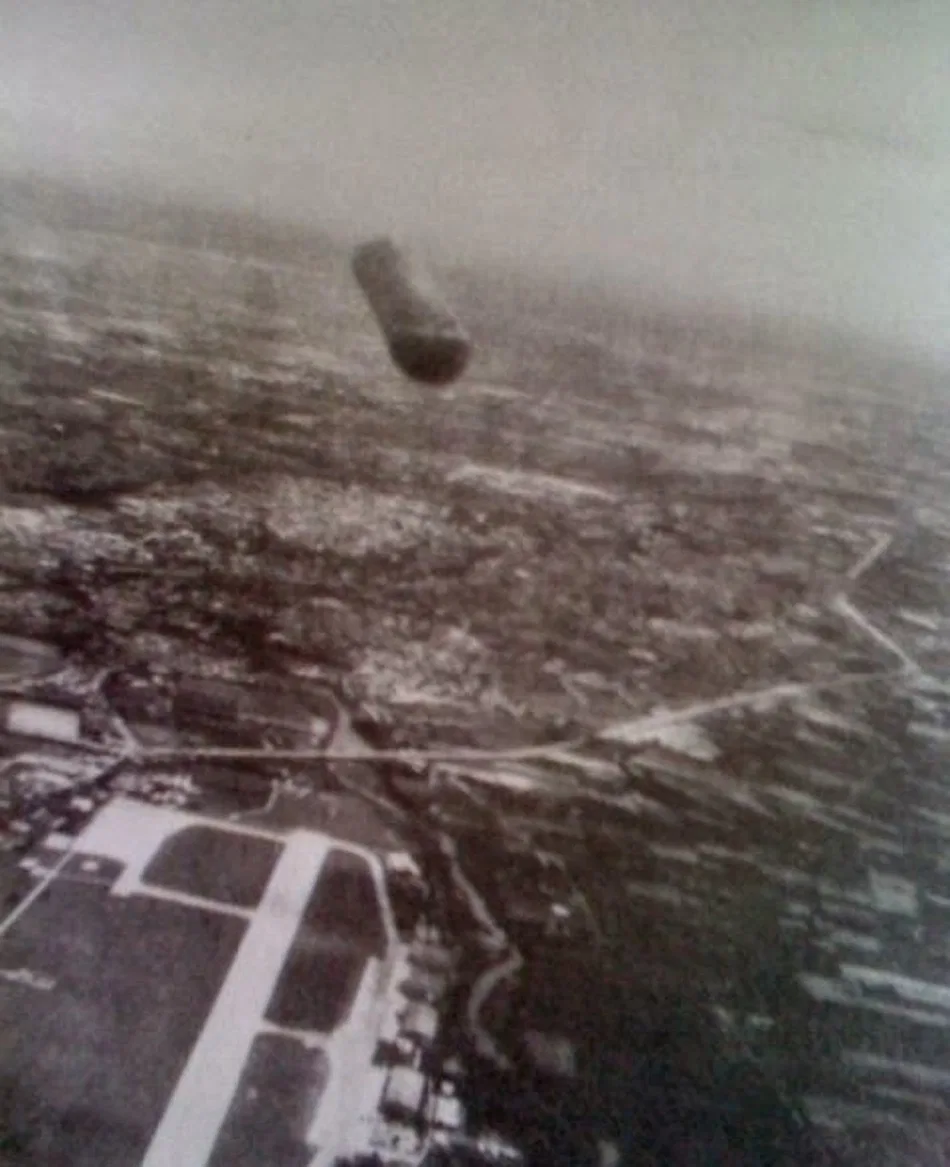
The Cecconi photographs establish something important but limited: during the Treviso incident of 18 June 1979, an airborne reconnaissance camera recorded a dark, compact form against the daylight sky. They strengthen the case beyond a witness’s memory and help confirm that Cecconi was reacting to a visible target rather than merely reporting a fleeting light. They do not, however, establish the object’s true size, distance, speed, construction or origin.
That distinction matters because the photographs are often treated as though they independently prove an eight-metre craft performing controlled manoeuvres. The publicly available images cannot support measurements of that confidence. The original film sequence, camera-calibration records, exact exposure times, aircraft position and attitude, and synchronised radar data have not been made available as a complete evidential package. What survives publicly is therefore better understood as photographic corroboration of an unusual observation, not a conclusive physical analysis.
What appears in the published images
The best-known reproductions show a dark object with a rounded or elongated outline, photographed in a clear sky. One image appears to show a lighter area near its upper edge. This broadly fits Cecconi’s later description of a matt-black, tank-like form with a pale raised feature, although the photographs are not detailed enough to establish whether that light patch was a dome, a reflection, a gap in the silhouette or a defect introduced during copying and reproduction.[Il mondo degli UFO]silverland.infoIl mondo degli UFOIl caso CecconiIl mondo degli UFO…
The images also support a more basic point: the photographed feature occupies several pixels or grains and has a coherent outline. It is not merely a single bright point such as a star. Even so, an apparently solid silhouette does not reveal what kind of object produced it. A large object at considerable distance and a much smaller object nearby can subtend the same angle at the camera and therefore appear the same size in a photograph.
The Italian Air Force’s public archive independently records the Treviso event as a black, cylindrical phenomenon observed on a clear morning at an estimated altitude of about 3,000 metres. It identifies Air Force personnel as the reporting source and says that the incident remained catalogued as unidentified. The same entry leaves speed and direction unreported and does not publish any photographic measurements.[Aeronautica Militare]aeronautica.difesa.itAeronautica Militare
This means the official register confirms the date, place, general appearance and unresolved administrative status of the event. It does not confirm the more elaborate claims sometimes attached to the pictures, such as a precisely measured length, extraordinary acceleration or technologically impossible manoeuvring.
Later investigators reported that Cecconi recognised three photographs published by the magazine Epoca in 1985 as belonging to his original sequence. That helps answer an early dispute over whether those particular pictures were connected to his flight. It does not establish that the published copies preserve the full detail, framing or tonal range of the original reconnaissance negatives.[Il mondo degli UFO]silverland.infoIl mondo degli UFOIl caso CecconiIl mondo degli UFO…
Why distance and scale remain uncertain
A photograph usually records angular size: how much of the camera’s field of view an object occupies. Converting that into a physical length requires a reliable distance. Without distance, the image cannot distinguish confidently between, for example, a three-metre balloon 100 metres away and a much larger object several hundred metres away.
Cecconi reportedly estimated that he passed within roughly 70–80 metres and judged the object to be about eight metres long. Those figures are part of the witness account reproduced by investigators, not measurements demonstrated from the surviving published photographs. The distinction is crucial. A trained pilot may be highly skilled at judging aircraft whose dimensions, shape and motion are familiar, but estimating the range of an unfamiliar object against an empty sky is intrinsically difficult because there is no fixed background reference.[Il mondo degli UFO]silverland.infoIl mondo degli UFOIl caso CecconiIl mondo degli UFO…
The Air Force archive illustrates the problem. It lists an approximate altitude for the phenomenon but no recorded speed, heading or range from Cecconi’s aircraft. An object’s altitude above the ground is not the same as its slant distance from the camera. Even if both aircraft and target altitudes were known, their horizontal separation would still be needed to calculate range.[Aeronautica Militare]aeronautica.difesa.itAeronautica Militare
The online image most widely circulated today is itself a later digital file rather than a documented scan of an original negative. Its Commons record identifies a third-party UFO website as the source and notes that its metadata may have been added or altered during digitisation. The file is therefore useful for seeing the published shape, but unsuitable for precise forensic claims about the original film, exposure or timing.[Wikimedia Commons]commons.wikimedia.orgFile:UFO photographed by Italian pilot Giancarlo Cecconi, 1979.jpgWikimedia CommonsFile:UFO photographed by Italian pilot Giancarlo Cecconi, 1979.jpg - Wikimedia Commons…
This loss of provenance also affects authenticity testing. A high-quality reproduction may show that a dark form was printed, but it cannot by itself reveal every feature needed to exclude scratches, processing marks, retouching, cropping or changes introduced over several generations of copying. In other fields of photographic examination, analysts prefer original negatives and first-generation prints because later copies lose detail and can acquire defects that were not present in the source material.[National Archives]archives.govNational Archives FindingsNational ArchivesFindingsAugust 15, 2016 — 15 Aug 2016 — In its analyses, the photographic evidence panel worked with the original negati…
None of this demonstrates that Cecconi’s pictures were fabricated. It means that the accessible versions cannot bear the evidential weight sometimes placed upon them.
The sequence matters more than a single frame
Accounts of the incident commonly state that Cecconi exposed about 80 frames during several passes. A genuine sequence of that length could potentially be much more informative than the handful of images usually reproduced. Changes in the object’s position, apparent size, orientation and sharpness from frame to frame might allow investigators to test whether it was stationary, drifting with the wind, rotating or moving independently.[Il mondo degli UFO]silverland.infoIl mondo degli UFOIl caso CecconiIl mondo degli UFO…
The difficulty is that the complete sequence has not been presented publicly in a form that permits independent reconstruction. Researchers would need to know which frames came from which of the G.91R’s cameras, whether exposures were simultaneous or sequential, the interval between frames and whether every surviving image has been preserved in its original order. A selection of striking photographs cannot substitute for the whole run.
Sequence order is especially important when claims are made about speed. Apparent movement across successive frames can arise from the target, the aircraft, camera orientation or all three. Cecconi was flying past and turning around the object, so the camera platform itself was moving rapidly. Without the aircraft’s flight path and the exact time between exposures, changes in image position cannot be assigned confidently to the target.
Modern official analyses of aerial footage illustrate the amount of supporting information required. The All-domain Anomaly Resolution Office’s reconstruction of the “GoFast” video used frame timing, aircraft altitude, airspeed, bank angle, viewing geometry and sensor data to model both the observing aircraft and the apparent target. NASA likewise warns that UAP analysis is hindered when sensor calibration, metadata and multiple simultaneous measurements are absent.[AARO]aaro.milGo Fast Case ResolutionAARO GoFast Case ResolutionFebruary 24, 2025 — 6 Feb 2025 — The distance traveled at each point in time was the elapsed frame time mu…
The Cecconi photographs may once have been accompanied by some of this information inside military records. The material currently available to the public does not show that a complete, reproducible calculation was performed or preserve enough inputs for an outside analyst to repeat one.
Could the images distinguish a craft from a balloon?
A cylindrical or elongated silhouette is compatible with more than one class of object. It could represent a manufactured aerial vehicle, but it could also resemble a balloon, an inflatable solar object or another lightweight body whose shape changed with viewing angle. Contemporary discussion of the case reportedly included an official suggestion involving a cylindrical balloon made from black plastic, while Cecconi and sympathetic investigators rejected that identification on grounds of apparent size, shape and reported behaviour.[Il mondo degli UFO]silverland.infoIl mondo degli UFOIl caso CecconiIl mondo degli UFO…
The photographs alone do not settle that dispute. They do not reveal material strength, mass, propulsion, internal structure or aerodynamic control. Nor do the published frames clearly show exhaust, wings, control surfaces or an attachment line. An absence of visible balloon features is not decisive when the image resolution is low and the viewing angle uncertain.
The claimed pale feature on top is similarly ambiguous. If it were shown consistently across several original negatives from different angles, it might support the conclusion that the object possessed a stable three-dimensional structure. In the available reproduction, however, it is too poorly resolved to determine whether it is a physical projection or a photographic effect.
A balloon explanation would have to account for the whole incident, not merely visual similarity in one frame. Relevant questions would include local wind direction at different altitudes, the object’s reported changes in altitude, radar behaviour and whether any suitable balloon was released or recovered. Conversely, rejecting a particular balloon model would not establish an exotic craft. It would only remove one proposed explanation.
What a proper photogrammetric study would require
Photogrammetry is the extraction of measurements from photographs. Applied properly to the Cecconi case, it could estimate viewing angles, test changes in apparent dimensions and, under favourable conditions, constrain distance or motion. It would require far more than enlarging the familiar published image.
At minimum, investigators would need:
- the original negatives or the earliest surviving film-generation material;
- the complete set of frames in verified chronological order;
- identification of the camera used for each exposure;
- lens focal length, film format, calibration records and information about lens distortion;
- precise exposure times or dependable intervals between frames;
- the G.91R’s altitude, position, heading, bank, pitch and speed at each exposure;
- the fixed orientation of each camera within the aircraft;
- uncropped frame boundaries and internal reference marks;
- original radar plots, scan rate and tracking uncertainty;
- weather data, including winds at the relevant altitudes;
- records showing how the film was handled, developed, selected and reproduced.
Calibrated aerial photogrammetry depends on camera parameters such as focal length and distortion, as well as exterior orientation — the camera’s position and angular attitude at the moment of exposure. Without these, a picture may document appearance but cannot reliably yield real-world dimensions.[USGS]usgs.govOpen source on usgs.gov.
Two independent viewpoints would be particularly valuable. If the same object were photographed simultaneously from known positions, triangulation could provide distance. A synchronised radar track might serve a similar purpose if analysts could show that the radar return and photographed object were the same target. The public Air Force summary does not supply such a correlation, and later narrative accounts of radar involvement do not provide the raw plots or technical parameters needed to verify it.[Aeronautica Militare]aeronautica.difesa.itAeronautica Militare
An adequate study would also report uncertainty rather than producing a single neat figure. Small errors in camera angle, aircraft position or assumed range can create large changes in calculated size, particularly when the target is seen against featureless sky. A result such as “between two and twelve metres under these assumptions” would be scientifically more meaningful than repeating an unsupported eight-metre estimate.

The strongest defensible conclusion
The Cecconi photographs make the Treviso incident unusually valuable within Veneto’s UFO history. They show that a military observer photographed a distinct airborne-looking form during the reported encounter, and they broadly match the Air Force archive’s description of a black cylindrical phenomenon. Alongside Cecconi’s testimony and the official record, they make the case harder to dismiss as a simple invented story or a momentary misidentification of a distant point of light.[Aeronautica Militare]aeronautica.difesa.itAeronautica Militare
They do not prove that the object was eight metres long, that it deliberately faced Cecconi’s aircraft, that it moved at extraordinary speed or that it was an advanced vehicle. Most importantly, they do not identify its origin. “Photographed” and “measured” are not interchangeable, and “unidentified” does not mean extraterrestrial.
The fairest assessment is therefore narrow but significant: the images corroborate the presence of a real visual target of uncertain nature. The absence of a publicly accessible original sequence, reliable scale information and synchronised flight and radar data prevents them from becoming decisive physical evidence. Later republication has kept the case visible, but it has not materially solved those evidential gaps.
Amazon book picks
Further Reading
Books and field guides related to What Do the Cecconi Photographs Really Prove?. Use these as the next step if you want deeper reading beyond the article.
UFOs: Generals, Pilots, and Government Officials Go on the Re...
NEW YORK TIMES BESTSELLER • Impeccably researched, this riveting journalistic investigation separates fact from fiction, and documents th...
Understanding Exposure
Rating: 4.5/5 from 19 Google Books ratings
Provides detailed lessons on the elements of exposure and how each relates to depth of field, freezing and blurring action, and shooting...
The UFO Experience: A Scientific Inquiry
Cited by the New York Review of Books as "the best brief for visitation," this classic study presents an analysis of UFO reports and conc...
The Manual of Photography
The tenth edition of The Manual of Photography is an indispensable textbook for anyone who is serious about photography. It is ideal if y...
eBay marketplace picks
Marketplace Samples
Live-tested eBay searches with available results related to this page.
Selected fromaviation poster oneBay.co.uk.


Endnotes
1.
Source: silverland.info
Title: Il mondo degli UFOIl caso Cecconi
Link:https://www.silverland.info/documenti/il-caso-cecconi/
Source snippet
Il mondo degli UFO...
2.
Source: commons.wikimedia.org
Title: File:UFO photographed by Italian pilot Giancarlo Cecconi, 1979.jpg
Link:https://commons.wikimedia.org/wiki/File%3AUFO_photographed_by_Italian_pilot_Giancarlo_Cecconi%2C_1979.jpg
Source snippet
Wikimedia CommonsFile:UFO photographed by Italian pilot Giancarlo Cecconi, 1979.jpg - Wikimedia Commons...
3.
Source: aeronautica.difesa.it
Title: Aeronautica Militare
Link:https://www.aeronautica.difesa.it/wp-content/uploads/2023/05/Archivio_OVNI_periodo1972-1990.pdf
4.
Source: archives.gov
Title: National Archives Findings
Link:https://www.archives.gov/research/jfk/select-committee-report/part-1a.html
Source snippet
National ArchivesFindingsAugust 15, 2016 — 15 Aug 2016 — In its analyses, the photographic evidence panel worked with the original negati...
Published: August 15, 2016
5.
Source: aaro.mil
Title: Go Fast Case Resolution
Link:https://www.aaro.mil/Portals/136/PDFs/case_resolution_reports/AARO_GoFast_Case_Resolution_Card_Methodology_Final.pdf
Source snippet
AARO GoFast Case ResolutionFebruary 24, 2025 — 6 Feb 2025 — The distance traveled at each point in time was the elapsed frame time mu...
Published: February 24, 2025
6.
Source: science.nasa.gov
Link:https://science.nasa.gov/wp-content/uploads/2023/09/uap-independent-study-team-final-report.pdf
Source snippet
NASA ScienceIndependent Study Team ReportAt present, analysis of UAP data is hampered by poor sensor calibration, the lack of multiple me...
7.
Source: usgs.gov
Link:https://www.usgs.gov/ngp-standards-and-specifications/lidar-base-specification-glossary
8.
Source: pubs.usgs.gov
Link:https://pubs.usgs.gov/sim/2004/2852/SIM2852.pdf
9.
Source: aaro.mil
Title: 2025 UAP Workshop Paper
Link:https://www.aaro.mil/Portals/136/PDFs/Information%20Papers/2025_UAP_Workshop_Paper.pdf
10.
Source: ntrs.nasa.gov
Link:https://ntrs.nasa.gov/api/citations/20050202011/downloads/20050202011.pdf?attachment=true
11.
Source: nasa.gov
Link:https://www.nasa.gov/wp-content/uploads/2025/08/2022-agency-foia-log.xlsx?emrc=93a4ff
12.
Source: nasa.gov
Link:https://www.nasa.gov/wp-content/uploads/2025/08/fy-2025-q3-foia-log.xlsx?emrc=36f27c
13.
Source: nasa.gov
Link:https://www.nasa.gov/wp-content/uploads/2025/08/2023-agency-foia-log.xlsx?emrc=54069a
14.
Source: pubs.usgs.gov
Link:https://pubs.usgs.gov/of/2004/1389/OFR2004-1389.pdf
15.
Source: pubs.usgs.gov
Link:https://pubs.usgs.gov/pp/1750/chapters/pp2008-1750_chapter12.pdf
16.
Source: pubs.usgs.gov
Link:https://pubs.usgs.gov/pp/0599b/report.pdf
17.
Source: pubs.usgs.gov
Link:https://pubs.usgs.gov/gip/70039196/report.pdf
18.
Source: pubs.usgs.gov
Title: OFR2004 1391
Link:https://pubs.usgs.gov/of/2004/1391/OFR2004-1391.pdf
19.
Source: pdsimage2.wr.usgs.gov
Title: Kosofsky Broome 1965 LO.APhotoSat
Link:https://pdsimage2.wr.usgs.gov/cdroms/Lunar_Orbiter/LO4_0001/extras/document/Kosofsky_Broome_1965_LO.APhotoSat.pdf
20.
Source: data.usgs.gov
Link:https://data.usgs.gov/datacatalog/data/USGS%3A6813a40ad4be02316305174d
21.
Source: usgs.gov
Link:https://www.usgs.gov/faqs/what-remote-sensing-and-what-it-used
22.
Source: commons.wikimedia.org
Title: Category:Pictures of UFOs
Link:https://commons.wikimedia.org/wiki/Category%3APictures_of_UFOs
23.
Source: archives.gov
Link:https://www.archives.gov/records-mgmt/scheduling/appraisal
24.
Source: archives.gov
Link:https://www.archives.gov/research/jfk/warren-commission-report/chapter-4.html
25.
Source: archives.gov
Link:https://www.archives.gov/research/jfk/warren-commission-report/chapter-6.html
26.
Source: archives.gov
Link:https://www.archives.gov/research/guide-fed-records/groups/331.html
27.
Source: archives.gov
Link:https://www.archives.gov/files/records-mgmt/grs/grs-trs22-superseded.pdf
28.
Source: archives.gov
Link:https://www.archives.gov/files/research/arc/lifecycle-data-requirements.doc
29.
Source: archives.gov
Link:https://www.archives.gov/files/publications/ref-info-papers/rip115.pdf
30.
Source: archives.gov
Title: trs28 sch only
Link:https://www.archives.gov/files/records-mgmt/grs/trs28-sch-only.pdf
31.
Source: archives.gov
Title: pi 90 antarctic
Link:https://www.archives.gov/files/research/cartographic/pi-90-antarctic.pdf
32.
Source: aeronautica-militare.eu
Link:https://www.aeronautica-militare.eu/
33.
Source: silverland.info
Title: Billy Meier
Link:https://www.silverland.info/ufo-s-people/billy-meier/
34.
Source: aeronautica.fandom.com
Link:https://aeronautica.fandom.com/wiki/Aircraft
35.
Source: it.scribd.com
Link:https://it.scribd.com/document/490374032/Ufo
36.
Source: dictionary.cambridge.org
Link:https://dictionary.cambridge.org/dictionary/italian-english/aeronautica
37.
Source: sab-ero.cultura.gov.it
Title: Contavalli ultimo 9gen
Link:https://sab-ero.cultura.gov.it/fileadmin/risorse/Inventari/Contavalli_ultimo_9gen.pdf
Additional References
38.
Source: mattinopadova.it
Title: Scattò circa 80 fotografie prima che l’oggetto,
Link:https://www.mattinopadova.it/cronaca/la-rotta-degli-ufo-sono-attratti-da-padova-perche-tecnologica-mucqcc7a
Source snippet
Il Mattino di PadovaLa rotta degli Ufo: «Sono attratti da Padova perché...17 Dec 2012 — Centinaia di luci, Giancarlo Cecconi, e fu effet...
39.
Source: quotidiano.net
Title: Nazionale Ufo e palloni spia
Link:https://www.quotidiano.net/esteri/ufo-e-palloni-spia-cosa-succede-nei-cieli-e-perche-torna-sempre-la-rotta-del-nord-america-6ebb1a3f
Source snippet
Cosa succede nei cieli e perché torna...13 Feb 2023 — Il caso del maresciallo Cecconi risale al 18 giugno 1979. Non si è mai capito nemm...
40.
Source: facebook.com
Link:https://www.facebook.com/HiddenFactsss/posts/among-the-countless-ufo-photographs-ever-taken-one-from-italy-stands-out-as-trul/1415860017207300/
41.
Source: facebook.com
Link:https://www.facebook.com/groups/387604307559872/posts/938198172500480/
42.
Source: facebook.com
Link:https://www.facebook.com/instituteofmetaphysics/posts/italian-air-force-pilot-giancarlo-ceccino-captures-26-ft-cylindrical-ufo-in-phot/1254930479696489/
43.
Source: x.com
Link:https://x.com/thiojoe/status/1476553119609720835
44.
Source: mydarkpath.com
Link:https://www.mydarkpath.com/78-historical-ufo-photos
45.
Source: air.uniud.it
Link:https://air.uniud.it/retrieve/e27ce0c5-6934-055e-e053-6605fe0a7873/10990_877_Chiara%20Naldi_tesi%20dottorato.pdf
46.
Source: ora.uniurb.it
Link:https://ora.uniurb.it/retrieve/e18b865c-f445-1ee6-e053-3a05fe0ae544/phd_uniurb_279470.pdf
47.
Source: calameo.com
Link:https://www.calameo.com/books/0007819459b74a581e4c5