Within Piedmont UFO Files
How Did Piedmont's UFO Stories Grow in Retelling?
Newspaper compression, repeated retellings and merged witness accounts often made Piedmont's UFO stories more coherent and dramatic than the records support.
On this page
- How separate observations become one story
- When spectacular details first appear
- The difference between coverage and corroboration
Page outline Jump by section
Introduction
Piedmont’s best-known UFO stories did not usually begin as polished legends. They began as scattered observations: a bright light seen from different positions, a radar echo reported second-hand, a pilot’s brief comment, or a rumour passed from military staff to reporters. Newspapers then supplied the structure. They joined events that may not have belonged together, selected the most dramatic details, and repeated uncertain claims until they appeared settled.
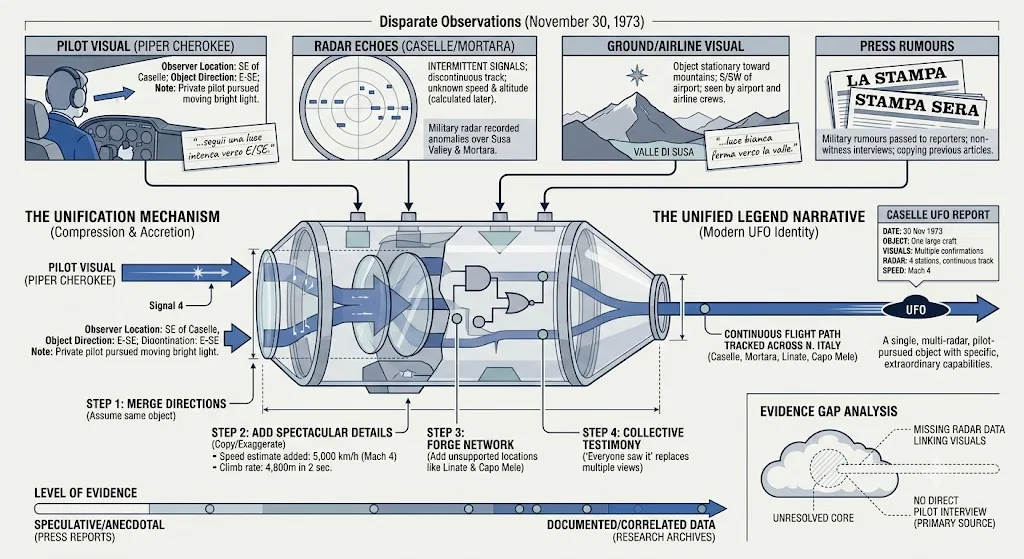
The clearest example is the Caselle airport episode of 30 November 1973. Later accounts often present it as one object simultaneously watched by pilots, chased by an aircraft and tracked across several radar stations at impossible speed. The surviving material supports a more complicated picture: separate visual and radar observations, conflicting directions, intermittent echoes and substantial dependence on press interviews rather than contemporaneous investigation. Piedmont’s legends grew chiefly through compression—turning several uncertain reports into one coherent event—and accretion, in which each retelling added memorable details that later writers treated as original evidence.[CISU - Centro Italiano Studi Ufologici]cisu.orgcaselle 1973Centro Italiano Studi UfologiciCASELLE, 1973 - CISU - Centro Italiano Studi Ufologici…
How separate observations became one story
The first newspaper trace of the Caselle case was a short item in the Turin edition of La Stampa on 1 December 1973. In the days that followed, newspapers, radio and television expanded the episode rapidly. More than 100 press articles eventually covered it nationally, yet no UFO organisation interviewed the principal pilots or radar operators at the time. Most early reconstructions therefore depended on journalists’ summaries, military rumours and accounts copied from other accounts.[CISU - Centro Italiano Studi Ufologici]cisu.orgcaselle 1973Centro Italiano Studi UfologiciCASELLE, 1973 - CISU - Centro Italiano Studi Ufologici…
That reporting environment encouraged several distinct observations to be treated as different views of the same object. According to the later reconstruction by the Turin-based Centro Italiano Studi Ufologici, or CISU, observers on the ground and airline pilots approaching Caselle saw a strong white light apparently stationary towards the Susa Valley, south-west of the airport. Radar personnel reported intermittent moving echoes. A private pilot, meanwhile, followed a bright light moving away towards the east or south-east. These observations differed in direction and behaviour, but the familiar newspaper version fused them into a single intruder moving between all three settings.[CISU - Centro Italiano Studi Ufologici]cisu.orgCentro Italiano Studi UfologiciRADAR E AEREI A CACCIA DI UFO SOPRA L’AEROPORTO DI CASELLE - CISU - Centro Italiano Studi Ufologici…
The merger made the story easier to understand and far more dramatic. Instead of several uncertain stimuli, readers encountered one object that appeared near the landing route, was seen by professional witnesses, detected electronically, pursued by a pilot and finally escaped towards Liguria. Once that unified narrative had been established, every component seemed to corroborate every other component.
The difficulty is that “reported at the same airport on the same evening” is not the same as “proved to be the same object”. Radar returns were discontinuous. The stationary light remained towards the mountains while the private aircraft flew in another direction. No preserved radar plot securely links each visual observation to a corresponding echo. The legend removes these gaps by assuming the conclusion that investigators would first need to demonstrate.[CISU - Centro Italiano Studi Ufologici]cisu.orgCentro Italiano Studi UfologiciRADAR E AEREI A CACCIA DI UFO SOPRA L’AEROPORTO DI CASELLE - CISU - Centro Italiano Studi Ufologici…
This is the central mechanism behind many Piedmont UFO legends:
- Different witnesses become a single collective witness. Disagreements in bearing, timing or description disappear behind phrases such as “everyone saw it”.
- Different phenomena become one object. A fixed light, a moving light and radar noise are narrated as successive manoeuvres.
- A sequence becomes simultaneous. Details reported over half an hour, or even on different dates, are presented as one continuous chase.
- Professional status becomes blanket validation. A pilot’s expertise in aviation is treated as confirmation of details the pilot may never have personally observed, such as radar speed or events at another station.
None of this proves that the witnesses saw nothing unusual. It shows why the most famous version is more orderly than the evidence from which it was built.
When spectacular details first appeared
The most memorable parts of the Caselle legend are also among the least securely documented. Published accounts described violent zigzags, sudden vertical climbs, right-angle turns and speeds of almost 5,000 kilometres per hour, roughly Mach 4. Some versions said the object climbed 4,800 metres in two seconds. Others had the private pilot chasing it for about 20 minutes as far as Voghera before abandoning the pursuit to avoid running out of fuel.[CISU - Centro Italiano Studi Ufologici]cisu.orgcaselle 1973Centro Italiano Studi UfologiciCASELLE, 1973 - CISU - Centro Italiano Studi Ufologici…
These figures gave the story apparent technical precision. A speed estimate such as “Mach 4” sounds more evidential than “very fast”, even when the underlying distance, altitude and timing measurements are unavailable. The same applies to descriptions of an echo as large as that of an airliner: the comparison was repeated as though it established the physical size of an object, although radar-return strength depends on many factors and does not by itself identify a solid craft.
Later investigation found that contemporary journalism mixed accurate points with errors, exaggerations and invented material. Essential questions were not asked in the original interviews: the witnesses’ exact viewing positions, angular elevation, duration of each phase, whether visual and radar targets coincided, and how speed or altitude had been calculated. Even the later official analysis relied largely on press reports and lacked the meteorological and witness data needed to test its proposed atmospheric explanation.[CISU - Centro Italiano Studi Ufologici]cisu.orgCentro Italiano Studi UfologiciRADAR E AEREI A CACCIA DI UFO SOPRA L’AEROPORTO DI CASELLE - CISU - Centro Italiano Studi Ufologici…
The alleged network of radar confirmation illustrates how repetition hardened a weak claim. Caselle and the military centre at Mortara were associated with reports of anomalous echoes. Later versions added Linate and Capo Mele, creating the impression of a large object tracked across northern Italy. CISU’s review concluded that the Linate and Capo Mele claims were unsupported. Nevertheless, the expanded radar chain continued to appear in books and summaries because it made the case look geographically continuous and institutionally confirmed.[CISU - Centro Italiano Studi Ufologici]cisu.orgcaselle 1973Centro Italiano Studi UfologiciCASELLE, 1973 - CISU - Centro Italiano Studi Ufologici…
A 2009 La Stampa item shows how such claims could be revived decades later. Reporting statements made at a UFO conference, it said declassified radar plots confirmed the presence of “non-conventional aircraft” around Turin at the end of 1973. The article presented that interpretation as a retrospective revelation, although the surviving record does not establish a single unconventional craft performing the entire sequence described in popular versions.[La Stampa]lastampa.it1973 4 ufo nei cieli di caselle 1.37054389La Stampa1973: 4 Ufo nei cieli di Caselle - La Stampa…
The process was therefore circular. Newspaper stories became the raw material for books and conference claims; later newspapers then cited those books or conferences as fresh confirmation. What appeared to be several independent layers of support could ultimately lead back to the same small group of press reports.
How Caselle expanded into a regional flap
Caselle did not remain an airport story. Within days, newspaper coverage helped turn it into a broader Piedmont “wave”, especially around the Susa Valley and Monte Musinè. A Stampa Sera article of 5 December described hundreds of people supposedly watching an object head from Caselle towards the mountain. It called the Susa Valley a meeting place for mysterious objects and repeated speculation that the Musinè’s alleged radioactivity made it a useful landmark for UFOs.[Mariano Tomatis Wonder Injector]marianotomatis.itMariano Tomatis Wonder Injectorwww.marianotomatis.itMariano Tomatis Wonder Injectorwww.marianotomatis.it
This was a major narrative shift. A difficult aviation case became evidence for a geographical pattern: Caselle was the point of detection, the Susa Valley the corridor and Musinè the destination. The region’s landscape began to organise otherwise disconnected reports.
The stories circulating in December 1973 included alleged landings, strange lights, aircraft scrambles, prophetic messages and physical traces. Some had ordinary explanations. An object found near Villarfocchiardo, for example, was identified as a meteorological balloon launched from Lyon. Other reports were attributed to space debris or atmospheric effects involving ice crystals. Yet once included in accounts of the “Piedmont carousel”, even explained incidents contributed to the impression that something extraordinary had repeatedly entered the region.[Mariano Tomatis Wonder Injector]marianotomatis.itMariano Tomatis Wonder Injectorwww.marianotomatis.itMariano Tomatis Wonder Injectorwww.marianotomatis.it
Books then preserved the strongest version. In a 1976 edition of Ombre sulle stelle, Peter Kolosimo described “wild carousels” over Piedmont and referred to radar detections at Caselle, Linate and Mortara. He also repeated claims of landings near Musinè and supposed traces, while acknowledging that they remained to be demonstrated. The caution was present, but the striking images—the carousel, the multiple radars and the landing mountain—were what made the account memorable.[Mariano Tomatis Wonder Injector]marianotomatis.itMariano Tomatis Wonder Injectorwww.marianotomatis.itMariano Tomatis Wonder Injectorwww.marianotomatis.it
This illustrates a common imbalance in paranormal reporting. A qualification such as “not proved” occupies a few words; the spectacular allegation occupies the reader’s imagination. Later summaries may retain the allegation and lose the qualification entirely.
Musinè was already becoming a legend
Newspapers did not create the Musinè’s reputation from nothing, but they gave it a modern UFO identity. The mountain already carried local religious, magical and esoteric associations. Reporting in 1973 overlaid those traditions with the vocabulary of spaceships, radiation, secret bases and extraterrestrial routes.
The transformation was reinforced by publicity surrounding the Sidereal Intercontacts Centre, a contactee group that issued strange circulars attributed to an alien figure called Absu Ismaily Swandy. One circular announced a “grand manifestation” on Musinè. Another, shortly before a Turin UFO conference on 14 December 1973, warned that false prophets would be destroyed by fire and that the mountain would burn. Fires did break out on its slopes that afternoon, although law enforcement regarded them as deliberate. Newspapers covered the coincidence, while other periodicals debated whether the group represented belief, political manipulation or an elaborate prank.[Mariano Tomatis Wonder Injector]marianotomatis.itMariano Tomatis Wonder Injectorwww.marianotomatis.itMariano Tomatis Wonder Injectorwww.marianotomatis.it
Here the press was not simply recording sightings. It was creating a continuing serial in which predictions, conferences, fires, cartoons and aircraft reports occupied the same narrative space. Readers could move from a radar story to an alien proclamation without a clear boundary between documented incident, rumour, satire and performance.
By 1978, people were reportedly visiting the mountain specifically to look for mysterious lights. On 8 December that year, a group saw a bright source among the trees; one young man was missing for about an hour and later said he had been surrounded by light and glimpsed humanoid figures. The important media point is that this encounter occurred after Musinè had already been widely marked as a place where UFO events were expected. The legend did not merely preserve later observations: it helped shape where observers went, what they anticipated and how ambiguous experiences were interpreted.[CISU - Centro Italiano Studi Ufologici]cisu.orgil mito del monte musineCentro Italiano Studi UfologiciIl mito del Monte MusinèMay 29, 2018 — 29 May 2018 — L'8 dicembre 1978 invece alcuni giovani saliti…
That does not establish that the witnesses fabricated their experience. Expectation can influence attention and interpretation without conscious deception. A light on an ordinary hillside is more likely to become a “UFO light” when the observers have deliberately climbed a mountain already promoted as an extraterrestrial meeting place.
Coverage is not corroboration
A story appearing in several newspapers may look strongly confirmed, but publication count is not the same as source count. During the 1973 flap, many reports were copied, summarised or expanded from earlier articles. A national newspaper, a local evening paper, a magazine and a later book could all repeat one unnamed military rumour while appearing to represent four independent confirmations.
Reliable corroboration requires evidence that is genuinely independent. For the Piedmont cases, that means asking whether witnesses were interviewed separately, whether original recordings or written statements survive, whether radar data can be matched to the claimed time and bearing, and whether later details were present before witnesses encountered press coverage.
Three distinctions are especially useful:
A direct quotation is stronger than a narrative summary.
A recorded pilot interview allows readers to distinguish what the pilot actually described from what a journalist added. Caselle has only a small number of surviving direct contemporary interview records; much of its detail comes from paraphrase.[CISU - Centro Italiano Studi Ufologici]cisu.orgCentro Italiano Studi UfologiciRADAR E AEREI A CACCIA DI UFO SOPRA L’AEROPORTO DI CASELLE - CISU - Centro Italiano Studi Ufologici…
An official file is not automatically independent evidence.
The later military file on Caselle contained analysis, but that analysis itself relied substantially on newspaper material. An official document can preserve a press claim without independently verifying it.[CISU - Centro Italiano Studi Ufologici]cisu.orgCentro Italiano Studi UfologiciRADAR E AEREI A CACCIA DI UFO SOPRA L’AEROPORTO DI CASELLE - CISU - Centro Italiano Studi Ufologici…
Radar and visual reports corroborate each other only when they can be correlated.
It is not enough that a light and an echo occurred during the same general period. Investigators need matching time, direction, distance and movement. Without those links, the evidence may consist of two anomalies rather than one radar-confirmed craft.
These tests weaken the polished legend without dismissing the original witnesses. At Caselle, qualified observers did report unusual lights and radar personnel did report anomalous echoes. What remains doubtful is the later claim that every observation formed a single, continuously tracked object performing extraordinary manoeuvres.
Why later retellings became cleaner, not stronger
With time, uncertainty tends to disappear from popular accounts. Names are shortened to roles—“the pilot”, “the radar operator”, “the military”—and separate statements become a collective institutional verdict. Approximate times become exact. Alleged speeds become measured speeds. A light “in the same general period” becomes an object “simultaneously confirmed by radar”.
Anniversary journalism can intensify this effect because it must compress old material into a brief, readable narrative. The 2009 report describing “three, perhaps four” Caselle UFO episodes bundled several late-1973 events together and foregrounded claims that declassified files proved non-conventional aircraft. That made a strong news hook, but it obscured continuing disputes over whether the episodes were connected and what the radar material actually established.[La Stampa]lastampa.it1973 4 ufo nei cieli di caselle 1.37054389La Stampa1973: 4 Ufo nei cieli di Caselle - La Stampa…
Popular books and mystery tourism added another layer. Once Musinè was labelled a “UFO mountain”, every subsequent light could be read as part of an established sequence. The place itself became a form of evidence: reports seemed credible because they occurred at Musinè, while Musinè seemed mysterious because reports kept being associated with it.
Archives reverse that process. By placing early newspaper cuttings beside later interviews and released documents, researchers can see when a claim first appeared, whether it changed and whether multiple citations are genuinely independent. In Caselle’s case, this comparison preserves a real unresolved core while exposing the collage around it: unsupported radar stations, exaggerated manoeuvres, merged directions and episodes from different dates.
Reading Piedmont’s media legends fairly
The right conclusion is not that Piedmont’s newspapers invented every sighting. Journalism preserved names, dates and witness comments that might otherwise have vanished. Without those reports, much of the region’s UFO history would be inaccessible. The problem arose when reporting became the substitute for investigation and later retellings treated journalistic repetition as corroboration.
A careful reading therefore separates three levels:
- The documented core: people reported unusual lights; pilots and airport personnel were involved at Caselle; radar operators reported anomalous echoes.
- The plausible but unproved reconstruction: one object may have produced several of those observations.
- The legendary layer: a single craft was tracked by a wide radar network, performed precisely measured impossible manoeuvres, drew aircraft across northern Italy and formed part of an extraterrestrial route centred on Musinè.
The first level is historically secure. The second remains arguable. The third owes much of its coherence to newspapers, books and anniversary retellings.
That distinction makes Piedmont’s UFO history more interesting, not less. It reveals how a genuine reporting puzzle can become a regional legend without requiring either a conspiracy or wholesale fabrication. Witnesses supplied observations; journalists supplied sequence and drama; later writers supplied continuity. By the time the story reached a new generation, the joins between those layers were difficult to see.

Amazon book picks
Further Reading
Books and field guides related to How Did Piedmont's UFO Stories Grow in Retelling?. Use these as the next step if you want deeper reading beyond the article.
Passport to Magonia: from Folklore to Flying Saucers
Contains facts of some 900 reliable sightings of Unidentified Flying Objects in the past 100 years.
Mirage Men: A Journey into Disinformation, Paranoia and UFOs
Seeking the truth about UFOs in America, Mark Pilkington and John Lundberg uncover a 60 year-old story stranger than any conspiracy thril...
Mistakes Were Made (but Not by Me)
Why do people dodge responsibility when things fall apart? Why the parade of public figures unable to own up when they make mistakes? Why...
eBay marketplace picks
Marketplace Samples
Live-tested eBay searches with available results related to this page.
Selected fromUFO poster oneBay.co.uk.

Current eBay listing
I Want To Believe UFO Poster Giclée Fine Art Heavyweight Print



Current eBay listing
VINTAGE UFO FLYING SAUCERS COMIC ADVERTISING A2 POSTER PRINT
Endnotes
1.
Source: cisu.org
Title: [caselle 1973]({{ ‘caselle-1973/’ | relative_url }})
Link:https://www.cisu.org/caselle-1973/
Source snippet
Centro Italiano Studi UfologiciCASELLE, 1973 - CISU - Centro Italiano Studi Ufologici...
2.
Source: cisu.org
Link:https://www.cisu.org/radar-e-aerei-a-caccia-di-ufo-sopra-laeroporto-di-caselle/
Source snippet
Centro Italiano Studi UfologiciRADAR E AEREI A CACCIA DI UFO SOPRA L’AEROPORTO DI CASELLE - CISU - Centro Italiano Studi Ufologici...
3.
Source: cisu.org
Title: il mito del [monte musine]({{ ‘monte-musine/’ | relative_url }})
Link:https://www.cisu.org/il-mito-del-monte-musine/
Source snippet
Centro Italiano Studi UfologiciIl mito del Monte MusinèMay 29, 2018 — 29 May 2018 — L'8 dicembre 1978 invece alcuni giovani saliti...
Published: May 29, 2018
4.
Source: cisu.org
Title: Centro Italiano Studi Ufologici Musiné Archivi
Link:https://www.cisu.org/tag/musine/
Source snippet
more...
5.
Source: cisu.org
Link:https://www.cisu.org/tag/convegno-nazionale-di-ufologia/
6.
Source: cisu.org
Title: Torino Archivi
Link:https://www.cisu.org/tag/torino/
7.
Source: cisu.org
Title: gian paolo grassino
Link:https://www.cisu.org/tag/gian-paolo-grassino/
8.
Source: cisu.org
Link:https://www.cisu.org/page/2/
9.
Source: cisu.org
Title: Peter Kolosimo Archivi
Link:https://www.cisu.org/tag/peter-kolosimo/
10.
Source: cisu.org
Link:https://www.cisu.org/tag/paolo-fiorino/
11.
Source: marianotomatis.it
Title: Mariano Tomatis Wonder Injectorwww.marianotomatis.it
Link:https://www.marianotomatis.it/index.php?doc=musine05&special=musine
12.
Source: lastampa.it
Title: 1973 4 ufo nei cieli di caselle 1.37054389
Link:https://www.lastampa.it/torino/2009/11/16/news/1973-4-ufo-nei-cieli-di-caselle-1.37054389
Source snippet
La Stampa1973: 4 Ufo nei cieli di Caselle - La Stampa...
13.
Source: marianotomatis.it
Link:https://www.marianotomatis.it/index.php?page=blog&y=2014
14.
Source: marianotomatis.it
Title: l Clypeus l
Link:https://www.marianotomatis.it/biblioteca/repository/CLYP043.pdf
15.
Source: marianotomatis.it
Title: Camminata spirituale sul monte Musinè
Link:https://www.marianotomatis.it/archive/20140921_CamminataSpiritualeSulMusine.pdf
16.
Source: Wikipedia
Title: Monte Musinè
Link:https://it.wikipedia.org/wiki/Monte_Musin%C3%A8
17.
Source: it.scribd.com
Link:https://it.scribd.com/document/490374032/Ufo
18.
Source: euroufo.net
Link:https://www.euroufo.net/tag/flap/
Additional References
19.
Source: youtube.com
Title: UFO Files #4: UFOs over Florence
Link:https://www.youtube.com/watch?v=dQHx76CM0d4
Source snippet
This video on Italian UFO Waves and Media History explores how press reports and sensationalized newspaper headlines helped turn scattere...
20.
Source: youtube.com
Title: Piedmont, Mo. to celebrate 50 years since reported UFO incident
Link:https://www.youtube.com/watch?v=vt5CdK3-psA
Source snippet
Investigators Visit The Site Of The 1973 Clearwater Lake UFO Sighting | Alien Highway...
21.
Source: youtube.com
Link:https://www.youtube.com/watch?v=LHWxWNy6VO0
Source snippet
UFO Files #7: UFO Invasion in Italy - 1978...
22.
Source: youtube.com
Title: How Piedmont became the UFO Capitol of Missouri | Living St. Louis
Link:https://www.youtube.com/watch?v=JDTIqTJMBZ0
Source snippet
Piedmont, Mo. to celebrate 50 years since reported UFO incident...
23.
Source: centroufologiconazionale.net
Link:https://www.centroufologiconazionale.net/news/newarchive.htm
24.
Source: amazon.it
Link:https://www.amazon.it/Cronache-UFO-Medievali-avvistamenti-documentati-ebook/dp/B0FQK23171?tag=searcht-20
25.
Source: instagram.com
Link:https://www.instagram.com/p/DY40BC-jGWn/
26.
Source: instagram.com
Link:https://www.instagram.com/p/DY40BC-jGWn/?img_index=7
27.
Source: sigeaweb.it
Link:https://www.sigeaweb.it/documenti/gda-supplemento-guto.pdf
28.
Source: facebook.com
Link:https://www.facebook.com/martelawebtv/videos/il-monte-italiano-che-nasconde-leggende-di-ufo-nel-piemonteesiste-una-montagna-c/2536541676790920/