Within Aosta Valley UFOs
Did the RAI Camera Capture a Changing Craft?
A television crew's 1985 recording is intriguing, but focus errors, lens effects and atmospheric distortion could mimic transformation.
On this page
- The reported sequence of shapes
- How cameras distort bright objects
- What the missing original footage prevents
Page outline Jump by section
Introduction
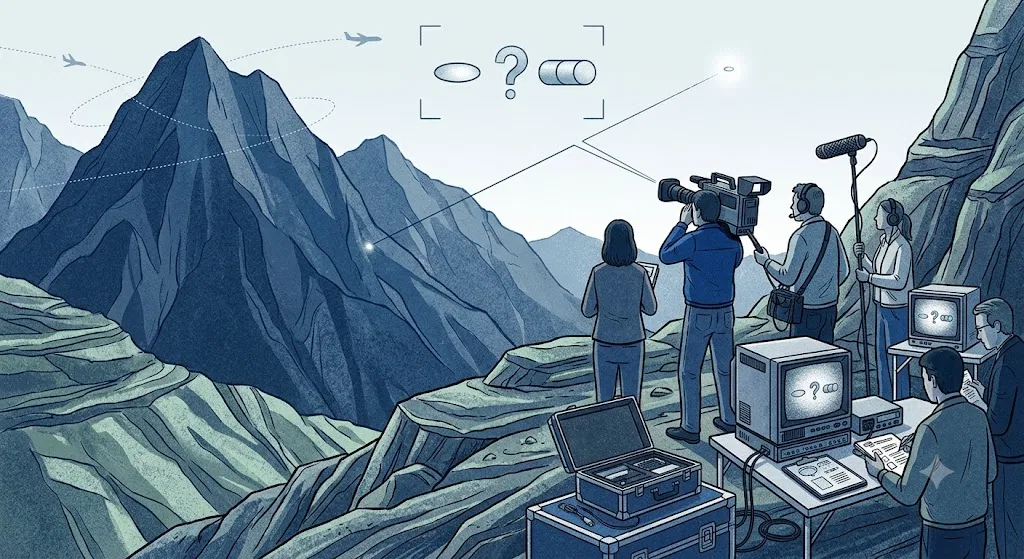
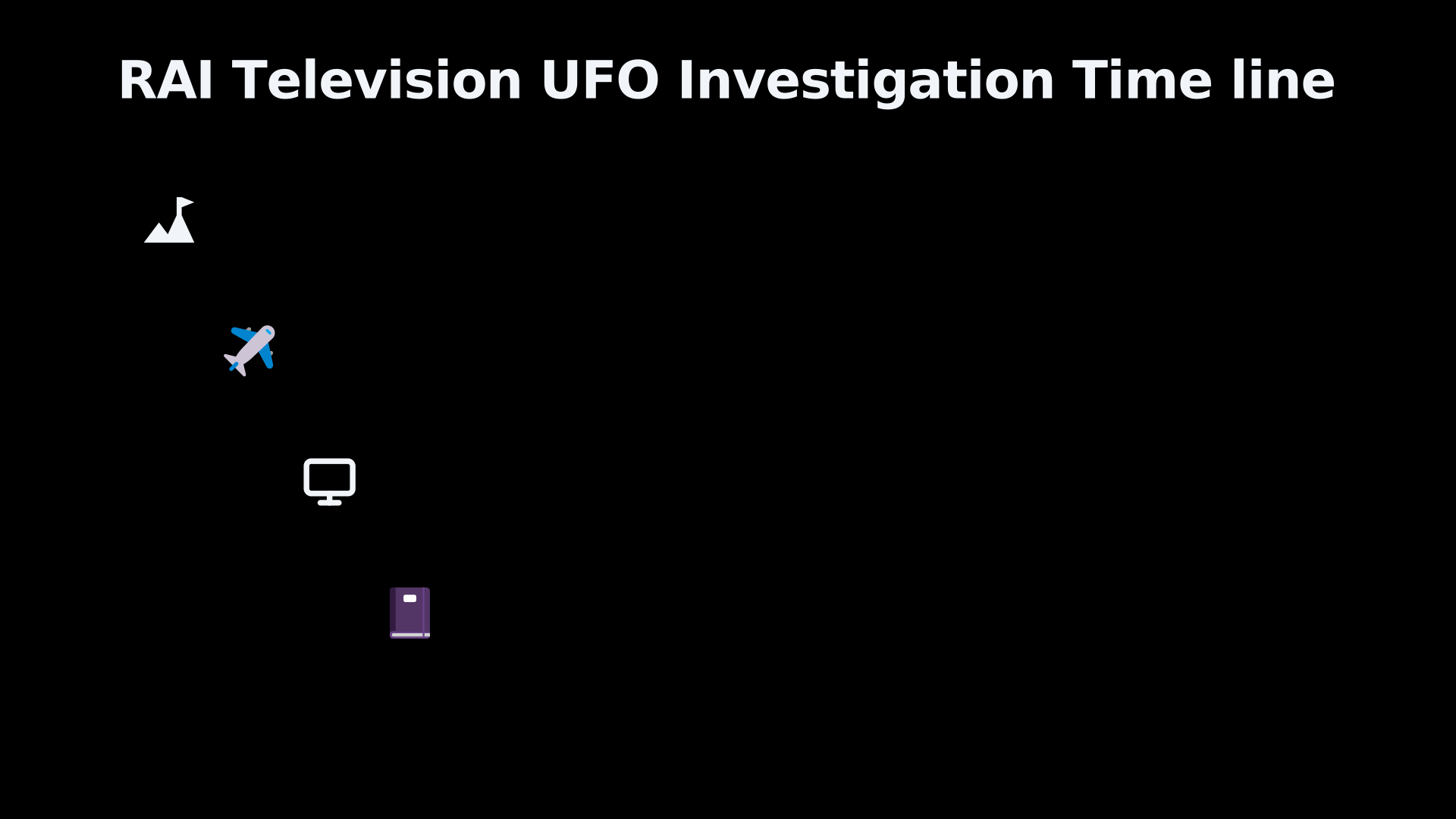
On 15 September 1985, a RAI television crew based in Aosta filmed a small luminous object from a hired light aircraft. The broadcast images were later described as showing the object changing from an oval into a question-mark-like form and then into three adjoining cylinders. That sequence made the incident one of the most visually memorable claims in Aosta Valley’s UFO history.[Reccom Magazine]reccom.orgMagazine Quando la RAI inseguì un UFOReccom MagazineQuando la RAI inseguì un UFO - reccom.org…
The footage does not, however, establish that a solid craft physically changed shape. Investigators who viewed the original recording soon afterwards concluded that the apparent transformations were more likely connected with filming conditions than with changes in the object itself. Most ground witnesses described something resembling a balloon, drop or elongated reflective body, and they did not report the dramatic sequence seen through the camera. The original film is not now readily available for independent frame-by-frame examination, leaving an intriguing television story but a weak foundation for extraordinary claims.[Reccom Magazine]reccom.orgMagazine Quando la RAI inseguì un UFOReccom MagazineQuando la RAI inseguì un UFO - reccom.org…
The reported sequence of shapes
The sighting unfolded over a wide mountainous area extending beyond Aosta Valley into north-western Piedmont. Reports came from the Susa, Chisone and Lanzo valleys and parts of the upper Canavese, suggesting that the object was distant and visible across a broad region rather than hovering close to the RAI aircraft. Witnesses began noticing it early in the morning, and reports continued for several hours until clouds obscured the view.[Reccom Magazine]reccom.orgMagazine Quando la RAI inseguì un UFOReccom MagazineQuando la RAI inseguì un UFO - reccom.org…
RAI responded by hiring a light aircraft and sending a camera crew to obtain closer images. The televised sequence reportedly showed a bright body passing through three striking appearances:
- an elliptical or oval form;
- a hooked outline resembling a question mark;
- three cylinder-like sections apparently joined together.
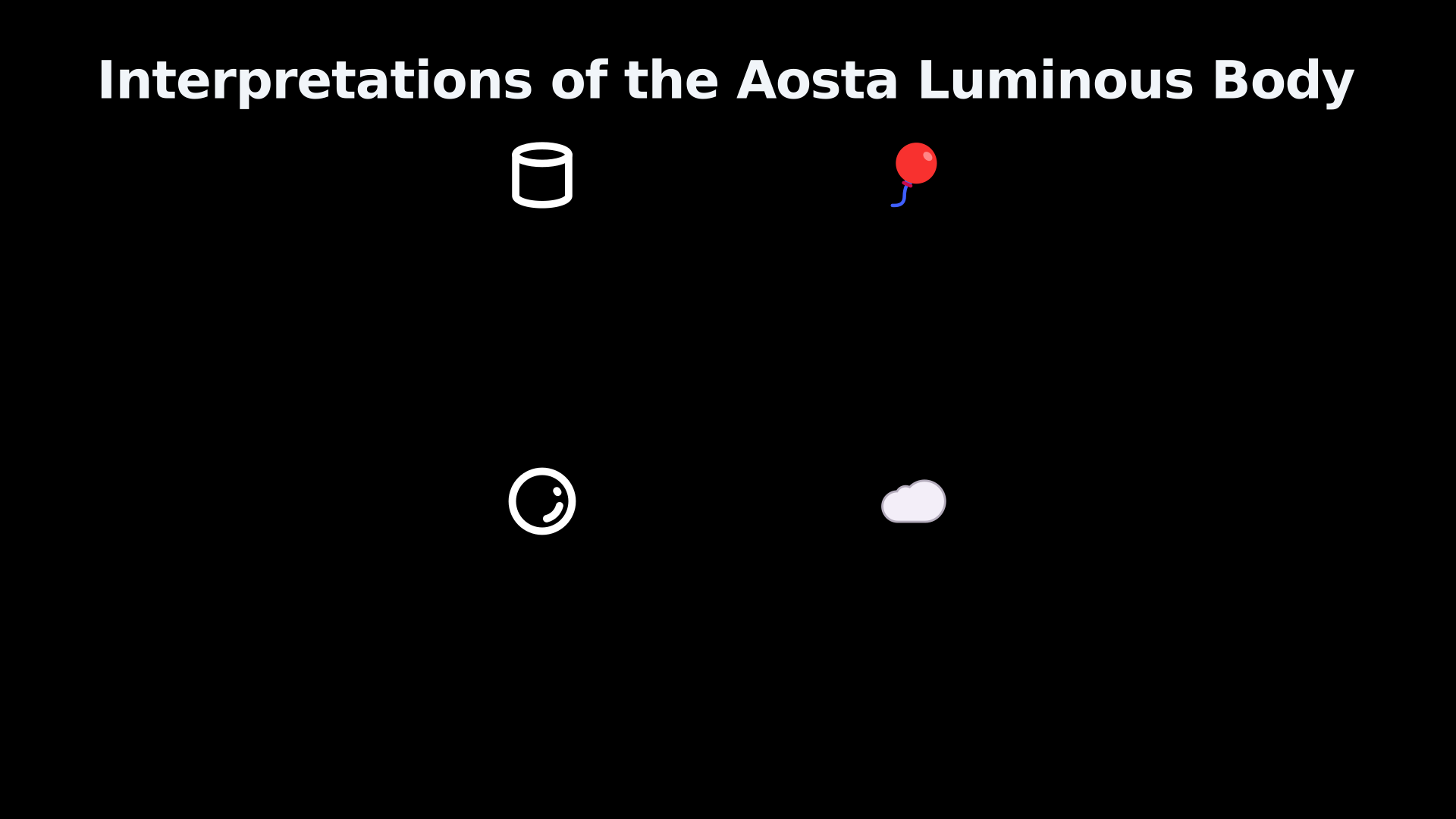
Those descriptions became the defining feature of the case. A vague point of light is common in UFO reporting; a filmed object apparently reorganising itself into recognisable geometric forms sounds much more specific. Yet the comparison between the footage and the witnesses’ unaided observations is crucial. More than half of those later interviewed reportedly compared the object with a weather balloon, an inverted pear, a drop, a rugby ball or a hot-air balloon. Some mentioned appendages or cords below it, while only a minority described more unusual outlines such as organ pipes or a butterfly.[Reccom Magazine]reccom.orgMagazine Quando la RAI inseguì un UFOReccom MagazineQuando la RAI inseguì un UFO - reccom.org…
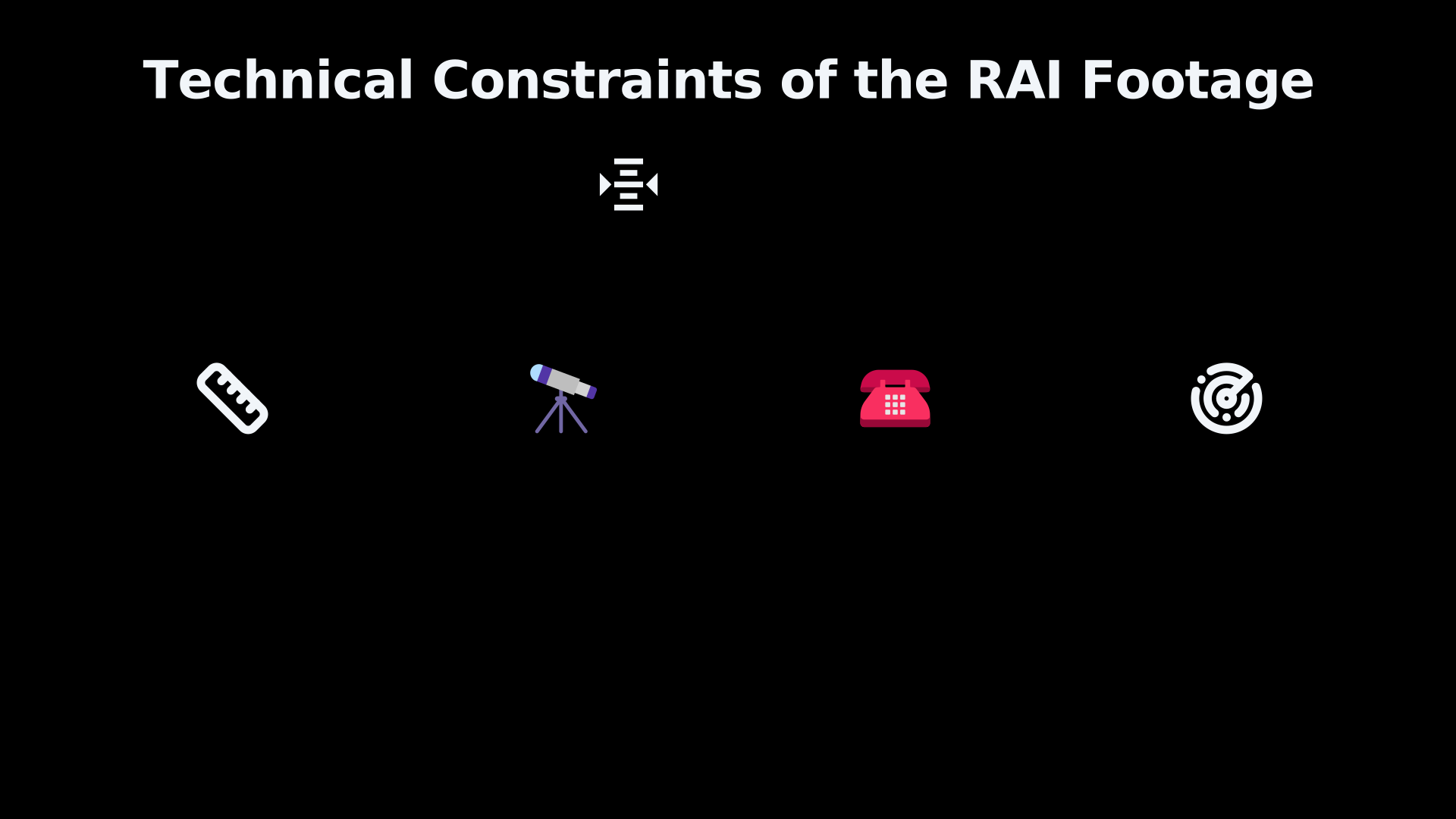
The object was also extremely small to the naked eye. Several witnesses said it looked no larger than a star, and photographs collected from three locations showed, even after substantial enlargement, little more than a pale drop-shaped mark. The large appearance in the television pictures resulted from the use of a telephoto lens, reported as roughly equivalent to 300 millimetres, rather than from the aircraft reaching close range. A journalist involved in the investigation said that the object did not appear noticeably larger from the aircraft than it had from the ground.[Reccom Magazine]reccom.orgMagazine Quando la RAI inseguì un UFOReccom MagazineQuando la RAI inseguì un UFO - reccom.org…
That evidence weakens the most dramatic reading. The camera registered elaborate changes that were not consistently seen by observers using binoculars or small telescopes. When a transformation appears mainly in magnified footage rather than in simultaneous visual testimony, the imaging system becomes part of the phenomenon that must be explained.
How cameras distort bright objects
A camera does not record a distant point of light as a perfectly neutral copy of reality. It records light after it has passed through many kilometres of atmosphere, through a lens and aperture, and onto film or a video sensor. Small errors in focus, exposure, camera movement or optical alignment can therefore produce shapes that belong partly to the recording process.
Defocus and aperture shape
When a distant bright object is out of focus, its light spreads across the image rather than remaining a sharp point. Photographers call the appearance of this out-of-focus light “bokeh”. Nikon’s technical guidance notes that the shape of blurred highlights is influenced by the diaphragm blades inside the lens: a circular aperture tends to produce rounded discs, while a more angular aperture can imprint a polygonal shape. Bright objects photographed out of focus can consequently become diffuse blobs whose outline reflects the lens rather than the object.[Nikon]nikonusa.comNikon Bokeh for BeginnersNikon Bokeh for Beginners
This matters because the RAI target was small, bright and distant—the kind of subject on which precise focus can be difficult to hold, particularly from a moving aircraft. A slight change in focus could enlarge the image, split bright areas or bring lens irregularities into view. If focus was being adjusted during filming, consecutive frames might appear to show a physical transformation even though the underlying light source remained broadly unchanged.
The question-mark description should therefore be treated as an interpretation of an unstable outline, not as a precise technical measurement. Human perception is highly inclined to turn ambiguous forms into familiar symbols. Once a curved blur is described as a question mark, viewers may continue to perceive that symbol even when the image contains too little detail to justify it.
Telephoto movement and airborne vibration
Long lenses magnify camera movement as well as the subject. Canon’s explanation of camera-shake blur notes that the problem becomes more pronounced with super-telephoto lenses. Angular wobble, sideways movement and rotation can each stretch or displace the recorded image. Modern stabilisation systems are designed specifically to correct those effects, but a television camera used in a small aircraft in 1985 would not have benefited from current digital stabilisation and computational correction.[Canon Europe]files.canon-europe.comCanon Europe Camera-shake blur compensation (image stabilizationCanon Europe Camera-shake blur compensation (image stabilization
The aircraft itself introduced several possible sources of instability: engine vibration, turbulence, changes in bank angle and the operator’s attempt to keep a tiny target centred while using magnification. A bright dot moving across several video fields could appear elongated or divided. Motion blur combined with a brief focus shift could plausibly create something resembling adjacent cylinders, especially after copying, broadcasting or enlarging the sequence.
This does not prove that every unusual contour was an artefact. It shows why shape claims drawn from a few magnified frames require the camera settings and motion history before they can be treated as properties of the object.
Atmospheric distortion over long distances
Later investigators reportedly used witness bearings to place the object near Lanslebourg in France, at an estimated altitude of about 22,000 metres and between roughly 40 and 80 kilometres from observers. Those figures were the product of a private UFO investigation rather than a publicly available official flight record, so they should not be regarded as exact. They nevertheless indicate the scale of distance that investigators believed was involved.[Reccom Magazine]reccom.orgMagazine Quando la RAI inseguì un UFOReccom MagazineQuando la RAI inseguì un UFO - reccom.org…
Light travelling over that distance passes through air layers with differing temperatures and densities. NASA describes atmospheric “seeing” as a combination of image motion, blurring and distortion caused by changing refractive conditions in the atmosphere. The effect is familiar in astronomy, where stars appear to shimmer because turbulent air repeatedly alters the path of their light.[NASA Technical Reports Server]ntrs.nasa.govTechnical Reports Server The problem of atmospheric turbulenceNASA Technical Reports ServerThe problem of atmospheric turbulence - NASA Technical Reports Server (NTRS)…
A bright high-altitude object viewed through a powerful lens may therefore fluctuate, stretch or break into uneven patches even when its physical form remains stable. The effect could have been compounded by turbulence around the aircraft itself. Atmospheric distortion alone may not reproduce the exact reported sequence, but it provides a well-established mechanism for rapid changes in the apparent outline of a small distant light.
The balloon interpretation
The strongest conventional interpretation is that the object was a high-altitude balloon or balloon-like research platform reflecting sunlight. This was not simply a later sceptical invention. Many witnesses reportedly reached for balloon comparisons before investigators had settled on an explanation, describing a pear-shaped, drop-shaped or elongated body with possible cords beneath it. Some observers using telescopes said they had to adjust their instruments gradually, suggesting slow drift rather than sudden manoeuvring.[Reccom Magazine]reccom.orgMagazine Quando la RAI inseguì un UFOReccom MagazineQuando la RAI inseguì un UFO - reccom.org…
The reported altitude near 22 kilometres would also be compatible with the broad operating environment of stratospheric balloons, although the surviving investigation summary does not identify a launch, operator or payload. That missing identification prevents the case from being labelled conclusively solved. “Probably a balloon” is better supported than “confirmed balloon”.
Radar evidence does little to rescue the changing-craft interpretation. The Milan Linate radar reportedly detected the RAI aircraft when contacted by the pilot but did not detect the luminous object. A small high-altitude balloon, particularly one made largely of thin material, may present a weak or inconsistent radar return. Equally, the absence of a return cannot identify the target and does not by itself prove that nothing physical was present.[Reccom Magazine]reccom.orgMagazine Quando la RAI inseguì un UFOReccom MagazineQuando la RAI inseguì un UFO - reccom.org…
The duration and behaviour are more informative. The object remained visible for hours, appeared stationary to some witnesses and slowly moving to others, and eventually disappeared behind cloud. That pattern fits a distant body drifting gradually in high-altitude winds more comfortably than an aircraft performing rapid controlled manoeuvres. The reported “shape changes” are the main feature that seems exotic—and they are also the feature most closely tied to the camera rather than to the broader witness record.
What investigators found after the broadcast
Two groups associated with the Italian Centre for UFO Studies, commonly known as CISU, investigated the incident on 16 September, the day after the RAI broadcast. With help from journalist Luciano Caveri, they reportedly viewed the original film at the Aosta RAI office and interviewed the camera operator, the pilot, witnesses and a representative of the airport weather station. A newspaper appeal then produced dozens of additional calls, from which investigators selected witnesses capable of giving useful directional information.[Reccom Magazine]reccom.orgMagazine Quando la RAI inseguì un UFOReccom MagazineQuando la RAI inseguì un UFO - reccom.org…
This rapid fieldwork is one of the stronger aspects of the case. Investigators were not relying only on recollections collected years later; they had access to the original recording and to witnesses while memories were fresh. Their reported conclusion was nevertheless cautious and conventional: the strange forms in the television sequence were probably produced by filming conditions, since comparable transformations had not been observed directly.[Reccom Magazine]reccom.orgMagazine Quando la RAI inseguì un UFOReccom MagazineQuando la RAI inseguì un UFO - reccom.org…
Their reconstruction placed the object over French territory rather than directly above Aosta Valley. That distinction helps explain why the aircraft did not obtain a close, detailed view despite attempting to approach it. A target tens of kilometres away and many kilometres above the aircraft would remain visually small, while a telephoto lens could make it seem close enough to reveal structure.
The investigation also exposes the difference between a television image and a complete evidential package. The film looked dramatic because it enlarged a luminous, unstable shape. The interviews and triangulation made the case less dramatic by indicating great distance, slow movement and balloon-like visual characteristics.
What the missing original footage prevents
The largest obstacle to a firm modern assessment is the absence of a publicly accessible, high-quality copy of the original recording. A current analysis would need more than the short descriptions repeated in later articles. It would require the complete sequence at the best surviving quality, including frames before and after each reported transformation.
Several technical details would be essential:
- the camera and lens model;[files.canon-europe.com]files.canon-europe.comSource details in endnotes. * focal length and aperture;[files.canon-europe.com]files.canon-europe.comSource details in endnotes.
- whether focus was manual or automatic;
- exposure settings and whether highlights were saturated;
- use of filters or image enhancement;
- the aircraft’s movement during each segment;
- whether the broadcast copy was cropped, enlarged or slowed;
- the generation history of any surviving duplicate.
Without those details, claims about “three cylinders” cannot be separated reliably from defocus, motion blur, optical aberration, film grain or video-copy degradation. A compressed online clip copied from an old broadcast would be particularly unreliable because each additional generation can soften edges, exaggerate contrast and merge neighbouring bright areas.
The missing footage also prevents independent testing of the investigators’ conclusion. CISU members reportedly saw the original and judged the transformations to be photographic, but the public cannot reproduce their examination or check whether particular frames support another reading. Their conclusion is plausible and consistent with the witness record, yet it remains a reported assessment rather than a transparent modern analysis.
Equally important, no surviving evidence cited in accessible accounts shows that the object’s apparent shapes were synchronised with independent observations. Had several telescope users reported the oval-to-hook-to-cylinder sequence at the same moments, a camera artefact would be less convincing. Instead, the more dramatic transformations appear confined largely to the television imagery.
Did the RAI camera capture a changing craft?
The available record supports a restrained answer: the RAI camera captured a distant luminous object whose recorded outline changed, but it does not show that a craft physically altered its structure.
Three considerations carry the greatest weight. First, most witnesses described a balloon-like or drop-shaped body rather than a sequence of radically different forms. Second, the object’s apparent behaviour—hours of visibility and slow drift—fits a high-altitude balloon better than an agile vehicle. Third, the difficult filming conditions combined a very small target, a telephoto lens, an unstable airborne platform and a long atmospheric path, all of which can distort bright objects.[reccom.org]reccom.orgMagazine Quando la RAI inseguì un UFOReccom MagazineQuando la RAI inseguì un UFO - reccom.org…
The case is therefore best classified as probably explained but not conclusively identified. The probable explanation is a distant balloon whose image was altered by focus, camera movement and atmospheric turbulence. The unresolved part is the lack of a confirmed launch record or surviving original film that can be examined independently.
Within Aosta Valley’s wider UFO history, the incident remains important because it demonstrates how television evidence can both strengthen and mislead. RAI’s involvement gave the report unusual credibility and preserved an apparently extraordinary visual sequence. Yet the accompanying investigation shifted attention away from the suggestive shapes and towards distance, optics and witness comparison. The enduring mystery lies less in a craft changing form than in how an ordinary-looking high-altitude object became extraordinary when viewed through a camera.
Amazon book picks
Further Reading
Books and field guides related to Did the RAI Camera Capture a Changing Craft?. Use these as the next step if you want deeper reading beyond the article.
UFOs Explained
Analyzing several UFO cases, the author exposes the myth of extraterrestrial visitors to earth.
The Photographer's Eye
Design is the single most important factor in creating a successful photograph. The ability to see the potential for a strong picture and...
Photo Fakery: The History and Techniques of Photographic Dece...
The history and techniques of photographic deception and manipulation
eBay marketplace picks
Marketplace Samples
Live-tested eBay searches with available results related to this page.
Selected fromUFO poster oneBay.co.uk.

Current eBay listing
VINTAGE UFO FLYING SAUCERS COMIC ADVERTISING A2 POSTER PRINT



Current eBay listing
I Want To Believe UFO Poster Giclée Fine Art Heavyweight Print
Endnotes
1.
Source: reccom.org
Title: Magazine Quando la RAI inseguì un UFO
Link:https://reccom.org/quando-la-rai-insegui-un-ufo/
Source snippet
Reccom MagazineQuando la RAI inseguì un UFO - reccom.org...
2.
Source: files.canon-europe.com
Title: Canon Europe Camera-shake blur compensation (image stabilization)
Link:https://files.canon-europe.com/files/webcontent/rf-lens-world/knowledge/correction/index.html
3.
Source: ntrs.nasa.gov
Title: Technical Reports Server The problem of atmospheric turbulence
Link:https://ntrs.nasa.gov/citations/19850019153
Source snippet
NASA Technical Reports ServerThe problem of atmospheric turbulence - NASA Technical Reports Server (NTRS)...
4.
Source: apod.nasa.gov
Link:https://apod.nasa.gov/apod/ap210210.html
Source snippet
Astronomy Picture of the DayAtmospheric turbulence is a problem for astronomers because it blurs the images of the sources they want to s...
5.
Source: canon-europe.com
Link:https://www.canon-europe.com/press-centre/press-releases/2026/04/canon-expands-professional-video-ecosystem-with-ultra-telephoto-cinema-zoom-lens-and-ptz-controller/
Source snippet
Canon EuropeApril 15, 2026 — CAPTURE AND CONTROL: CANON EXPANDS PROFESSIONAL VIDEO ECOSYSTEM WITH ULTRA-TELEPHOTO CINEMA ZOOM LENS AND PT...
Published: April 15, 2026
6.
Source: nasa.gov
Title: Cloud Patterns Over the Prince Edward Islands
Link:https://www.nasa.gov/image-article/cloud-patterns-over-prince-edward-islands/
7.
Source: lambda.gsfc.nasa.gov
Link:https://lambda.gsfc.nasa.gov/product/websites/AMI/mrao.cam.ac.uk/telescopes/coast/theses/rnt/node7.html
8.
Source: ntrs.nasa.gov
Link:https://ntrs.nasa.gov/citations/20030091469
9.
Source: lambda.gsfc.nasa.gov
Link:https://lambda.gsfc.nasa.gov/product/websites/AMI/mrao.cam.ac.uk/telescopes/coast/handout.html
10.
Source: ntrs.nasa.gov
Link:https://ntrs.nasa.gov/citations/19920009569
11.
Source: ntrs.nasa.gov
Link:https://ntrs.nasa.gov/citations/19770043329
12.
Source: ntrs.nasa.gov
Link:https://ntrs.nasa.gov/search.jsp?R=19740061029
13.
Source: ao.jpl.nasa.gov
Link:https://ao.jpl.nasa.gov/palao.html
14.
Source: apod.nasa.gov
Title: nslens effects
Link:https://apod.nasa.gov/htmltest/gifcity/nslens_effects.html
15.
Source: heasarc.gsfc.nasa.gov
Link:https://heasarc.gsfc.nasa.gov/docs/xmm/uhb/omdistortion.html
16.
Source: rai.it
Link:https://www.rai.it/dl/RaiTV/programmi/media/ContentItem-33269ff3-e4c9-434a-8d51-c893495eaf3e.html
17.
Source: files.canon-europe.com
Link:https://files.canon-europe.com/files/webcontent/rf-lens-world/features/rf-lineup/index.html?pop=pop18
18.
Source: files.canon-europe.com
Link:https://files.canon-europe.com/files/webcontent/rf-lens-world/history/index.html
19.
Source: files.canon-europe.com
Link:https://files.canon-europe.com/files/webcontent/rf-lens-world/features/technology/index.html?pop=pop16
20.
Source: tst-sfcc-service.canon-europe.com
Link:https://tst-sfcc-service.canon-europe.com/1178C001/1178C001.html
21.
Source: sfcc-service.canon-europe.com
Link:https://sfcc-service.canon-europe.com/3447C005/3447C005.html
22.
Source: sfcc-service.canon-europe.com
Link:https://sfcc-service.canon-europe.com/3044C005/3044C005.html
23.
Source: files.canon-europe.com
Link:https://files.canon-europe.com/files/webcontent/rf-lens-world/knowledge/perspective/index.html
24.
Source: sfcc-service.canon-europe.com
Link:https://sfcc-service.canon-europe.com/4409B005/4409B005.html
25.
Source: sfcc-service.canon-europe.com
Link:https://sfcc-service.canon-europe.com/5776C005/5776C005.html
26.
Source: sfcc-service.canon-europe.com
Link:https://sfcc-service.canon-europe.com/9524B005/9524B005.html
27.
Source: nikonusa.com
Title: Nikon Bokeh for Beginners
Link:https://www.nikonusa.com/learn-and-explore/c/tips-and-techniques/bokeh-for-beginners
28.
Source: nikonusa.com
Title: 135mm plena
Link:https://www.nikonusa.com/press-room/135mm-plena
29.
Source: nikonusa.com
Link:https://www.nikonusa.com/press-room/24mm
30.
Source: nikonusa.com
Link:https://www.nikonusa.com/press-room/a-coveted-classic-reborn-nikkor-noct
31.
Source: library.metoffice.gov.uk
Title: metoffice.gov.uk Noninverted images in inferior mirages
Link:https://library.metoffice.gov.uk/portal/Default/en-GB/RecordView/Index/150152
32.
Source: weather.metoffice.gov.uk
Title: metoffice.gov.uk How we measure visibility
Link:https://weather.metoffice.gov.uk/guides/observations/how-we-measure-visibility
33.
Source: library.metoffice.gov.uk
Title: Record View
Link:https://library.metoffice.gov.uk/portal/Default/en-GB/RecordView/Index/471177
34.
Source: library.metoffice.gov.uk
Title: Record View
Link:https://library.metoffice.gov.uk/portal/Default/en-GB/RecordView/Index/458258
35.
Source: weather.metoffice.gov.uk
Title: metoffice.gov.uk Optical effects: nature’s light show
Link:https://weather.metoffice.gov.uk/learn-about/weather/optical-effects
36.
Source: weather.metoffice.gov.uk
Title: metoffice.gov.uk Understanding weather
Link:https://weather.metoffice.gov.uk/learn-about/met-office-for-schools/other-content/other-resources/understanding-weather
37.
Source: metoffice.gov.uk
Title: Radiative transfer in the atmosphere
Link:https://www.metoffice.gov.uk/research/foundation/parametrizations/radiative-transfer
38.
Source: library.metoffice.gov.uk
Link:https://library.metoffice.gov.uk/Portal/Default/en-GB/RecordView/Index/254335
39.
Source: weather.metoffice.gov.uk
Title: metoffice.gov.uk Coriolis effect
Link:https://weather.metoffice.gov.uk/learn-about/weather/how-weather-works/coriolis-effect
40.
Source: library.metoffice.gov.uk
Title: Record View
Link:https://library.metoffice.gov.uk/portal/Default/en-GB/RecordView/Index/416095
41.
Source: library.metoffice.gov.uk
Link:https://library.metoffice.gov.uk/Portal/Default/en-GB/RecordView/Index/52993
42.
Source: library.metoffice.gov.uk
Link:https://library.metoffice.gov.uk/portal/Default/en-GB/RecordView/Index/88979
43.
Source: it.scribd.com
Link:https://it.scribd.com/document/490374032/Ufo
44.
Source: nikonusa.com
Link:https://www.nikonusa.com/learn-and-explore/c/tips-and-techniques/top-tips-for-photographing-holiday-light-displays
45.
Source: nikonusa.com
Link:https://www.nikonusa.com/learn-and-explore/c/tips-and-techniques/photograph-the-classic-holiday-light-bokeh-effect
46.
Source: nikonusa.com
Link:https://www.nikonusa.com/p/nikkor-z-50mm-f18-s/20083/overview
47.
Source: nikonusa.com
Link:https://www.nikonusa.com/p/nikkor-z-dx-24mm-f17/20119/overview
48.
Source: nikonusa.com
Link:https://www.nikonusa.com/p/af-s-dx-micro-nikkor-40mm-f28g/2200/overview
49.
Source: nikonusa.com
Title: creating bokeh in a photo with the af s dx nikkor 35mm f 1 8g lens
Link:https://www.nikonusa.com/learn-and-explore/c/tips-and-techniques/creating-bokeh-in-a-photo-with-the-af-s-dx-nikkor-35mm-f-1-8g-lens
50.
Source: nikonusa.com
Link:https://www.nikonusa.com/p/nikkor-z-85mm-f12-s-refurbished/20114Q/overview
51.
Source: nikonusa.com
Link:https://www.nikonusa.com/learn-and-explore/c/tips-and-techniques/bright-idea-adding-star-power
Additional References
52.
Source: arpnet.it
Title: QUANDO LA RAI INSEGUI’ L’UFO IN AEREO
Link:https://www.arpnet.it/ufo/r2pallone.htm
Source snippet
QUANDO LA RAI INSEGUI' L'UFO IN AEREO - ARPnetDomenica 15 settembre 1985 i telegiornali serali di entrambe le reti RAI riportarono...
53.
Source: youtube.com
Title: Shapeshifting Cloud Sighting Sparks Alien Debate (S5) | The Proof Is Out There
Link:https://www.youtube.com/watch?v=pq1H4Xp0mGQ
Source snippet
CLEAREST UFO Footage EVER FILMED? Inside The Italian Alien Stalker Case...
54.
Source: youtube.com
Title: Is This Footage Proof That Shapeshifting UFOs Threaten US Military?
Link:https://www.youtube.com/watch?v=NI_UMzXh26k
Source snippet
Shapeshifting Cloud Sighting Sparks Alien Debate (S5) | The Proof Is Out There...
55.
Source: youtube.com
Title: UFO Encounters In Europe | Never-Seen-Before Evidence!
Link:https://www.youtube.com/watch?v=n7FS9BXBa8E
Source snippet
Fascist UFOs - Italian Mass Sightings | Full Documentary Mediatime Network · 1.9K views...
56.
Source: youtube.com
Title: CLEAREST UFO Footage EVER FILMED? Inside The Italian Alien Stalker Case
Link:https://www.youtube.com/watch?v=RJADBG-qsbw
Source snippet
UFO Encounters In Europe | Never-Seen-Before Evidence...
57.
Source: youtube.com
Title: Fascist UFOs
Link:https://www.youtube.com/watch?v=ojvSWFiJiec
Source snippet
Is This Footage Proof That Shapeshifting UFOs Threaten US Military?...
58.
Source: scribd.com
Title: 16512951 Itufor03
Link:https://www.scribd.com/doc/40774837/16512951-Itufor03
Source snippet
Lanslebourg, just beyond the French borderline, at a height of about 22,000 meters (66,000 feet), and so at a distance of 40 to 80 kilome...
59.
Source: currys.co.uk
Link:https://www.currys.co.uk/phones/mobile-phones/mobile-phones/apple/iphone-15
60.
Source: apple.com
Link:https://www.apple.com/uk/iphone/compare/?modelList=iphone-15%2Ciphone-X
61.
Source: brill.com
Link:https://brill.com/downloadpdf/display/title/22701.pdf?srsltid=AfmBOop4dNkUrzu9rMF06xduDWgUTV4kWOAftm2HrPDIRPPptsUlu1N4