Within Alpine UFO Files
Does No Radar Return Mean Nothing Was There?
A missing radar return can weaken a sighting claim, but it cannot exclude every small, distant or poorly positioned object.
On this page
- What Bolzano Airport reported
- Which objects radar may miss
- How radar claims should be interpreted
Page outline Jump by section
Introduction
A missing radar return can weaken a UFO claim, but it does not prove that nothing was present. That distinction is especially important around Bolzano, where mountains restrict lines of sight and where the phrase “airport radar” can suggest a level of local surveillance that the available records do not support.
The best-known relevant sighting is the large white light reported over the Bolzano basin by Monica Trettel and three companions, probably in 2010. The surviving public account describes a silent light watched for roughly ten minutes before it appeared to move rapidly towards Renon. It does not reproduce an airport log, radar plot, controller’s statement or official investigation showing that Bolzano Airport searched for the object and found nothing.[Franz Magazine]franzmagazine.comFranz Magazine Monica Trettel e l’incontro ravvicinato con gli Ufo sullo SciliarFranz Magazine Monica Trettel e l’incontro ravvicinato con gli Ufo sullo Sciliar
This evidence gap matters. “It was not on the airport’s radar” is not a self-explanatory fact. Before treating it as decisive, a reader needs to know which surveillance system was operating, where its sensors were located, whether the reported object was inside their coverage, and whether it was the kind of target those systems were designed to detect.
What Bolzano Airport reported
The first problem is that no accessible primary document has been found in which Bolzano Airport formally reports a negative radar result for the Sciliar or Bolzano-basin sighting. Trettel’s published narrative says that the astronomical observatory at Collepietra had also observed the phenomenon and received other reports. It mentions a newspaper explanation involving material released during a satellite launch, but it says nothing about controllers examining recorded radar data.[Franz Magazine]franzmagazine.comFranz Magazine Monica Trettel e l’incontro ravvicinato con gli Ufo sullo SciliarFranz Magazine Monica Trettel e l’incontro ravvicinato con gli Ufo sullo Sciliar
That absence should not be filled with assumptions. A later retelling may compress several different claims—“the airport saw nothing”, “air traffic control reported no unknown aircraft” and “there was no radar contact”—into one apparently authoritative statement. They are not equivalent.
An airport employee looking from the tower could fail to see a light hidden by terrain or outside the view from the aerodrome. A controller could report that no unidentified aircraft appeared on the operational traffic display. A radar technician could conduct a retrospective examination of raw primary-radar recordings. Each would answer a different question, and only the last would directly test whether a non-cooperative reflecting object produced detectable echoes.
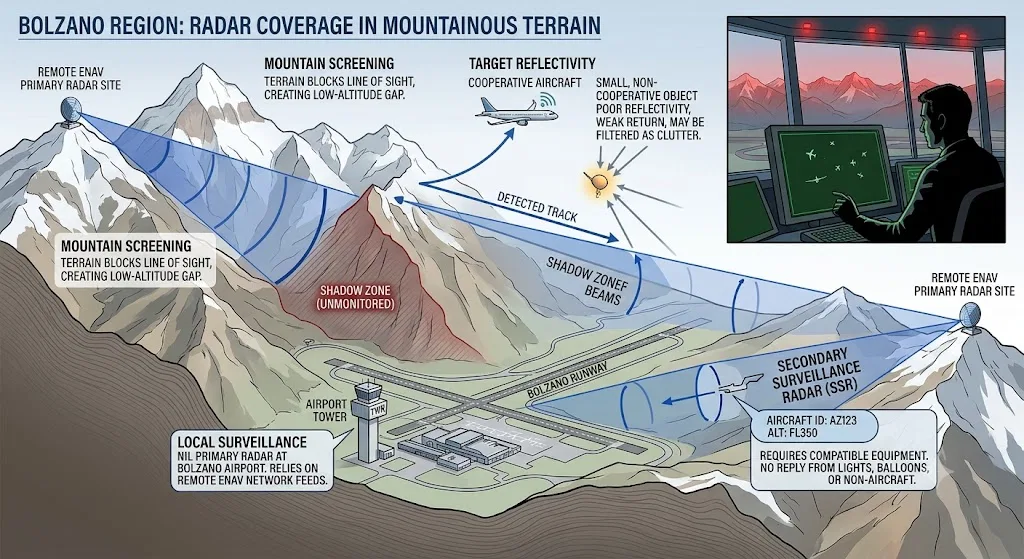
Bolzano Airport’s own fact sheet identifies it as a civil and military aerodrome south of the city, with ENAV operating the tower. The document lists its runways and operational facilities but does not claim that the airport possesses its own primary air-surveillance radar.[Bolzano Airport]bolzanoairport.itBolzano Airport An aeronautical-information reproduction dated 2023 is more explicit: under the use of radar for aerodrome control, surface movements and technical characteristics, the Bolzano entry states “NIL”.[NextDigital]nextdigital.itNext Digital1 LIPB BOLZANO1 LIPB BOLZANO - NextDigitalJune 1, 2023 — 20 Apr 2023 — RADAR RADAR PROCEDURES. Use of radar in Aerodrome Control Service. Us…
This does not mean that aircraft around Bolzano are wholly invisible to Italian air-traffic surveillance. ENAV operates a national network of primary radars, secondary radars and other surveillance systems, and information may be supplied from facilities well beyond an individual airport.[Enav]enav.itSurveillance SystemsENAV uses 9 primary radars and 12 secondary radars for controlling en-route traffic, and 18 primary and 18 second… It does mean that the casual expression “Bolzano Airport radar” is potentially misleading. A negative check could have referred to a remote radar feed, cooperative aircraft data or the absence of recognised traffic—not necessarily to a sensitive local sensor scanning every part of the Bolzano basin.
Which objects radar may miss
Radar is not a single all-seeing instrument. Air-traffic management commonly combines several technologies, each with different detection requirements.
Primary surveillance radar transmits radio energy and listens for echoes reflected from an object. It can detect a target that carries no radio equipment, but the strength of the return depends on factors including range, orientation, material, size and the amount of background clutter. The US Federal Aviation Administration’s basic description makes the central mechanism clear: a target appears only when enough transmitted energy is reflected back and processed as a usable return.[Federal Aviation Administration]faa.govFederal Aviation Administration Chapter 4Air Traffic ControlPrimary radar relies on a signal being transmitted from the radar antenna site and for this signal to be reflected or…
Secondary surveillance radar works cooperatively. It interrogates an aircraft transponder and receives a coded reply containing identification and, depending on the mode, altitude or other flight data. A light, balloon, bird, drone, atmospheric effect or distant rocket plume would not appear through this channel unless it carried compatible equipment and was transmitting correctly. EUROCONTROL specifications describe Mode S stations as systems that obtain surveillance data from aircraft equipment, including transponder replies and Automatic Dependent Surveillance–Broadcast, or ADS-B, transmissions.[EUROCONTROL]eurocontrol.intEUROCONTROL Specification for European Mode S…September 20, 2021 — 17 Sept 2021 — This document provides specification for…
ADS-B is also cooperative. The aircraft calculates its own position and broadcasts it. It is valuable for following normal aviation traffic, but the absence of an ADS-B track says little about a non-aircraft light or an object not carrying an operating transmitter.
Even primary radar has important limits.
Mountain screening. Ground radar normally depends on a clear radio line of sight. Mountains can block the beam just as they block a view, leaving shadowed areas at low altitude or inside adjoining valleys. EUROCONTROL technical material notes that selecting radar sites in mountainous regions is complex and illustrates the problem with valleys enclosed by peaks above 2,000 metres.[EUROCONTROL]eurocontrol.intFinal ReportFinal ReportJune 11, 2007 — Optimising the site of a radar may be a complex task in difficult terrain such as mountains. This… FAA guidance likewise states that terrain, obstructions and the curvature of the Earth can block radar and surveillance signals.[Federal Aviation Administration]faa.govFederal Aviation Administration4Air Traffic Control Radar Beacon System (ATCRBS)8 Jan 2015 — This maximum range can vary by radar site and is always subject to “line of…
This is particularly relevant to the Bolzano basin, which is enclosed by steep Alpine terrain. A target apparently seen against or below a ridge from Aica di Fiè might occupy a very different line of sight from one available to a sensor elsewhere. Without a measured altitude and position, it is impossible to establish whether it should have been visible to a specific radar.
Small or weakly reflective targets. Radar detectability is not determined by visual brightness. A brilliant light can come from a physically small source, while a large dark aircraft may produce a strong radar echo. Some shapes and materials reflect energy poorly towards the receiver. Distance further weakens the returned signal. A primary radar optimised for aircraft safety is not guaranteed to display every small object, bird, lightweight balloon or fragment within its theoretical range.
Ground and weather clutter. Mountains, buildings, precipitation and other fixed or slowly moving reflectors can generate unwanted echoes. Processing systems suppress much of this clutter so that controllers are not overwhelmed by unusable marks. The trade-off is that a weak, slow or apparently stationary target close to terrain may be filtered, merged with background returns or judged operationally irrelevant. EUROCONTROL training material lists line-of-sight restrictions, environmental effects and clutter among primary radar’s basic limitations.[EUROCONTROL]eurocontrol.intOpen source on eurocontrol.int.
This point bears directly on Trettel’s description. She said the light remained motionless for much of the observation. If that impression was accurate and the source lay low against the mountains, it would represent a difficult detection geometry for systems designed principally to track moving aircraft in managed airspace. That is a conditional technical observation, not evidence that an extraordinary craft escaped detection.
Uncertain position. Eyewitnesses can usually report a direction, elevation and apparent movement, but they rarely know range. A light appearing “over Bolzano” could be relatively close, far beyond the city or high above the horizon. The difference may amount to tens or hundreds of kilometres. Without triangulation from known observation points, investigators cannot confidently compare the sighting with a particular radar’s coverage volume.
Brief or intermittent returns. Radar antennas scan rather than watch every direction continuously. Detection normally depends on repeated returns being associated into a track. A weak echo that appears during only one or two rotations may never become a stable symbol on an operational display. Air-traffic controllers also assess a history of measurements rather than treating every isolated radar report as a meaningful aircraft track.[ICAO]icao.intOpen source on icao.int.
Recording and retention. Even where appropriate radar coverage existed, a later investigation requires preserved data, accurate timing and enough positional information to select the correct section of the recording. A witness asking general questions the following day is not equivalent to a documented technical review. For the Bolzano account, no publicly available radar recording, coverage diagram, controller transcript or technical analysis has emerged.
How radar claims should be interpreted
A negative radar result is most persuasive when investigators can demonstrate that the reported target should have been detected. That requires more than a statement that an airport was nearby.
A strong non-detection would specify:
- the exact date and time, including the correct time zone;
- the witnesses’ positions and measured sight lines;
- a credible estimate of the object’s range, altitude and path;
- the radar or surveillance station examined;
- whether the system was primary, secondary, ADS-B or a combined display;
- the sensor’s coverage and minimum detectable altitude in that direction;
- confirmation that it was operating normally;
- the search criteria applied to recorded data;
- and whether weak, uncorrelated or clutter-filtered returns were also examined.
None of that material is publicly documented for the Bolzano-basin episode. The non-detection claim therefore cannot carry the weight sometimes placed upon it.
This does not make the original sighting stronger by default. Radar absence still has evidential value when testing particular explanations. If witnesses claimed that a large conventional aircraft flew for ten minutes through well-covered controlled airspace, with its transponder operating and at an altitude visible to several surveillance stations, the absence of any corresponding track would count against that interpretation. It would also weaken claims of a substantial object following the precise local route imagined by the witnesses.
But the same absence would be much less informative for a rocket-related cloud at great distance, a bright astronomical or atmospheric phenomenon, a small non-cooperative object, or something seen low against mountainous terrain. Such possibilities may create a striking visual display without producing an expected aircraft track. Trettel’s report was in fact publicly associated with material released during a military satellite launch from Vandenberg, although she and other witnesses argued that this did not match their impression of a low, controlled light.[Franz Magazine]franzmagazine.comFranz Magazine Monica Trettel e l’incontro ravvicinato con gli Ufo sullo SciliarFranz Magazine Monica Trettel e l’incontro ravvicinato con gli Ufo sullo Sciliar Radar non-detection would not settle that disagreement because a distant illuminated cloud is not an aircraft-sized solid target travelling over Bolzano.
The Italian Air Force’s investigation procedure also cautions against treating radar as a simple yes-or-no test. Its stated method is to look for correlations with human activities and natural phenomena, involving other competent bodies where necessary. A report remains unidentified only if those enquiries fail to establish an explanation.[Aeronautica Militare]aeronautica.difesa.itAeronautica Militare OVNIAeronautica Militare OVNI Radar information can be one component of that process, alongside aviation movements, launches, astronomy, weather and witness accounts.
For the UFO history of Trentino-Alto Adige, the responsible conclusion is therefore limited but useful. There is no publicly demonstrated Bolzano Airport radar result that disproves the reported light, and the local Alpine setting provides several technical reasons why some targets or luminous phenomena might not appear on an air-traffic display. At the same time, the lack of a radar track offers no support for an exotic interpretation. It leaves the case dependent on human observation and on the disputed satellite-launch explanation, without the independent positional evidence that could establish whether the light was genuinely nearby, physically solid or moving through the Bolzano basin.
A missing return is best treated as one piece of negative evidence whose strength depends on documented sensor capability and geometry. In the Bolzano case, those supporting details are missing. The result is not proof that nothing was there, but a reminder that “not detected” and “not present” are technically different claims.
Amazon book picks
Further Reading
Books and field guides related to Does No Radar Return Mean Nothing Was There?. Use these as the next step if you want deeper reading beyond the article.
Radar Handbook
Publisher's Note: Products purchased from Third Party sellers are not guaranteed by the publisher for quality, authenticity, or access to...
Introduction to Radar Systems
Since the publication of the second edition of "Introduction to Radar Systems," there has been continual development of new radar capabil...
UFOs: Generals, Pilots, and Government Officials Go on the Re...
NEW YORK TIMES BESTSELLER • Impeccably researched, this riveting journalistic investigation separates fact from fiction, and documents th...
The UFO Handbook: A Guide to Investigating, Evaluating, and R...
An explanation of the usual reasons for confusing IFOs (identified flying objects) with UFOs and a survey of the tools used to investigat...
eBay marketplace picks
Marketplace Samples
Live-tested eBay searches with available results related to this page.
Selected fromaviation poster oneBay.co.uk.




Endnotes
1.
Source: bolzanoairport.it
Title: Bolzano Airport
Link:https://www.bolzanoairport.it/images/pdf/160615_Factsheet-EN.pdf
2.
Source: nextdigital.it
Title: Next Digital1 LIPB BOLZANO
Link:https://www.nextdigital.it/apps/aip/browse/ad/adppb1-1
Source snippet
1 LIPB BOLZANO - NextDigitalJune 1, 2023 — 20 Apr 2023 — RADAR RADAR PROCEDURES. Use of radar in Aerodrome Control Service. Us...
Published: June 1, 2023
3.
Source: enav.it
Link:https://www.enav.it/en/node/17161
Source snippet
Surveillance SystemsENAV uses 9 primary radars and 12 secondary radars for controlling en-route traffic, and 18 primary and 18 second...
4.
Source: faa.gov
Title: Federal Aviation Administration Chapter 4
Link:https://www.faa.gov/air_traffic/publications/atpubs/aim_html/chap4_section_5.html
Source snippet
Air Traffic ControlPrimary radar relies on a signal being transmitted from the radar antenna site and for this signal to be reflected or...
5.
Source: eurocontrol.int
Link:https://www.eurocontrol.int/sites/default/files/2021-09/eurocontrol-ems-spec-ed-4-0.pdf
Source snippet
EUROCONTROL Specification for European Mode S...September 20, 2021 — 17 Sept 2021 — This document provides specification for...
Published: September 20, 2021
6.
Source: eurocontrol.int
Title: Final Report
Link:https://www.eurocontrol.int/sites/default/files/2019-05/final_report_rev-.pdf
Source snippet
Final ReportJune 11, 2007 — Optimising the site of a radar may be a complex task in difficult terrain such as mountains. This...
Published: June 11, 2007
7.
Source: faa.gov
Title: Federal Aviation Administration4-5-2
Link:https://www.faa.gov/air_traffic/publications/atpubs/AIM/aim0405.html
Source snippet
Air Traffic Control Radar Beacon System (ATCRBS)8 Jan 2015 — This maximum range can vary by radar site and is always subject to “line of...
8.
Source: faa.gov
Link:https://www.faa.gov/air_traffic/publications/atpubs/aim_html/chap4_section_1.html
9.
Source: eurocontrol.int
Link:https://www.eurocontrol.int/sites/default/files/publication/files/20090827-atsep-ccc-initial-training-spec-v1.0.pdf
10.
Source: icao.int
Link:https://www.icao.int/sites/default/files/Meetings/AMC/MA/2003/adsb_2003/wp16.pdf
11.
Source: enav.it
Link:https://www.enav.it/en/what-we-do/we-create-solutions-for-international-markets/civil-military
12.
Source: enav.it
Link:https://www.enav.it/en/what-we-do/we-create-solutions-for-international-markets/research-development
13.
Source: enav.it
Link:https://www.enav.it/node/16109
14.
Source: eurocontrol.int
Title: p15 04 01 d10 final report part 2v1.1
Link:https://www.eurocontrol.int/sites/default/files/2019-06/p15-04-01-d10-final-report-part-2v1.1.pdf
15.
Source: eurocontrol.int
Title: surveillance mode s concept of operations 19961128
Link:https://www.eurocontrol.int/sites/default/files/2019-04/surveillance-mode-s-concept-of-operations-19961128.pdf
16.
Source: eurocontrol.int
Link:https://www.eurocontrol.int/sites/default/files/2021-07/eurocontrol-tod-manual-ed-3-0.pdf
17.
Source: eurocontrol.int
Title: 007 GNSS Sole Service Feasibility Study
Link:https://www.eurocontrol.int/sites/default/files/library/007_GNSS_Sole_Service_Feasibility_Study.pdf
18.
Source: eurocontrol.int
Title: 22102007 b amc project deliverable d4 v11
Link:https://www.eurocontrol.int/sites/default/files/2019-05/22102007-b-amc-project-deliverable-d4-v11.pdf
19.
Source: eurocontrol.int
Title: eurocontrol irina stakeholder workshop sol0379 keynotes 17 18022026
Link:https://www.eurocontrol.int/sites/default/files/2026-03/eurocontrol-irina-stakeholder-workshop-sol0379-keynotes-17-18022026.pdf
20.
Source: eurocontrol.int
Title: cn decisions 95 en
Link:https://www.eurocontrol.int/sites/default/files/content/documents/official-documents/pc/commission-act/cn-decisions-95-en.pdf
21.
Source: eurocontrol.int
Link:https://www.eurocontrol.int/publication/air-traffic-control-surveillance-coverage-maps
22.
Source: icao.int
Link:https://www.icao.int/sites/default/files/APAC/Documents/edocs/CNS/gmst_technology.pdf
23.
Source: icao.int
Title: Meeting Aireon
Link:https://www.icao.int/sites/default/files/sp-files/SAM/Documents/2016-CRPP4/ICAO%20Meeting%20Aireon.pdf
24.
Source: icao.int
Link:https://www.icao.int/sites/default/files/sp-files/SAM/Documents/2022-RLA06901-ADSBYADSBANP1/1b.%20CONOPS%20ADSBANP01-APN%20rev%2002%20MAR%202022%20Eng.pdf
25.
Source: icao.int
Link:https://www.icao.int/ru/filebrowser/download/94707?fid=94707
26.
Source: icao.int
Title: WP01 ADSBANP01 and Apx
Link:https://www.icao.int/sites/default/files/sp-files/SAM/Documents/2022-RLA06901-ADSBYADSBANP1/WP01-ADSBANP01%20and%20Apx.pdf
27.
Source: icao.int
Title: ADSB Guide Vs1.2 English
Link:https://www.icao.int/sites/default/files/SAM/eDocuments/ADSB%20Guide%20Vs1.2%20English.pdf
28.
Source: icao.int
Link:https://www.icao.int/sites/default/files/sp-files/SAM/Documents/2017-ADSB/15%20Aireon-NAM%20CAR%20SAM%20ADS-B%20WS%20v4.pdf
29.
Source: icao.int
Title: SAMIG17 WP14
Link:https://www.icao.int/sites/default/files/sp-files/SAM/Documents/2016-SAMIG17/SAMIG17_WP14.pdf
30.
Source: icao.int
Link:https://www.icao.int/fr/filebrowser/download/94692?fid=94692
31.
Source: faa.gov
Link:https://www.faa.gov/documentLibrary/media/Order/6310.6.pdf
32.
Source: faa.gov
Link:https://www.faa.gov/air_traffic/publications/atpubs/aip_html/part2_enr_section_1.1.html
33.
Source: faa.gov
Link:https://www.faa.gov/air_traffic/technology/adsb/faq
34.
Source: faa.gov
Link:https://www.faa.gov/documentLibrary/media/Order/6340.15.pdf
35.
Source: faa.gov
Link:https://www.faa.gov/air_traffic/publications/atpubs/AIR/air0603.html
36.
Source: faa.gov
Link:https://www.faa.gov/air_traffic/publications/atpubs/ATC/PCG/T.HTM
37.
Source: faa.gov
Title: ins outs
Link:https://www.faa.gov/air_traffic/technology/equipadsb/capabilities/ins_outs
38.
Source: franzmagazine.com
Title: Franz Magazine Monica Trettel e l’incontro ravvicinato con gli Ufo sullo Sciliar
Link:https://franzmagazine.com/2012/01/26/monica-trettel-e-lincontro-ravvicinato-con-gli-ufo-sullo-sciliar
39.
Source: aeronautica.difesa.it
Title: Aeronautica Militare OVNI
Link:https://www.aeronautica.difesa.it/en/ovni/
40.
Source: bolzanoairport.it
Link:https://www.bolzanoairport.it/en/
41.
Source: bolzanoairport.it
Link:https://www.bolzanoairport.it/en/pilots-corner
42.
Source: aeronautica.difesa.it
Link:https://www.aeronautica.difesa.it/en/category/ovni/
43.
Source: aeronautica.difesa.it
Title: it OVN I
Link:https://www.aeronautica.difesa.it/ovni/
44.
Source: flightradar24.com
Link:https://www.flightradar24.com/data/airports/bzo/arrivals
45.
Source: flightradar24.com
Link:https://www.flightradar24.com/data/airports/BZO
46.
Source: youtube.com
Link:https://www.youtube.com/watch?v=NVDosb-PbFA
47.
Source: youtube.com
Title: Italian Air Force
Link:https://www.youtube.com/watch?v=xKRMg9ZXQaU
48.
Source: bigorre.org
Link:https://www.bigorre.org/aero/meteo/lipb/en
49.
Source: scribd.com
Link:https://www.scribd.com/document/781221312/LIPB
50.
Source: enac.gov.it
Title: Reg Infaero Edizione1
Link:https://www.enac.gov.it/app/uploads/2024/04/Reg-Infaero_Edizione1.pdf
Additional References
51.
Source: youtube.com
Link:https://www.youtube.com/watch?v=XCXxQNCEQZ4
Source snippet
Types of Radar Systems Explained: Primary and Secondary Surveillance...
52.
Source: youtube.com
Title: Types of Radar Systems Explained: Primary and Secondary Surveillance
Link:https://www.youtube.com/watch?v=hVsgoSquMEU
Source snippet
GENERAL DYNAMICS F-111 AARDVARK TERRAIN FOLLOWING RADAR TRAINING FILM 80074...
53.
Source: youtube.com
Title: How Aircraft Fool Radars by Flying Low
Link:https://www.youtube.com/watch?v=OYouEQaoAPI
Source snippet
Identification Friend or Foe (IFF) & Secondary Surveillance Radar Explained | Fundamentals of EW...
54.
Source: accuweather.com
Link:https://www.accuweather.com/en/it/bolzano/216356/air-travel-weather/216356
55.
Source: airportmap.de
Link:https://airportmap.de/airport/LIPB/info
56.
Source: airnavradar.com
Link:https://www.airnavradar.com/airport/LIPB
57.
Source: metar-taf.com
Link:https://metar-taf.com/taf/LIPB
58.
Source: weather.province.bz.it
Link:https://weather.province.bz.it/en
59.
Source: tgcom24.mediaset.it
Link:https://www.tgcom24.mediaset.it/cronaca/ufo-nel-2013-l-aeronautica-militare-ha-registrato-7-avvistamenti-in-italia_2029891-201402a.shtml
60.
Source: youtube.com
Link:https://www.youtube.com/watch?v=DQgTdT6KEyI