Within Piedmont UFO Files
Could Planets Explain Piedmont's Brightest UFO Reports?
Bright planets, horizon haze and unusual radar propagation can explain parts of Piedmont sightings without resolving every reported detail.
On this page
- Venus and Jupiter near the horizon
- How motion changes visual judgement
- Atmospheric effects on radar
Page outline Jump by section
Introduction
Bright planets could plausibly explain part of Piedmont’s best-known UFO reports, especially prolonged lights seen towards the Alpine horizon. The strongest example is the Caselle airport incident of 30 November 1973. Venus was then an exceptionally prominent evening object, while the sighting geometry, darkness and limited visual references created conditions in which a stationary light could appear to change colour, move or retreat from an aircraft.
That does not settle every element of Caselle. The reported radar echoes, the private pilot’s account and the inconsistencies between surviving versions cannot simply be collapsed into “it was Venus”. A more defensible conclusion is narrower: astronomical and atmospheric effects may explain the long-lasting light seen towards the mountains, while the radar returns and later claims of extreme manoeuvres require separate assessment. The case matters because it shows how one Piedmont sighting could contain several overlapping phenomena rather than one extraordinary object.
Venus and Jupiter near the horizon
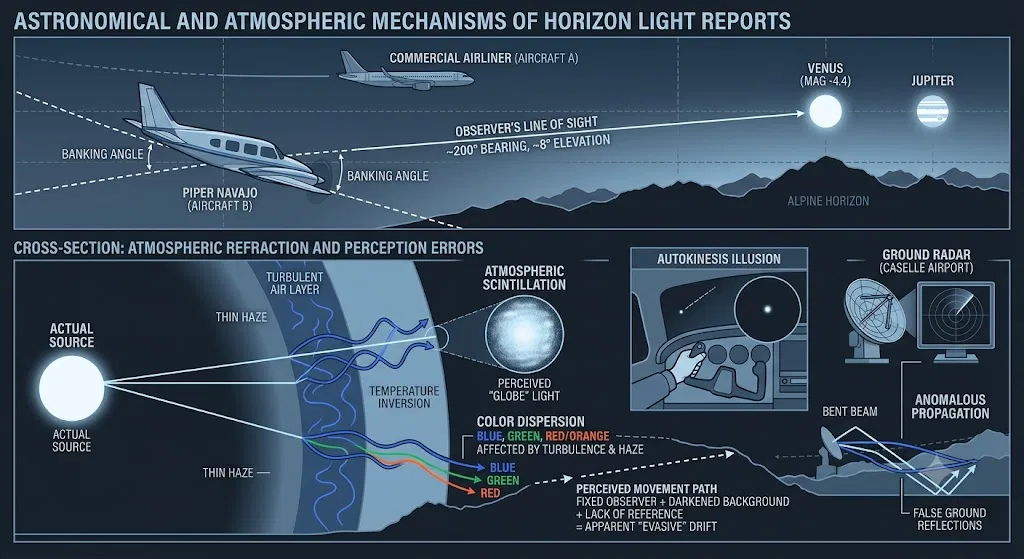
The Caselle observations began shortly before 7 pm, when witnesses at Turin’s airport and aboard approaching aircraft reported a powerful white or bluish light in the general direction of the mountains and the Susa Valley. Contemporary descriptions varied: some called it a luminous globe, while others reported pulses or apparent changes between white, blue, violet, red and green. The light was reportedly visible for an extended period, rather than flashing briefly across the sky.[CISU - Centro Italiano Studi Ufologici]cisu.orgcaselle 1973Centro Italiano Studi UfologiciCASELLE, 1973 - CISU - Centro Italiano Studi Ufologici…
Venus deserves particular attention because its position and brightness were unusually favourable for misidentification. In 1973 it became an evening object after April, reached its greatest angular separation from the Sun on 13 November and was approaching maximum brilliance in December. It was therefore conspicuous in the western or south-western evening sky at the end of November. The year’s astronomical handbook placed its peak brightness at magnitude −4.4, bright enough to dominate an otherwise darkening horizon.[RASC]rasc.caObserversHandbook 1973Observer's Handbook 1973…
This does not prove that every Caselle witness saw Venus. It does establish that a very bright, persistent celestial light was present in roughly the relevant sector of sky. That is especially significant for accounts describing an object that stayed in one area for tens of minutes. An aircraft, balloon or unusual atmospheric phenomenon might also remain visible, but a planet requires no additional assumptions to explain the basic features of brightness, duration and apparent immobility.
Jupiter is sometimes mentioned alongside Venus in discussions of the incident, but it is a less straightforward candidate. It was also a bright planet during 1973, although the detailed evening visibility and bearing must be reconstructed for the exact time and observing position rather than inferred from a general yearly table. The important point is not that two planets jointly explain the event, but that the low evening sky contained natural objects bright enough to demand exclusion before extraordinary interpretations are accepted.
Why colours do not rule out a planet
Witnesses often regard colour changes as evidence that a light cannot have been a star or planet. Near the horizon, however, celestial light passes through a much longer path of atmosphere than it does overhead. Moving layers of air with different temperatures and densities repeatedly bend the incoming light. This can make a point-like object shimmer, brighten, fade or appear to flash different colours.
Astronomers call the broader image degradation caused by turbulent air “seeing”. Atmospheric dispersion also becomes more severe close to the horizon, where different wavelengths are refracted by slightly different amounts. Under unstable conditions, a brilliant white object can therefore appear reddish, bluish or greenish from moment to moment.[britastro.org]britastro.orgchanges its refractive propertiesBritish Astronomical AssociationAbsolute Beginners no.14: Astronomical 'seeing'22 Nov 2018 — If the stars are twinkling (or 'scintillatin…
Haze can intensify the ambiguity. It may soften the surrounding landscape while leaving the brightest object visible, removing the mountain ridges or clouds that would normally supply scale and distance. Thin, uneven haze may also create a halo or enlarge the apparent light, encouraging descriptions such as “globe” or “disc”. These are real visual effects, not evidence that witnesses were careless or dishonest.
How motion changes visual judgement
The most difficult feature of many UFO reports is not brightness but movement. At Caselle, later accounts described rapid shifts, climbs, dives and an object that seemed to evade the private Piper Navajo sent towards it. Yet motion seen at night is highly dependent on reference points, and a planet can appear surprisingly active when viewed against a dark or indistinct background.
One relevant illusion is autokinesis. When an observer fixes on a single light in darkness, with few surrounding features, the stationary light can appear to drift or dart. Aviation authorities treat this as a genuine operational hazard. The US Federal Aviation Administration explains that a fixed light, star or similar point source can appear to move across an aircraft’s path when stared at against a dark, featureless background.[FAA]faa.govSpatial Disorientation: Visual IllusionsSpatial Disorientation: Visual IllusionsSeptember 15, 2016 — The Autokinetic Illusion gives you the impression that a stationary objec…
The effect does not need to produce a slow, gentle wobble. Its apparent direction and extent can change as the observer shifts gaze, moves their head or turns the aircraft. A pilot trying to approach a distant light may therefore experience a convincing sequence:
- The target appears fixed ahead.
- The aircraft changes heading towards it.
- The light shifts relative to the windscreen, cockpit frame or mountain silhouette.
- The observer interprets that angular change as evasive motion.
- Because the target is effectively at an immense distance, it never seems to become closer.
This last point is crucial. A pilot can close rapidly on a nearby aircraft, but cannot noticeably reduce the distance to Venus. If the observer assumes that the light is only a few kilometres away, its failure to grow larger may be understood as retreat. The aircraft’s own turns then make the apparently distant target slide across the field of view, reinforcing the impression that it is manoeuvring.
Similar errors can affect people on the ground. When haze hides the Alpine skyline, an observer may not know whether a light is above a ridge, in front of it or far beyond it. Without a reliable angular reference, estimates of height, distance and speed become largely intuitive. A tiny apparent movement can then be converted into an enormous calculated speed if the assumed distance is wrong.
Caselle may contain more than one event
The astronomical explanation is strongest when applied to the prolonged light towards the south-western horizon. It becomes weaker when stretched to cover every visual and radar claim associated with the evening. This is why the phrase “Caselle was Venus” is too blunt.
The surviving case history is not a single continuous instrument record. Contemporary newspapers, later interviews and retrospective reconstructions contain different times, bearings and descriptions. CISU, the Italian Centre for UFO Studies, notes that no UFO organisation carried out a full direct investigation at the time. Much early reporting relied on newspaper stories and indirect military information, producing contradictions that later researchers had to untangle.[CISU - Centro Italiano Studi Ufologici]cisu.orgcaselle 1973Centro Italiano Studi UfologiciCASELLE, 1973 - CISU - Centro Italiano Studi Ufologici…
The case appears to include at least three evidence streams:
- a bright light visible for a substantial period towards the mountains;
- a shorter and more dynamic episode reported by the Piper pilot;
- intermittent or unusual radar echoes at Caselle and the Mortara military radar centre.
Those streams may be related, but their simultaneous appearance does not prove that they had one cause. A bright planet could have supplied the visual focus while a separate aircraft, balloon, radar artefact or reporting error generated other details. Once controllers and pilots were alerted to an unknown light, normal ambiguity may also have been interpreted within a shared expectation that one unusual target was present.
This “composite case” interpretation explains why Caselle resists both dramatic and dismissive summaries. Treating all reports as one perfectly correlated object exaggerates the evidence. Treating all of them as a simple planetary mistake ignores the unresolved differences between witnesses and instruments.

Atmospheric effects on radar
Radar is often treated as independent confirmation because it does not depend on human eyesight. In practice, radar is an atmospheric sensing system with its own limitations. A return on a screen shows that transmitted energy came back to the receiver; it does not automatically identify a solid aircraft or establish that a visual light occupied the same position.
Under normal assumptions, radar waves travel along a predictable path. Temperature inversions and sharp humidity gradients can bend that path, a process known as anomalous propagation or ducting. If the beam is refracted towards the ground, it may strike terrain or structures beyond the usual radar horizon. The resulting reflections can appear as extraneous targets. The FAA explicitly warns that atmospheric bending can generate multiple false blips and that mountains, dense clouds, precipitation and ground obstacles can also affect radar displays.[FAA]faa.govOpen source on faa.gov.
The mechanism is especially relevant around stable evening or night-time air layers. When the ground cools faster than the air above it, a temperature inversion can develop. Radar energy may then travel unusually far or return from surfaces that would normally be hidden. NOAA describes anomalous propagation as a source of false, non-precipitation echoes, while aviation safety guidance notes that ground objects can appear on a display as though they were airborne.[noaa.gov]noaa.govanomalous propagationanomalous propagation
Piedmont’s terrain complicates matters further. The Turin plain is bordered by the Alps and other elevated ground, giving a radar beam many possible reflecting surfaces if abnormal refraction bends it below its expected path. Terrain also screens low-altitude targets and makes comparisons between separate radar stations more difficult. An echo at Caselle and an echo at Mortara therefore cannot be assumed to represent one object without matching times, ranges, bearings, signal characteristics and movement histories.
What anomalous propagation can and cannot explain
Atmospheric propagation is a credible general explanation for intermittent or irregular radar returns, but it is not a retrospective proof. To demonstrate it conclusively for Caselle, investigators would need detailed meteorological profiles, original radar plots, equipment settings and precise operator logs. Much of that material is incomplete, summarised or filtered through later testimony.
The explanation is most persuasive where echoes were weak, intermittent, stationary or inconsistent. It is less persuasive if surviving primary data were to show a coherent moving target tracked continuously by separate radars at matching positions. The public record, however, does not establish that ideal form of radar-visual correlation.
CISU’s reconstruction confirms that Caselle and Mortara reported echoes, but rejects later claims that Linate and Capo Mele also tracked the object. It also records that early descriptions of extraordinary speeds and vertical climbs came through press reports and retrospective testimony rather than a complete publicly available sequence of calibrated radar data.[CISU - Centro Italiano Studi Ufologici]cisu.orgcaselle 1973Centro Italiano Studi UfologiciCASELLE, 1973 - CISU - Centro Italiano Studi Ufologici…
A stronger way to assess Piedmont light reports
The main lesson is not that planets explain every unexplained light in Piedmont. It is that an investigation should separate what an observer saw from what they inferred. “A bright white light remained above the Alpine horizon” is an observation. “It was a craft hovering at 400 metres” is an interpretation that requires reliable distance and altitude information.
For reports of this type, the most useful checks are:
- Exact bearing and elevation: Was the light in the same direction and height as Venus, Jupiter or a bright star?
- Duration: Did it remain visible as long as a celestial object would, or did it cross the sky like an aircraft or satellite?
- Angular movement: Did it change position against known stars, mountain peaks or buildings, rather than merely against the observer’s windscreen?
- Observer movement: Did the apparent manoeuvre begin when a car or aircraft turned?
- Weather profile: Were haze, temperature inversions or turbulent layers present?
- Independent instrument matching: Did radar and visual reports agree in time, bearing, range and motion, or were they associated only after the event?
- Original records: Are speed and altitude claims supported by logs and plots, or only by newspaper paraphrases?
These checks do not diminish witness credibility. Pilots, controllers and experienced observers remain subject to visual ambiguity, particularly at night. Aviation training material exists precisely because skilled people can make sincere and consequential errors when horizons disappear and isolated lights become their main reference.

The most defensible conclusion
Planets and atmospheric effects weaken the claim that Piedmont’s brightest UFO reports necessarily involved extraordinary vehicles. In the Caselle case, Venus was bright, well placed in the evening sky and capable of accounting for a long-lasting light near the south-western horizon. Turbulence, haze and low-altitude refraction could explain reported changes in colour or apparent size, while autokinesis and aircraft motion could create a strong impression that a distant light was moving or retreating.
Anomalous radar propagation offers a technically recognised explanation for at least some of the associated echoes, particularly if they were intermittent or poorly correlated with the visual target. Yet the surviving evidence is not complete enough to demonstrate one comprehensive solution.
Caselle is therefore best described as partly explicable but not cleanly resolved. The planetary hypothesis is strong for one central part of the sighting, weaker for the private pilot’s full narrative and unproven for the radar evidence. Its lasting value within Piedmont’s UFO history lies in that distinction: a famous “radar-visual” incident may have grown from several ordinary or ambiguous effects that were interpreted as one extraordinary object.
Amazon book picks
Further Reading
Books and field guides related to Could Planets Explain Piedmont's Brightest UFO Reports?. Use these as the next step if you want deeper reading beyond the article.
NightWatch: A Practical Guide to Viewing the Universe
A practical guide to viewing the universe.
The Backyard Astronomer's Guide
Discusses the practical aspects of stargazing, including how to choose appropriate equipment, contending with light pollution, taking suc...
Bad Astronomy: Misconceptions and Misuses Revealed, from Astr...
A clever, thought-provoking guide that attacks common astronomical misconceptions What is Bad Astronomy? Anything that accidentally or in...
Turn Left at Orion
With over 100,000 copies sold since first publication, this is one of the most popular astronomy books of all time. It is a unique guideb...
eBay marketplace picks
Marketplace Samples
Live-tested eBay searches with available results related to this page.
Selected fromVenus poster oneBay.co.uk.

Endnotes
1.
Source: cisu.org
Title: [caselle 1973]({{ ‘caselle-1973/’ | relative_url }})
Link:https://www.cisu.org/caselle-1973/
Source snippet
Centro Italiano Studi UfologiciCASELLE, 1973 - CISU - Centro Italiano Studi Ufologici...
2.
Source: cisu.org
Link:https://www.cisu.org/compie-50-anni-il-piu-famoso-caso-radar-visuale-italiano/
Source snippet
Centro Italiano Studi UfologiciCompie 50 anni il più famoso caso radar-visuale italiano - CISU - Centro Italiano Studi Ufologici...
3.
Source: rasc.ca
Title: ObserversHandbook 1973
Link:https://www.rasc.ca/sites/default/files/publications/ObserversHandbook-1973.pdf
Source snippet
Observer's Handbook 1973...
4.
Source: faa.gov
Title: Spatial Disorientation: Visual Illusions
Link:https://www.faa.gov/pilots/safety/pilotsafetybrochures/media/spatiald_visillus.pdf
Source snippet
Spatial Disorientation: Visual IllusionsSeptember 15, 2016 — The Autokinetic Illusion gives you the impression that a stationary objec...
Published: September 15, 2016
5.
Source: faa.gov
Link:https://www.faa.gov/air_traffic/publications/atpubs/AIM/aim0405.html
6.
Source: noaa.gov
Title: anomalous propagation
Link:https://www.noaa.gov/jetstream/anomalous-propagation
7.
Source: forecast.weather.gov
Title: National Weather Service NOAA’s National Weather Service
Link:https://forecast.weather.gov/glossary.php?word=AP
8.
Source: weather.gov
Link:https://www.weather.gov/slc/radar
9.
Source: planetary.org
Title: night sky what to see this month
Link:https://www.planetary.org/night-sky/night-sky-what-to-see-this-month
10.
Source: faa.gov
Link:https://www.faa.gov/air_traffic/publications/atpubs/aim_html/chap4_section_5.html
11.
Source: britastro.org
Title: changes its refractive properties
Link:https://britastro.org/journal_contents_ite/absolute-beginners-no-14-astronomical-seeing
Source snippet
British Astronomical AssociationAbsolute Beginners no.14: Astronomical 'seeing'22 Nov 2018 — If the stars are twinkling (or 'scintillatin...
12.
Source: skyandtelescope.org
Link:https://skyandtelescope.org/astronomy-equipment/beating-the-seeing/
Source snippet
Sky & TelescopeHow to Successfully Beat Atmospheric SeeingAtmospheric dispersion elongates a star into a colorful little spectrum; close...
13.
Source: flightsafety.org
Title: showing where not to go
Link:https://flightsafety.org/asw-article/showing-where-not-to-go/
14.
Source: Wikipedia
Link:https://en.wikipedia.org/wiki/Piedmont
15.
Source: Wikipedia
Title: Anomalous propagation
Link:https://en.wikipedia.org/wiki/Anomalous_propagation
16.
Source: weather.metoffice.gov.uk
Link:https://weather.metoffice.gov.uk/maps-and-charts/rainfall-radar-forecast-map
17.
Source: home.ifa.hawaii.edu
Link:https://home.ifa.hawaii.edu/users/meech/a281/handouts/seeing.pdf
Additional References
18.
Source: faasafety.gov
Title: Your Senses in the Shadows
Link:https://www.faasafety.gov/files/events/SO/SO15/2024/SO15134204/YourSensesInTheShadows.pdf
Source snippet
Nighttime Visual Illusions...This illusion happens when a pilot stares at a bright, stationary light set against a pitch-black backgroun...
19.
Source: youtube.com
Title: Venus -the Morning Star and Evening Star
Link:https://www.youtube.com/watch?v=Ov3fYgGwy60
Source snippet
Venus planet UFO misidentification atmospheric explanations What They Found on Venus Is Terrifying Astrum...
20.
Source: researchgate.net
Link:https://www.researchgate.net/publication/340967261_An_analysis_of_anomalous_propagation_parameters_and_its_effect_on_the_intensity_of_clutter_in_weather_radars
21.
Source: instagram.com
Link:https://www.instagram.com/reel/DQZ2mlxkUzB/
22.
Source: instagram.com
Link:https://www.instagram.com/p/DUT_V0PE7v5/
23.
Source: reddit.com
Link:https://www.reddit.com/r/meteorology/comments/1iyrzy7/does_anybody_know_what_exactly_caused_this/
24.
Source: usni.org
Link:https://www.usni.org/magazines/proceedings/1973/december/dont-fall-radar-hole
25.
Source: facebook.com
Link:https://www.facebook.com/AirwaysAviationAustralia/posts/flying-at-night-is-as-challenging-as-it-is-breathtakingthere-are-three-visual-il/1318279753674629/
26.
Source: instagram.com
Link:https://www.instagram.com/reel/C2BMXjRsCk1/?hl=en
27.
Source: aopa.org
Link:https://www.aopa.org/training-and-safety/online-learning/safety-spotlights/spatial-disorientation/tricked-by-illusions