Within Friuli UFO Files
Which Ordinary Lights Explain Friuli's UFOs?
Many Friuli reports match ordinary lights in colour or motion, but sparse weather and positional data often prevent a firm identification.
On this page
- Chinese lanterns and drifting orange lights
- Stars, planets and atmospheric distortion
- Why plausible explanations may remain unproven
Page outline Jump by section
Introduction
Many UFO reports from Friuli-Venezia Giulia involve exactly the kinds of lights most easily misread at night: orange or red points drifting silently, bright “stars” that seem to change colour, and isolated lights whose apparent speed, height or shape cannot be checked against a reliable reference. Chinese lanterns, astronomical objects, aircraft and visual effects therefore offer plausible explanations for a substantial part of the regional record.
Plausible, however, is not the same as proved. The surviving reports often lack precise viewing direction, angular elevation, duration, wind data, photographs, radar confirmation or the exact position of each witness. Without those details, investigators may be able to exclude known military flights or weather balloons while still being unable to demonstrate that a light was a lantern, star or planet. This distinction is central to understanding Friuli’s UFO history: some cases remain officially unidentified because the evidence is incomplete, not because ordinary explanations were decisively ruled out.[Aeronautica Militare]aeronautica.difesa.itAeronautica Militare OVNIAeronautica MilitareOVNI - Aeronautica Militare…
Chinese lanterns and drifting orange lights
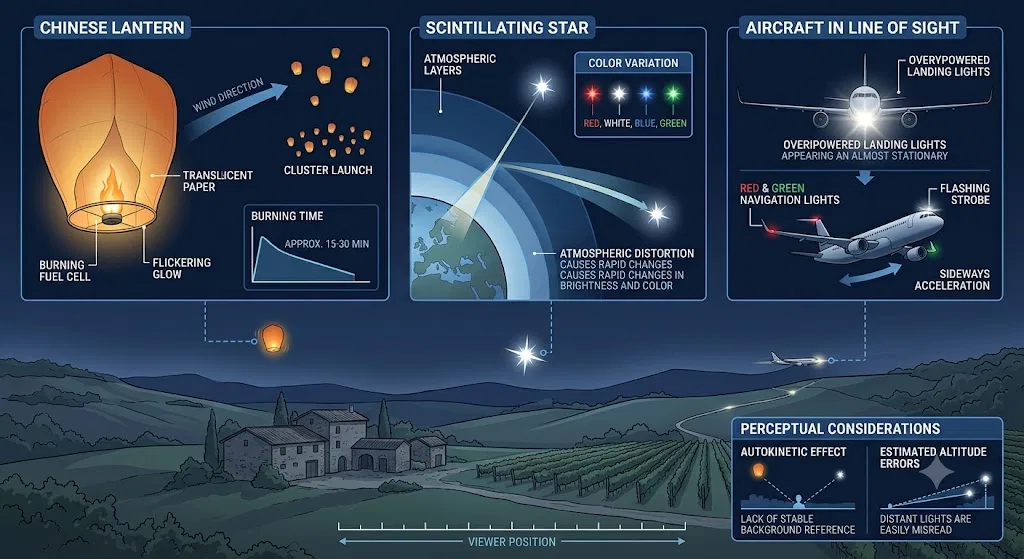
Chinese or sky lanterns are small paper hot-air balloons lifted by a burning fuel cell. At night, the flame produces a warm orange, amber or reddish glow while the paper envelope and supporting frame can remain invisible. To a distant observer, the result may look like a self-luminous sphere moving without engine noise.
Their motion is governed largely by the surrounding air. A lantern may rise, slow, drift sideways, appear almost stationary when travelling towards or away from the observer, and then fade abruptly when the fuel burns out or cloud obscures it. Several launched together can form a line, triangle or loose cluster whose geometry changes as different air currents separate them. Fire-service guidance confirms that lanterns are wind-borne devices and warns that they can also be confused with distress signals or interfere with aviation.[hwfire.org.uk]hwfire.org.ukHereford & Worcester Fire RescueSky LanternsSky lanterns pose a huge fire hazard, Do not launch in wind speeds in excess of five miles pe…
This mechanism closely matches one of the most discussed Friuli reports. At about 9.15 pm on 20 April 2011, three circular red-amber lights were seen above the Burida lake area near Pordenone. They were described as moving steadily from north-west to south-east at an estimated height of 400 metres. Contemporary regional reporting said the Air Force found no association with known flying or radiosonde activity, while a lantern explanation emerged in the following days but could not be confirmed.[Congedati Folgore]congedatifolgore.comOpen source on congedatifolgore.com.
The reported colour, silence, number of lights and steady shared direction are all compatible with lanterns. Similar Italian incidents have been resolved when launches were traced to celebrations. In the Veneto in June 2010, for example, a row of red lights seen above the Abano and Montegrotto area was attributed to flying lanterns; other reported “UFOs” elsewhere in northern Italy were likewise identified after the people responsible for releases came forward.[corriere.it]corrieredelveneto.corriere.itlanterne volanti scambiate ufo 1703280096136.shtmlCorriere del VenetoLanterne volanti scambiate per Ufo28 Jun 2010 — Tutto per colpa di sei oggetti misteriosi, di colore rosso, che nella…
Yet the Burida case cannot responsibly be labelled solved from resemblance alone. No publicly available record identifies a launch site, organiser or event. Nor does the surviving summary provide the observed angular height, exact duration, local wind at several altitudes or independent photographs from known positions. The estimated 400-metre altitude was almost certainly a witness judgement rather than an instrument reading. Because an observer cannot normally derive both distance and size from a featureless light, such estimates may be substantially wrong.
Lanterns become a weaker explanation when a report includes sustained movement far faster than the wind, travel against measured winds, sharp accelerations confirmed from fixed reference points, or a long route inconsistent with their short burning time. The Pinzano al Tagliamento report of 21 May 2011 was described as a red-orange object travelling in a straight line at very high speed, later visible over Pordenone. Regional coverage said lanterns were rejected because the estimated speed exceeded 1,000 kilometres per hour.[Congedati Folgore]congedatifolgore.comOpen source on congedatifolgore.com.
That conclusion still depends on how the speed was calculated. A witness cannot determine true velocity without a reliable distance, and a small nearby light may appear to cross the sky much faster than a distant object. The case is therefore poorly matched to a simple drifting lantern as reported, but the published information is too sparse to treat the extraordinary speed estimate as a firm measurement.
Stars, planets and atmospheric distortion
A bright star or planet can look much stranger than expected when seen low above Friuli’s mountains, rooftops or dark rural horizons. Light from a low celestial object passes through a longer and more turbulent path in the atmosphere than light from overhead. Changing layers of air bend the light by slightly different amounts, causing variations in brightness, colour and apparent position known as scintillation. The effect is strongest near the horizon.[metoffice.gov.uk]weather.metoffice.gov.ukOpen source on metoffice.gov.uk.
To the naked eye, a strongly scintillating star may flash red, white, blue or green and appear to wobble. Thin cloud, haze and temperature gradients can make it brighten, fade, spread or briefly seem to change shape. A witness who watches intermittently through trees, building edges or moving cloud may interpret repeated disappearances and reappearances as manoeuvres.
The Italian Air Force’s historical archive shows that astronomical misidentification is not merely a theoretical possibility. In a 1973 report from Otranto, an intense star-like light was investigated and attributed with reasonable certainty to an unusually bright celestial object. The same archive contains numerous other descriptions using phrases such as “similar to a star”, sometimes accompanied by apparent colour changes or uncertain motion.[Aeronautica Militare]aeronautica.difesa.itAeronautica Militare
Friuli’s pre-dawn Cordenons report of 31 December 2010 is particularly relevant. Witnesses described a flat white object apparently stationary at about 600 metres. The Air Force found no connection with recorded flight or weather-balloon activity.[Congedati Folgore]congedatifolgore.comOpen source on congedatifolgore.com. A bright astronomical object deserves consideration because the observation occurred before sunrise and involved a stationary white light, but the public summary does not provide the viewing direction or elevation needed to test that hypothesis against the sky at the time. The reported flatness might represent a genuine visual impression, atmospheric spreading, glare, imperfect eyesight or an inferred shape around a bright point.
A stationary light can also seem to move because of the autokinetic effect. When a person stares at a small light against a dark, featureless background, the absence of fixed reference points may cause the brain to interpret tiny eye movements as movement of the light itself. The phenomenon is recognised in aviation because stars, planets and distant ground lights can appear to drift or change course at night.[Skybrary]skybrary.aeroOpen source on skybrary.aero.
Autokinesis does not explain every report of movement. It is most relevant when there is one isolated point, no visible structure, no stable horizon reference and no photographic or radar track. It is less persuasive where several witnesses independently plot the light against buildings, hills or stars and agree on the same trajectory. Even then, witnesses standing together may influence one another’s interpretation once somebody announces that the light is moving.
Planets are generally steadier than stars because their visible discs average out some atmospheric disturbance, but bright planets can still be mistaken for nearby objects. Apparent motion may arise when the witness is in a moving vehicle, when foreground cloud crosses the line of sight, or when the observer unconsciously compares the planet with swaying branches or shifting reflections. Precise date, time, direction and elevation usually allow an astronomical explanation to be tested retrospectively. Most short regional summaries omit at least one of those essentials.
Aircraft, satellites and changing shapes
Not every orange or changing light is a lantern or celestial object. Aircraft seen almost head-on may appear stationary for several minutes because their movement is mostly along the observer’s line of sight. Landing lights can greatly overpower the red, green and flashing navigation lights until the aircraft turns. When it does, the bright point may suddenly dim, divide into several lights or appear to accelerate sideways.
This matters in Friuli-Venezia Giulia because the region contains busy civil and military airspace, including Aviano and the airport at Ronchi dei Legionari. An Air Force check that finds no connection with recorded flying activity is important, but its meaning should be kept narrow. It may exclude the operations available to the investigators at the reported time; it does not automatically exclude every distant civilian aircraft, misreported time, private flight, ground light or object beyond the area searched. The Air Force describes its procedure as an attempt to identify correlations with human activity or natural phenomena, classifying an incident as unidentified only when no technical or natural explanation can be established.[Aeronautica Militare]aeronautica.difesa.itAeronautica Militare OVNIAeronautica MilitareOVNI - Aeronautica Militare…
Satellites are another source of silent moving lights. A typical satellite appears as a steady point crossing the sky in a smooth path, sometimes fading rapidly as it enters the Earth’s shadow. It does not usually display the warm, flickering glow associated with a lantern. Groups of recently launched satellites can produce lines of evenly spaced lights, although that pattern is principally relevant to more recent reports rather than Friuli’s 2010–12 cluster.
Bright objects recorded on phones can acquire shapes that were not visible in the sky. Digital zoom enlarges blur rather than detail; autofocus may hunt against a dark background; movement of the camera produces streaks, discs or polygons; and compression can make a point of light pulse or break apart. A changing outline in a low-quality video is therefore not evidence that a distant object physically changed shape unless the recording also preserves stable foreground references and reliable focus.
The same caution applies to naked-eye descriptions such as “disc”, “sphere” or “flat object”. At night, witnesses frequently describe the shape of the luminous area rather than the body producing it. A circular glow may be a defocused star, a flame seen through haze, an aircraft light or a genuinely round object. Without visible structure, the description establishes appearance, not construction.

Why plausible explanations may remain unproven
The main obstacle in the Friuli cases is not a lack of possible explanations but a lack of discriminating evidence. Several very different sources can produce the same basic report: an orange light moving steadily, making no sound and fading after a few minutes. The correct identification depends on details that were often not recorded or have not been made public.
The most useful missing information is usually:
- the witness’s exact position and viewing direction;
- angular elevation rather than guessed altitude;
- start and finish times accurate to the minute;
- duration and angular distance travelled;
- fixed landmarks crossed by the light;
- wind direction and speed at ground level and aloft;
- cloud cover, haze and visibility;
- simultaneous astronomical positions;
- photographs or video retaining original metadata;
- independent witnesses separated by enough distance for triangulation;
- radar or air-traffic data covering the correct time and area.
These gaps explain why an ordinary hypothesis can be convincing without becoming conclusive. A lantern identification is strong when a matching release is documented upwind at the right time and the observed path follows the measured wind. A star or planet identification is strong when its calculated position matches the witness’s direction and the light remains fixed relative to the sky. An aircraft identification is strong when a flight track, timing and lighting geometry reproduce the observation. Without such a match, investigators are often left with categories of possibility rather than a demonstrated answer.
The yellow circular light reported near Gonars at 8.25 pm on 31 August 2012 illustrates the problem. It reportedly followed a straight south-to-north-west path at an estimated altitude of one kilometre, and no known event was associated with it by the Air Force.[Congedati Folgore]congedatifolgore.comOpen source on congedatifolgore.com. A lantern, aircraft or other wind-borne object might fit parts of that description, but the public account lacks the duration, apparent speed, wind profile and brightness behaviour needed to rank them confidently.
The low-speed red sphere seen over Pordenone on 26 June 2011 is even thinner in the published record. Its colour and slow motion make a lantern plausible, yet no release has been documented publicly. A responsible assessment is therefore not “a lantern” but “consistent with a lantern and insufficiently documented for confirmation”.[Congedati Folgore]congedatifolgore.comOpen source on congedatifolgore.com.
This restrained wording matters because “unidentified” and “inexplicable” are not synonyms. The first describes the outcome of an investigation using the information available. The second implies that adequate evidence defeated credible conventional explanations. Most of Friuli’s light reports fall into the former category.
What the likely causes reveal about Friuli’s record
The ordinary-light explanations do not erase Friuli-Venezia Giulia’s UFO history. They clarify its actual character. The regional record is dominated by brief nocturnal observations rather than close-range encounters supported by instruments or physical evidence. Colour, apparent motion and estimated altitude carry much of the narrative, but each is vulnerable to viewing conditions and distance errors.
The 2011 Burida lights are the strongest regional candidate for a lantern interpretation because they were multiple, red-amber, silent and steadily moving in a common direction. The Cordenons light has features compatible with an astronomical source, but it cannot be checked properly without its bearing and elevation. The Pinzano report is harder to reconcile with a lantern if its published speed is accepted, although that speed was not independently measured. The Pordenone and Gonars spheres remain weakly documented cases with several ordinary possibilities still open.[Congedati Folgore]congedatifolgore.comOpen source on congedatifolgore.com.
Later reporting has therefore weakened any claim that this cluster demonstrates unusual craft. It has identified credible mechanisms and highlighted how little positional and meteorological evidence survives. At the same time, it has not converted every report into a solved case. The fair conclusion is that lanterns, astronomical lights, aircraft and perceptual effects probably account for some of Friuli’s sightings, perhaps many of them, while the available records are often too sparse to assign a final cause case by case.
That is not an evasion but the central evidential lesson. A light can remain unidentified after official checks and still be ordinary. To move beyond plausibility, an investigation needs enough information to reconstruct where the light was, how it moved and what was present in the sky. In much of Friuli’s UFO archive, that opportunity was lost within minutes of the sighting.

Amazon book picks
Further Reading
Books and field guides related to Which Ordinary Lights Explain Friuli's UFOs?. Use these as the next step if you want deeper reading beyond the article.
The UFO Experience: A Scientific Inquiry
Cited by the New York Review of Books as "the best brief for visitation," this classic study presents an analysis of UFO reports and conc...
The Demon-Haunted World: Science as a Candle in the Dark
NEW YORK TIMES BESTSELLER • From the renowned astronomer and author of Cosmos comes a “powerful [and] stirring defense of informed ration...
Bad Astronomy: Misconceptions and Misuses Revealed, from Astr...
A clever, thought-provoking guide that attacks common astronomical misconceptions What is Bad Astronomy? Anything that accidentally or in...
The Invisible Gorilla: How Our Intuitions Deceive Us
NEW YORK TIMES BESTSELLER • Our minds don’t work the way we think they do. Two renowned psychologists explain how and why our intuitions...
eBay marketplace picks
Marketplace Samples
Live-tested eBay searches with available results related to this page.
Selected fromufo poster oneBay.co.uk.



Current eBay listing
VINTAGE UFO FLYING SAUCERS COMIC ADVERTISING A2 POSTER PRINT

Current eBay listing
I Want To Believe UFO Poster Giclée Fine Art Heavyweight Print
Endnotes
1.
Source: merseyfire.gov.uk
Link:https://www.merseyfire.gov.uk/safety-advice/community-safety/sky-lanterns/
Source snippet
Sky LanternsThey use the heat of a naked flame to float. Do not launch in wind speeds in excess of 5 mph Check wind direction before laun...
2.
Source: corrieredelveneto.corriere.it
Title: lanterne volanti scambiate ufo 1703280096136.shtml
Link:https://corrieredelveneto.corriere.it/rovigo/notizie/cronaca/2010/28-giugno-2010/lanterne-volanti-scambiate-ufo-1703280096136.shtml
Source snippet
Corriere del VenetoLanterne volanti scambiate per Ufo28 Jun 2010 — Tutto per colpa di sei oggetti misteriosi, di colore rosso, che nella...
3.
Source: weather.metoffice.gov.uk
Link:https://weather.metoffice.gov.uk/learn-about/weather/optical-effects/why-is-the-sky-blue
4.
Source: arxiv.org
Title: arXiv Atmospheric Scintillation in Astronomical Photometry
Link:https://arxiv.org/abs/1506.06921
5.
Source: aeronautica.difesa.it
Title: Aeronautica Militare
Link:https://www.aeronautica.difesa.it/wp-content/uploads/2023/05/Archivio_OVNI_periodo1972-1990.pdf
6.
Source: skybrary.aero
Link:https://skybrary.aero/articles/autokinetic-effect
7.
Source: hwb.gov.wales
Link:https://hwb.gov.wales/api/storage/6f1582f4-be69-40eb-99bf-99c8a799f47a/Task%2090%20Sky%20lanterns%202.pdf
8.
Source: weather.metoffice.gov.uk
Link:https://weather.metoffice.gov.uk/learn-about/weather/optical-effects
9.
Source: are.na
Title: Autokinetic effect
Link:https://www.are.na/block/27001321
10.
Source: aeronautica.difesa.it
Title: Aeronautica Militare OVNI
Link:https://www.aeronautica.difesa.it/ovni/
Source snippet
Aeronautica MilitareOVNI - Aeronautica Militare...
11.
Source: congedatifolgore.com
Link:https://www.congedatifolgore.com/it/laeronautica-militare-si-occuoeradi-cinque-casi-di-ufo-in-friuli/
12.
Source: hwfire.org.uk
Link:https://www.hwfire.org.uk/advice/outdoors/sky-lanterns/
Source snippet
Hereford & Worcester Fire RescueSky LanternsSky lanterns pose a huge fire hazard, Do not launch in wind speeds in excess of five miles pe...
13.
Source: lastampa.it
Title: nessun ufo nel cielo erano lanterne cinesi della festa al b amp b 1.36468590
Link:https://www.lastampa.it/novara/2012/06/07/news/nessun-ufo-nel-cielo-erano-lanterne-cinesi-della-festa-al-b-amp-b-1.36468590
Source snippet
E' successo a Bolzano Novarese. Una residente aveva raccontato di aver visto misteriose luci rossastre...Read more...
14.
Source: lastampa.it
Title: gli ufo avvistati a maggio br sulla collina erano lanterne cinesi 1.37054390
Link:https://www.lastampa.it/torino/2009/11/16/news/gli-ufo-avvistati-a-maggio-br-sulla-collina-erano-lanterne-cinesi-1.37054390
Source snippet
La StampaGli Ufo avvistati a maggiosulla collina erano lanterne cinesi16 Nov 2009 — Le lanterne cinesi rappresentano una tradizione in Or...
15.
Source: theguardian.com
Title: weatherwatch stars twinkling
Link:https://www.theguardian.com/news/2010/dec/23/weatherwatch-stars-twinkling
Additional References
16.
Source: nps.gov
Title: fire prevention 52 sky lanterns
Link:https://www.nps.gov/articles/fire-prevention-52-sky-lanterns.htm
Source snippet
National Park ServiceFire Prevention 52: Sky Lanterns (U.S. National Park Service)1 Dec 2016 — Sky lanterns (Chinese lanterns) are banned...
17.
Source: faa.gov
Link:https://www.faa.gov/air_traffic/technology/rwsl
18.
Source: scholarship.richmond.edu
Title: jepson faculty publications
Link:https://scholarship.richmond.edu/jepson-faculty-publications/162/
19.
Source: backyardastronomy.net
Title: Single Flashes of Light in Night Sky
Link:https://www.backyardastronomy.net/2017/02/04/single-flashes-of-light-in-night-sky/
20.
Source: bco.ie
Title: How To Identify A UFO
Link:https://www.bco.ie/how-to-identify-a-ufo/
21.
Source: brianmcgillivray.com
Title: how to identify a chinese lantern
Link:https://www.brianmcgillivray.com/2011/04/how-to-identify-a-chinese-lantern/
22.
Source: facebook.com
Link:https://www.facebook.com/cgtnamerica/videos/massive-ufo-spotted-over-northwestern-china/495370959322728/
23.
Source: facebook.com
Link:https://www.facebook.com/groups/uncannyfan/posts/2209774599499159/
24.
Source: facebook.com
Link:https://www.facebook.com/stonehenge.aotearoa/posts/some-stars-appear-to-change-colour-as-they-twinklethis-happens-when-their-light-/1401331795369812/
25.
Source: en.italiani.it
Title: it UF Os in the Italian skies, truths and lies
Link:https://en.italiani.it/ufo-nei-cieli-italiani-verita-bugie/