Within Lombardy
Why Strange Lights Are Common Around Milan
Busy air corridors, illuminated industrial sites and dense traffic give Milan's surroundings many ordinary sources of unusual-looking lights.
On this page
- Airports and heavily used flight paths
- Industrial lighting and transport infrastructure
- How distance and viewing angle distort familiar objects
Page outline Jump by section
Introduction
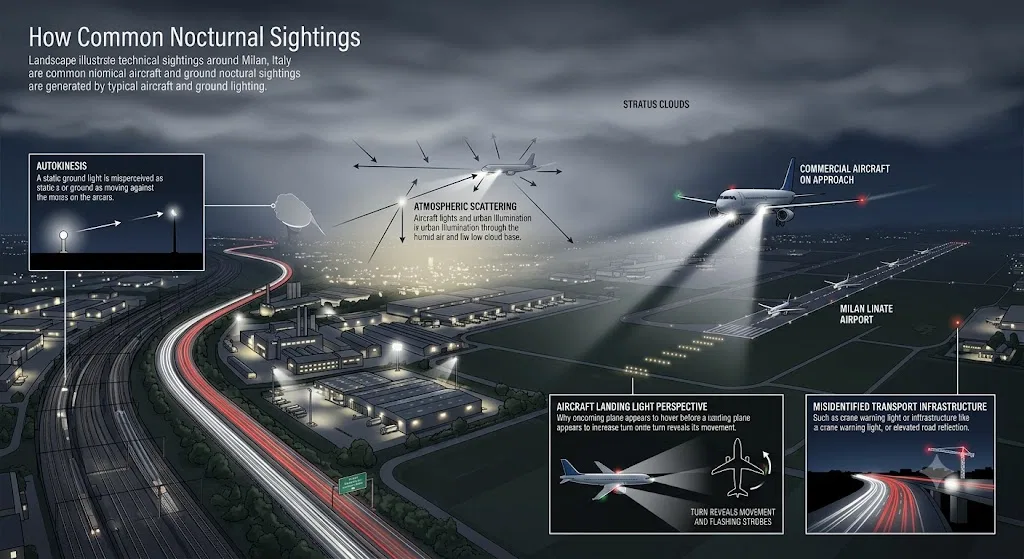
Strange lights are common around Milan for a straightforward reason: the metropolitan area combines exceptionally busy airspace with intense ground lighting, heavy road and rail traffic, industrial premises and a large population looking up from many different angles. An aircraft approaching head-on can appear almost motionless; a banking aeroplane can seem to change direction abruptly; and a fixed lamp seen through haze may appear to wander, brighten or change colour.
This does not mean every Milan-area report has been solved. The Italian Air Force has recorded cases in the province that remained unidentified after its available checks, including a luminous object reported at Cerchiate di Pero in July 2020. Yet “unidentified” is an investigative outcome, not proof of an extraordinary craft. Around Milan, the central challenge is separating genuinely unusual observations from ordinary objects seen under unusually difficult conditions.[difesa.it]aeronautica.difesa.itAeronautica Militare OVNIAeronautica MilitareOVNI - Aeronautica Militare - Ministero della DifesaSegnalazioni O.V.N.I., Oggetti Volanti Non Identificati. In quest…
Airports and heavily used flight paths
Milan is served by a closely connected airport system rather than a single isolated airfield. Malpensa lies to the north-west, Linate sits at the eastern edge of the city, and Bergamo Orio al Serio handles substantial traffic farther east. Aircraft using these airports share a wider controlled-airspace system managed through Milan’s area control centre. In 2023, the Italian air-navigation provider ENAV introduced arrival-sequencing technology at Milan control specifically to organise approaches into Malpensa, Linate and Bergamo.[enav.it]enav.itRoute sustainabilityDuring 2023, AMAN was also implemented at Milan ACC for optimizing approach sequences at Milan Malpensa, Milan Linate…
For an observer on the ground, this produces several kinds of misleading sight:
- A bright light that appears to hover. An arriving aircraft travelling almost directly towards the observer changes its angular position very slowly. Its landing lights may remain in nearly the same part of the sky for several minutes, even though the aircraft is moving rapidly.
- A sudden sideways movement. When the aircraft turns onto an approach route, the viewing angle changes. What looked like a stationary light may abruptly reveal red, green or flashing lights and appear to accelerate sideways.
- Lights that vanish and return. A turn can point the strongest forward-facing lamps away from the witness. Thin cloud, buildings or atmospheric haze may also obscure the aircraft briefly.
- Objects apparently following one another. Aircraft are deliberately sequenced along arrival and departure routes. From a distant viewpoint, several flights on similar tracks can resemble a formation or a recurring procession of lights.
These effects are especially strong near sunset and in the early evening. The sky may be dark enough for aircraft lights to stand out, while the airframe itself remains difficult to see. Perspective also removes the normal cues people use to judge distance and speed. A small nearby drone, a passenger aircraft many kilometres away and a bright planet can all look like points of light with no obvious scale.
Aircraft lighting can also create descriptions that sound more exotic than the underlying object. Powerful landing lamps may dominate the view, hiding the normal navigation-light pattern. Atmospheric scattering can give white lights a yellow, orange or reddish tint, while turbulence can make them flicker. Only when an aircraft turns may its shape, wing lights or regular strobe pattern become clear.
The density of traffic matters because it increases both the number of possible misidentifications and the probability that somebody will witness them. ENAC’s national traffic figures place Malpensa, Bergamo and Linate among Italy’s major passenger airports, while Malpensa is also a leading cargo centre. The Milan sky therefore contains activity beyond the most visible daytime passenger flights, including early-morning arrivals, evening departures and freight operations.[Enac]enac.gov.itDati di traffico 2024 v.0.7 cover cDati di traffico 2024Seguono, quindi, gli aeroporti di Milano Malpensa (28,7 mln di passeggeri, con una quota del 13,2% e una variazi…
Industrial lighting and transport infrastructure
Milan’s night sky is shaped as much by the ground as by the air. The urban area contains motorways, railway corridors, construction sites, exhibition grounds, logistics centres, warehouses and large illuminated commercial premises. Their lamps may be fixed, rotating, partly screened or reflected from glass and metal surfaces. Seen from a moving car or through gaps between buildings, these sources can appear detached from the ground.
Satellite observations provide a particularly clear indication of the scale of illumination. NASA compared photographs of Milan taken from the International Space Station in 2012 and 2015 and found that the city centre had become noticeably brighter and bluer after a transition towards LED street lighting. The change further reduced the visibility of stars from within the city.[NASA Science]science.nasa.govScience Light pollution, MilanScience Light pollution, Milan
This matters to sighting interpretation in two seemingly opposite ways. Bright urban lighting creates more possible false targets, but it also removes much of the celestial background that would help identify them. A witness who can see only one or two bright points may have difficulty comparing an object with nearby stars or recognising the movement of the sky. The result is a visually simplified scene in which an aircraft lamp, planet or distant floodlight attracts disproportionate attention.
Light pollution is not merely light travelling directly from a lamp to the observer. Upward and reflected illumination is scattered by molecules, aerosols, moisture and pollution in the atmosphere, producing the luminous dome known as skyglow. Research on artificial night lighting shows that even well-directed lamps contribute through reflection from roads, walls and other surfaces. White LEDs with a strong blue component can have a particularly pronounced effect on perceived sky brightness and stellar visibility.[arxiv.org]arxiv.orgOpen source on arxiv.org.
Milan’s humid or hazy conditions can make this illumination more conspicuous. Low cloud may reflect city light, creating bright patches or glows whose apparent boundaries shift as clouds move. A concentrated beam from a stadium, event venue or work site may illuminate the cloud base without the beam itself being continuously visible. To an observer who cannot see the source, the bright area can look suspended in the sky.
Transport infrastructure creates similar effects. Headlamps climbing an elevated road, warning lights on cranes, illuminated train windows and reflections in office façades can all appear airborne when the intervening structure is hidden. The illusion may last only briefly, which helps explain why many reports consist of a short observation with no usable photograph or reference point.
The key question is therefore not simply whether a witness saw a light in the sky. It is whether the report establishes that the light was physically in the sky rather than on distant or elevated infrastructure. A precise bearing, visible horizon, known landmarks and observations from more than one position can resolve that distinction. Without them, even an honest and attentive witness may have no reliable way to determine the object’s location.
How distance and viewing angle distort familiar objects
Human vision is poor at estimating the distance of an isolated light at night. Normally, size, texture, overlap, shadows and movement relative to the background provide depth information. A point of light against a dark or hazy sky removes most of those clues. Apparent speed then becomes almost impossible to calculate: the observer does not know whether the source is small and close or large and distant.
A related effect is autokinesis, in which a stationary light appears to drift when stared at against a dark, featureless background. Aviation authorities treat this as a genuine safety issue rather than an obscure psychological curiosity. The US Federal Aviation Administration warns pilots that a fixed ground light or star can appear to move and may even seem to be on a collision course. The same visual mechanism can affect an observer standing on the ground.[faa.gov]faa.govSpatial Disorientation: Visual IllusionsThe Autokinetic Illusion gives you the impression that a stationary object is moving in front…
Small movements of the eyes and head contribute to the effect. Because there is no stable surrounding pattern against which to measure the light, the brain may interpret those movements as motion by the object. In a sighting account, this can become “zigzagging”, “rapid direction changes” or “hovering and then moving again”. Such language should not be dismissed, but neither should it automatically be treated as a measurement of real flight behaviour.
Viewing from a moving vehicle adds another layer. Trees, lamp posts and buildings sweep rapidly across the foreground, while a distant aircraft or planet moves little. The point of light may therefore seem to follow the vehicle. When the road turns, it can appear to jump from one side of the windscreen to the other or keep pace through several changes of direction. Reflections inside double-glazed windows can also move in ways that bear little relation to the original external light.
Atmospheric conditions further alter colour and brightness. A light low above the horizon is seen through more atmosphere than one overhead. Variations in air temperature and density can bend and disturb the incoming light, while haze selectively scatters different wavelengths. A white source may therefore pulse between white, yellow and red or appear to split into several colours. This is not by itself evidence of an object changing shape or emitting multiple forms of energy.
These mechanisms are most persuasive when they match the full observation. A proposed aircraft explanation should fit the time, direction and duration; an industrial-light explanation should account for the apparent elevation and movement; and autokinesis should not be used to explain a clearly structured object observed against a detailed background. Conventional explanations become weak when applied as labels rather than tested against the witness’s actual geometry.

The Cerchiate di Pero report
One of the clearest modern examples of the boundary between “reported” and “explained” occurred at Cerchiate di Pero, immediately west of Milan, on 18 July 2020. According to summaries based on Italian Air Force records, a witness described an irregular spherical object that was initially intensely white and later reddish, with repeated changes of direction. It was one of only two Italian reports entered in the Air Force’s published 2020 OVNI record.[Il Giorno]ilgiorno.itufo altri due avvisamenti ufficiali in italia azga87g3Il GiornoUfo, altri due avvisamenti 'ufficiali' in Italia11 Jul 2021 — Nel 2020 negli archivi dell' Aeronautica militare vengono registra…
The location makes the case relevant to Milan’s identification problem. Pero lies within a densely developed western corridor containing major roads, railway infrastructure, commercial premises and the exhibition district, while Malpensa lies farther to the north-west. The surrounding environment therefore supplies numerous potential sources of moving and stationary lights.
However, no publicly available evidence establishes that one of those sources caused the report. The published description does not provide enough geometry, imagery or independent observations to reconstruct a reliable trajectory. The object’s reported colour change and apparent manoeuvring are compatible with several ordinary mechanisms, but compatibility is not identification.
The Air Force’s use of the OVNI classification should also be read carefully. Its official procedure exists to collect reports and examine them in relation to flight and national security. Once checks are complete, an event may be listed as unidentified when no technical or natural explanation can be established from the information available. That category does not certify the witness’s estimate of motion, distance or physical form, and it does not represent a finding that the object was extraterrestrial.[Aeronautica Militare]aeronautica.difesa.itAeronautica Militare OVNIAeronautica MilitareOVNI - Aeronautica Militare - Ministero della DifesaSegnalazioni O.V.N.I., Oggetti Volanti Non Identificati. In quest…
Cerchiate di Pero is therefore best described as an unresolved, thinly documented sighting rather than a debunked case or strong anomaly. It demonstrates why Milan-area reports can remain officially unidentified even when ordinary explanations are plentiful: investigators cannot retrospectively prove which explanation applies unless the original report contains adequate positional, temporal and visual detail.
What makes a Milan sighting persuasive
A credible report does not depend chiefly on how strange the object seemed. It depends on whether the observation contains enough information to test ordinary possibilities.
The most useful details are an exact time, observation point, compass direction, elevation above the horizon and duration. Landmarks visible beneath or beside the object help reconstruct its line of sight. A photograph is more valuable when the original file, exposure details and wider scene are preserved; a tightly cropped light against black sky may add almost nothing.
Independent witnesses become particularly important when they observe from different locations. Two separated lines of sight can establish whether a light was nearby or distant and can sometimes estimate altitude by triangulation. Radar, air-traffic data, weather records and astronomical positions can then be compared with the observation. Modern scientific proposals for studying unidentified aerial phenomena emphasise precisely this combination of wide-field imaging, accurate timing, triangulation, radar and environmental sensors because a single visual account rarely supplies enough physical information.[arXiv]arxiv.orgOpen source on arxiv.org.
Several warning signs weaken a Milan-area case:
- the only evidence is a point of light with no horizon or landmarks;
- movement is described, but the witness was in a car or filming through glass;
- the account gives no exact direction or time;
- distance, size and speed are stated as facts although none was measurable;
- aircraft-tracking data are treated as complete records of everything airborne;
- an object is declared extraordinary merely because an immediate identification was unavailable.
Conversely, a sighting deserves closer attention when multiple observers report the same structured object from separated positions, when its movement can be plotted against a stable background, or when reliable sensor data contradict known traffic and astronomical explanations. Milan’s cluttered environment raises the standard of evidence because so many conventional sources are present, not because unusual reports should be rejected in advance.
A pattern of ambiguity, not proof
Milan’s airports, industrial landscape and intense illumination do not explain every sighting automatically. They explain why the area repeatedly generates observations that are genuinely puzzling to witnesses and difficult to reconstruct afterwards. Busy air routes place bright moving objects in the sky; urban lighting hides their shapes and removes background reference points; haze changes colour and contrast; and human vision can turn a fixed light into an apparently manoeuvring one.
That pattern is important within Lombardy’s wider UFO history. It provides a sober counterweight to the region’s more dramatic encounter and crash stories. Around Milan, the most defensible conclusion is usually neither “alien craft” nor “nothing happened”. Something was observed, but the environment often prevents the witness—and later the investigator—from establishing exactly what it was.
Cases such as Cerchiate di Pero remain unresolved because the surviving information is insufficient, not because conventional explanations have been ruled out comprehensively. In one of Italy’s busiest and brightest metropolitan skies, the difference between unexplained and inexplicable is especially important.
Amazon book picks
Further Reading
Books and field guides related to Why Strange Lights Are Common Around Milan. Use these as the next step if you want deeper reading beyond the article.
The UFO Handbook: A Guide to Investigating, Evaluating, and R...
An explanation of the usual reasons for confusing IFOs (identified flying objects) with UFOs and a survey of the tools used to investigat...
The Demon-Haunted World: Science as a Candle in the Dark
NEW YORK TIMES BESTSELLER • From the renowned astronomer and author of Cosmos comes a “powerful [and] stirring defense of informed ration...
The UFO Experience: A Scientific Inquiry
Cited by the New York Review of Books as "the best brief for visitation," this classic study presents an analysis of UFO reports and conc...
eBay marketplace picks
Marketplace Samples
Live-tested eBay searches with available results related to this page.
Selected fromairplane model oneBay.co.uk.

Current eBay listing
16cm A380 Airbus Emirates Metal Aircraft Plane Model Gift UK
Current eBay listing
EasyJet Airbus A320Neo Snap-fit Model Plane 1/200 Model Plane
Endnotes
1.
Source: faa.gov
Link:https://www.faa.gov/pilots/safety/pilotsafetybrochures/media/spatiald_visillus.pdf
Source snippet
Spatial Disorientation: Visual IllusionsThe Autokinetic Illusion gives you the impression that a stationary object is moving in front...
2.
Source: enav.it
Link:https://www.enav.it/en/sustainable/environment/routes
Source snippet
Route sustainabilityDuring 2023, AMAN was also implemented at Milan ACC for optimizing approach sequences at Milan Malpensa, Milan Linate...
3.
Source: enav.it
Link:https://www.enav.it/en/what-we-do/we-manage-italian-airspace/air-traffic-control
Source snippet
air traffic controlWe take care of your flight from the closing of the door to the final destination, making it fly on our routes with sa...
4.
Source: science.nasa.gov
Title: Science Light pollution, Milan
Link:https://science.nasa.gov/earth/light-pollution-milan/
5.
Source: arxiv.org
Link:https://arxiv.org/abs/2007.02063
6.
Source: lightpollution.it
Title: Microsoft Word
Link:https://www.lightpollution.it/download/cinzano_nightskyeurope.pdf
7.
Source: skybrary.aero
Link:https://skybrary.aero/articles/visual-illusions
8.
Source: faa.gov
Link:https://www.faa.gov/sites/faa.gov/files/regulations_policies/handbooks_manuals/aviation/phak/19_phak_ch17.pdf
9.
Source: arxiv.org
Link:https://arxiv.org/abs/2305.18566
10.
Source: aeronautica.difesa.it
Title: Aeronautica Militare OVNI
Link:https://www.aeronautica.difesa.it/ovni/
Source snippet
Aeronautica MilitareOVNI - Aeronautica Militare - Ministero della DifesaSegnalazioni O.V.N.I., Oggetti Volanti Non Identificati. In quest...
11.
Source: ilgiorno.it
Title: ufo altri due avvisamenti ufficiali in italia azga87g3
Link:https://www.ilgiorno.it/cronaca/ufo-altri-due-avvisamenti-ufficiali-in-italia-azga87g3
Source snippet
Il GiornoUfo, altri due avvisamenti 'ufficiali' in Italia11 Jul 2021 — Nel 2020 negli archivi dell' Aeronautica militare vengono registra...
12.
Source: enac.gov.it
Title: Dati di traffico 2024 v.0.7 cover c
Link:https://www.enac.gov.it/app/uploads/2025/07/Dati-di-traffico-2024-v.0.7_cover_c.pdf
Source snippet
Dati di traffico 2024Seguono, quindi, gli aeroporti di Milano Malpensa (28,7 mln di passeggeri, con una quota del 13,2% e una variazi...
13.
Source: enac.gov.it
Title: Report Mensile Dati di traffico Aprile 2024 v.ita
Link:https://www.enac.gov.it/app/uploads/2024/07/Report-Mensile-Dati-di-traffico-Aprile-2024-v.ita_.pdf
Source snippet
Report Mensile DATI DI TRAFFICO Aprile 202423 Apr 2024 — Come primo aeroporto per volumi di traffico nazionale si attesta Milano Malp...
Additional References
14.
Source: youtube.com
Link:https://www.youtube.com/watch?v=WcvcUiyPowY
Source snippet
Milano Linate | Spring Morning Plane Spotting...
15.
Source: youtube.com
Title: Milano Approach and Landing on Boeing 737 | 4K video
Link:https://www.youtube.com/watch?v=NLy4eTIQ-uY
Source snippet
Cockpit view Airbus A380 Approach into Milano Malpensa Airport...
16.
Source: youtube.com
Title: Milano Linate | Spring Morning Plane Spotting
Link:https://www.youtube.com/watch?v=BezyEk3QFk4
Source snippet
Milano Approach and Landing on Boeing 737 | 4K video...
17.
Source: lastampa.it
Title: avvistamenti ufo registrati dall aeronautica militare a maggio 1.40486737
Link:https://www.lastampa.it/cronaca/2021/07/11/news/avvistamenti-ufo-registrati-dall-aeronautica-militare-a-maggio-1.40486737
18.
Source: youtube.com
Title: Cockpit view Airbus A380 Approach into Milano Malpensa Airport
Link:https://www.youtube.com/watch?v=zQ12e2TTCrE
Source snippet
Aviation visual illusions...
19.
Source: corriere.it
Title: dossier dell arma azzurra principale.shtml
Link:https://www.corriere.it/cronache/cards/gli-ufo-rapporti-dell-aeronautica-militare-sfere-dischi-dieci-avvistamenti-due-anni/dossier-dell-arma-azzurra_principale.shtml
20.
Source: youtube.com
Title: Aviation visual illusions
Link:https://www.youtube.com/watch?v=zZOhH07h4Iw