Within Emilia Romagna UFOs
How Newspapers Helped Build Emilia Romagna's UFO Waves
Press coverage helped turn scattered ambiguous sightings into shared regional stories by giving later witnesses a familiar language and expectation.
On this page
- The language newspapers repeated
- How one report encouraged another
- The limits of retrospective press catalogues
Page outline Jump by section
Introduction
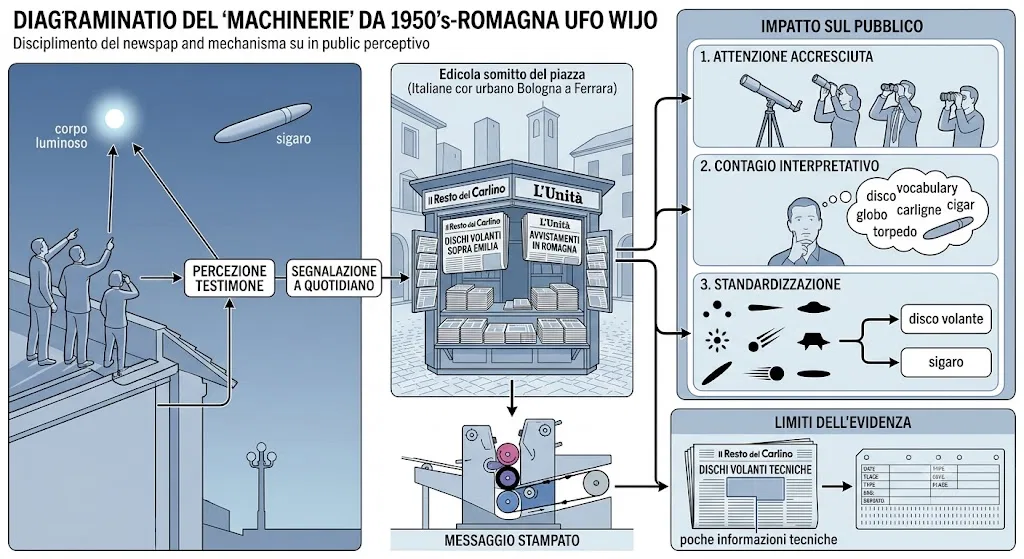
Newspapers did more than record Emilia-Romagna’s early UFO waves. They helped give them a recognisable shape. Reports from Bologna, Ferrara, Modena, Reggio Emilia and Ravenna were presented alongside similar stories from elsewhere in Italy, turning isolated lights into evidence of a wider “flying-saucer” phenomenon. Once readers had learned the expected vocabulary — discs, cigars, fiery globes, formations and mysterious trails — later witnesses had a ready-made way to describe ambiguous things in the sky.
This does not mean that newspapers invented every sighting. Some witnesses plainly saw real aerial or astronomical events that they could not identify. The more defensible conclusion is that press coverage influenced attention, interpretation and reporting. It encouraged people to look upwards, supplied familiar labels and made local observations seem connected. That mechanism is central to understanding Emilia-Romagna’s 1954 wave, especially because many surviving regional cases are now known only through short catalogue entries derived from contemporary reporting rather than complete investigative files.[psu.edu]pure.psu.eduPenn State After the flying saucers came: A global history of the UFO phenomenonPenn StateAfter the flying saucers came: A global history of the UFO phenomenon - Penn State…
The language newspapers repeated
The modern “flying saucer” was partly a journalistic creation from the beginning. After Kenneth Arnold’s 1947 sighting in the United States, reporters popularised the expression even though Arnold’s comparison originally concerned the objects’ skipping motion rather than necessarily their shape. The phrase spread internationally, and the Italian equivalent became part of a new global vocabulary for interpreting unusual aerial sights. Historian Greg Eghigian notes that news of the early American reports travelled rapidly and that similar objects were soon being reported across the world.[Penn State]pure.psu.eduPenn State After the flying saucers came: A global history of the UFO phenomenonPenn StateAfter the flying saucers came: A global history of the UFO phenomenon - Penn State…
By 1954, Italian readers did not encounter strange lights as culturally neutral observations. Newspapers had already taught them that fast-moving or luminous objects might be “flying saucers”. Reports were commonly framed through a relatively small set of visual comparisons: discs, cigars, globes, torpedoes and formations. Those comparisons were memorable, easy to place in headlines and broad enough to include very different phenomena, from meteors and aircraft to balloons, clouds and reflections.
The Emilia-Romagna entries in the national catalogue maintained by the Centro Ufologico Nazionale, or CUN, show this compression clearly. The catalogue records dates, times, places and brief classification codes, but usually preserves little of the witness’s original wording or the circumstances in which a newspaper obtained the account. On 14 October 1954 it lists reports from Bazzano, Ferrara, Fabbrico, Bologna, the Bologna–Budrio–Molinella road and the Modena countryside, among many observations elsewhere in northern and central Italy. Several fall within a narrow early-evening period.[centroufologiconazionale.net]centroufologiconazionale.netCasisticaCunItalia1900 2008CasisticaCunItalia1900 2008
That clustering looks impressive on a table, but a table is not the same as a set of independently documented investigations. It does not reveal whether witnesses had read an earlier edition, heard a radio bulletin, spoken to neighbours or described the object only after a reporter suggested a comparison. Nor does it show whether several entries referred to the same distant phenomenon viewed from different towns. The newspaper language may therefore preserve genuine observation while also concealing how the account was shaped.
This matters because repeated terminology can create an illusion of physical consistency. Ten witnesses using the word “disc” may appear to have seen the same type of object. In reality, some may have observed a point of light, others an elongated trail and others a poorly resolved aircraft. Once a dominant label becomes available, varied impressions can be translated into the same familiar form.
How one report encouraged another
A regional UFO flap is not simply a period when unusual objects are present. It is also a period when people are unusually attentive to the sky and unusually willing to report what they see. Press coverage can strengthen both tendencies.
The sequence is straightforward. A striking report appears in print. Readers are alerted that something unexplained may be overhead. Ordinary lights that might previously have been ignored receive closer attention. Witnesses compare what they see with the published account, and some contact a newspaper or the authorities. Their reports then become fresh stories, reinforcing the impression that the phenomenon is spreading.
The CUN chronology illustrates the pattern without proving its cause. On 14 October 1954, entries extend across a broad area and include Ferrara shortly after 1 am, Fabbrico at 5.10 pm, Bologna and the road towards Budrio and Molinella at 6.15 pm, and the Modena countryside at 6.30 pm. Ravenna appears on 16 October and Ferrara again on 17 October. A later November sequence includes Ravenna and Comacchio.[centroufologiconazionale.net]centroufologiconazionale.netCasisticaCunItalia1900 2008CasisticaCunItalia1900 2008
There are at least three possible contributors to such a pattern, and they can operate together.
A shared physical stimulus. A bright meteor, high-altitude aircraft, drifting material or another visible event may be observed from several places. Similar times then reflect a common cause rather than imitation.
Heightened public attention. Once newspapers announce repeated sightings, more people watch the sky and notice otherwise familiar objects. The number of reports rises even if the number of unusual stimuli does not.
Interpretive contagion. Readers acquire expectations about what a UFO should look like and how it should move. Ambiguous observations are then more likely to be described in the language already circulating in print. Researchers discussing UFO waves have long examined this spread of information and the possibility of a “trigger” effect in which one prominent story helps generate further reports.[cnes-geipan.fr]cnes-geipan.frUFO Waves. An International Bibliography NovemberUFO Waves. An International Bibliography November
“Contagion” should not be taken to mean that witnesses were dishonest or delusional. It refers to social influence on perception and classification. People constantly interpret uncertain sights by comparing them with familiar examples. During an intense press wave, the familiar example was the flying saucer.
Newspapers also altered the threshold for what counted as news. Once editors believed readers were interested, minor reports became publishable. An account that would ordinarily have remained a private anecdote could be added to a growing column of sightings. The resulting newspaper record therefore measured not only aerial events but editorial demand, public curiosity and the availability of witnesses willing to speak.
The 1954 wave became a national frame for local sightings
Emilia-Romagna’s reports cannot be understood entirely within regional boundaries because the autumn 1954 wave was presented as an Italian and European event. France produced the largest concentration of reports, while Italy experienced its own heavily publicised sequence. The best-known Italian episode occurred over Florence on 27 October, when objects were reported above the city and a football match was interrupted. Newspapers gave the event sustained attention, and it became a powerful reference point for interpreting other sightings.[Wikipedia]WikipediaAvvistamento di UFO a FirenzeAvvistamento di UFO a Firenze
For readers in Bologna, Modena or Ferrara, such national stories made local observations appear less isolated. A light over a country road could be linked imaginatively to reports over Tuscany, Rome or northern Italy. The press effectively supplied a map before later UFO organisations turned the stories into formal chronologies.
This national framing could work in both directions. Regional reports added weight to the claim that Italy was experiencing a widespread wave, while famous incidents elsewhere made Emilia-Romagna’s weaker cases seem more significant by association. A terse local story gained credibility from being placed beside reports involving crowds, pilots or major cities, even when the local evidence consisted of only one witness and no photograph, radar trace or official inquiry.
The timing of publication is therefore as important as the stated timing of the sighting. A case allegedly observed before a major newspaper story may have greater independence than one reported afterwards. Yet many retrospective catalogues do not consistently distinguish the date of observation from the date on which the account entered the public record. That missing information limits any attempt to determine whether reports developed independently or followed press exposure.

Newspapers preserved cases while stripping away detail
Without newspapers, many early Emilia-Romagna sightings might have disappeared entirely. Local reporting preserved dates, towns and fragments of testimony that would otherwise have been lost. In that sense, the press is indispensable evidence.
It is also difficult evidence. A short article was written to attract and inform readers, not to support a later technical investigation. Reporters rarely recorded the witness’s exact viewing direction, angular elevation, duration, weather conditions or familiarity with aircraft and astronomy. Statements may have been condensed, paraphrased or made more vivid. Headlines could imply certainty that the body of the story did not support.
Retrospective catalogues introduce a second layer of compression. The CUN compilation is valuable for showing the density and geographical spread of reports, but its tabular format often reduces a case to a date, time, locality and classification. The entries around 14 October 1954, for example, demonstrate a striking concentration but do not by themselves allow a reader to test whether Bologna, the Bologna–Budrio–Molinella road and the Modena countryside were independent observations or different reports of one event.[centroufologiconazionale.net]centroufologiconazionale.netCasisticaCunItalia1900 2008CasisticaCunItalia1900 2008
The problem is compounded by access. Historical holdings of regional newspapers survive in libraries and specialist collections, but complete 1954 editions are not always freely searchable online. The Emilia-Romagna Legislative Assembly library lists substantial runs of local newspapers in paper, microfilm and digital formats, while the National Central Library in Rome records holdings of Il Resto del Carlino from 1954 with access restrictions for some material. This means that checking the original wording may require an on-site archival search rather than a simple web query.[Assemblea Legislativa Emilia-Romagna]assemblea.emr.itBologna / Emilia-Romagna Consistenza: Edizioni locali: Forlì, Faenza-Lugo, Cesena, Rimini, Ravenna, Imola. RESTO DEL CARLINO…
As a result, modern accounts often repeat a catalogue entry that was itself based on a newspaper summary, without returning to the original article. Each repetition can make the case look more established while adding no new evidence.
The limits of retrospective press catalogues
A newspaper-based chronology can establish that a story circulated. It cannot automatically establish that an extraordinary object was present. Readers should separate three different claims:
- A newspaper published a report.
- A witness probably observed something.
- The observed thing resisted ordinary explanation after adequate investigation.
The first claim may be easy to confirm. The second often depends on the quality of the quotation and whether the witness can be identified. The third requires information that newspaper reports frequently lack.
This distinction changes how the 1954 Emilia-Romagna wave should be assessed. The concentration of entries is good evidence of a regional reporting wave. It is weaker evidence for a wave of separate, physically anomalous craft. Similar observation times may indicate a common stimulus. Descriptions of fiery globes, trails or sparks may fit meteors or re-entering material. Other cases may involve aircraft, balloons or astronomical objects seen under unfamiliar conditions. With no full file, a responsible conclusion may be “insufficient information” rather than either “explained” or “genuinely extraordinary”.
The press record is also subject to selection bias. Editors favoured reports that were vivid, local, timely or similar to stories already attracting attention. Mundane explanations might receive less space than the original mystery, and corrections could appear days later in smaller articles. A modern catalogue that records the first report but not the follow-up will preserve the mystery more effectively than its resolution.
Later coverage can create the same distortion. Anniversary pieces often retell the most dramatic elements while omitting contemporary uncertainty. The famous Florence case, for example, has repeatedly been revived in television, sport and mystery reporting. Sceptical interpretations involving airborne material, spider silk or military countermeasures have also developed, but these explanations rarely possess the narrative appeal of a football match halted beneath mysterious objects.[Wikipedia]WikipediaAvvistamento di UFO a FirenzeAvvistamento di UFO a Firenze

What the regional press record genuinely shows
The strongest conclusion is not that Emilia-Romagna’s newspapers fabricated a UFO wave. It is that they acted as part of the wave’s machinery.
They preserved observations, connected towns, standardised descriptions and encouraged further reporting. They also blurred the boundary between an event in the sky and a story about an event in the sky. Once an account entered print, it influenced what later witnesses watched for and how they explained what they saw.
For regional UFO history, this makes newspapers both essential and insufficient. They are essential for reconstructing when stories appeared and how public attention moved from Bologna to Ferrara, Modena, Reggio Emilia, Ravenna and the Adriatic area. They are insufficient when they stand alone, particularly where the original article, witness interview and technical checks are missing.
The 1954 material is therefore best read as evidence of a powerful cultural and reporting flap containing an uncertain mixture of genuine unidentified observations, misidentified ordinary phenomena, duplicated reports and cases made more coherent by newspaper language than they were in the sky. The unresolved question is not simply what flew over Emilia-Romagna, but how much of the apparent regional pattern belonged to the objects, how much to public attention and how much to the newspapers that taught readers what a flying saucer was supposed to look like.
Amazon book picks
Further Reading
Books and field guides related to How Newspapers Helped Build Emilia Romagna's UFO Waves. Use these as the next step if you want deeper reading beyond the article.
The UFO Experience
Cited by the New York Review of Books as “the best brief for visitation,” this classic study presents an analysis of UFO reports and conc...
Passport to Magonia
Over two decades ago, eminent scientist Vallee wrote a provocative book about alleged UFO landings, folklore, and certain unexplained phe...
The Demon-Haunted World
NEW YORK TIMES BESTSELLER • From the renowned astronomer and author of Cosmos comes a “powerful [and] stirring defense of informed ration...
eBay marketplace picks
Marketplace Samples
Live-tested eBay searches with available results related to this page.
Selected fromUFO poster oneBay.co.uk.
Current eBay listing
VINTAGE UFO FLYING SAUCERS COMIC ADVERTISING A2 POSTER PRINT



Current eBay listing
I Want To Believe UFO Poster Giclée Fine Art Heavyweight Print
Endnotes
1.
Source: centroufologiconazionale.net
Title: CasisticaCunItalia1900 2008
Link:https://www.centroufologiconazionale.net/avvistamenti/CasisticaCunItalia1900-2008.pdf
2.
Source: cnes-geipan.fr
Title: UFO Waves. An International Bibliography November 1 2015
Link:https://www.cnes-geipan.fr/sites/default/files/UFO_Waves.An_International_Bibliography__November__1_2015.pdf
3.
Source: Wikipedia
Title: Avvistamento di UFO a Firenze
Link:https://it.wikipedia.org/wiki/Avvistamento_di_UFO_a_Firenze
4.
Source: Wikipedia
Title: Ondata di avvistamenti dell’autunno 1954
Link:https://it.wikipedia.org/wiki/Ondata_di_avvistamenti_dell%27autunno_1954
Source snippet
Il maggior numero di avvistamenti si verificò nel mese di ottobre. Quella del 1954 fu la prima ondata di avvistamenti UFO che interessò l...
5.
Source: centroufologiconazionale.net
Title: storia dell’ufologia Emilia-Romagna Giorgio Pattera
Link:https://www.centroufologiconazionale.net/CUNstory.pdf
6.
Source: centroufologiconazionale.net
Link:https://www.centroufologiconazionale.net/faq/rapimenti.htm
7.
Source: centroufologiconazionale.net
Title: CASISTICA UFOLOGICA COMPLETA 14 1 16 B
Link:https://www.centroufologiconazionale.net/avvistamenti/CASISTICA%20UFOLOGICA%20COMPLETA%2014%201%2016%20B.pdf
8.
Source: centroufologiconazionale.net
Link:https://www.centroufologiconazionale.net/news/newarchive.htm
9.
Source: centroufologiconazionale.net
Title: UFOLOGI A SPERIMENTALE MONDO
Link:https://www.centroufologiconazionale.net/Progetto%20I.U.M.P..pdf
10.
Source: centroufologiconazionale.net
Title: filodiretto14 2015
Link:https://www.centroufologiconazionale.net/filodiretto/filodiretto14-2015.pdf
11.
Source: Wikipedia
Title: UFO sightings in Italy
Link:https://en.wikipedia.org/wiki/UFO_sightings_in_Italy
12.
Source: Wikipedia
Title: List of reported UFO sightings
Link:https://en.wikipedia.org/wiki/List_of_reported_UFO_sightings
13.
Source: Wikipedia
Title: Flying saucer
Link:https://en.wikipedia.org/wiki/Flying_saucer
14.
Source: Wikipedia
Link:https://en.wikipedia.org/wiki/Il_Resto_del_Carlino
15.
Source: sport.sky.it
Title: ufo avvistamenti calcio
Link:https://sport.sky.it/calcio/2021/01/16/ufo-avvistamenti-calcio
16.
Source: geoportale.regione.emilia-romagna.it
Title: foto aeree del volo igmi gai 1954 1955
Link:https://geoportale.regione.emilia-romagna.it/applicazioni-gis/regione-emilia-romagna/cartografia-di-base/cartografia-storica/foto-aeree-del-volo-igmi-gai
17.
Source: pure.psu.edu
Title: Penn State After the flying saucers came: A global history of the UFO phenomenon
Link:https://pure.psu.edu/en/publications/after-the-flying-saucers-came-a-global-history-of-the-ufo-phenome/
Source snippet
Penn StateAfter the flying saucers came: A global history of the UFO phenomenon - Penn State...
18.
Source: assemblea.emr.it
Link:https://www.assemblea.emr.it/biblioteca/approfondire/raccolte-specialistiche/quotidiani/quotidiani_prov
Source snippet
Bologna / Emilia-Romagna Consistenza: Edizioni locali: Forlì, Faenza-Lugo, Cesena, Rimini, Ravenna, Imola. RESTO DEL CARLINO...
19.
Source: digitale.bnc.roma.sbn.it
Title: Il Resto del Carlino
Link:https://digitale.bnc.roma.sbn.it/tecadigitale/giornale/RAV0037021/2003/n.%206%20del%207%20gennaio
Source snippet
Pubblicazione: \Bologna s. (4 gen. 1954) di Bologna Luoghi: disponibile solo dalle postazioni … 105 - 00185...
20.
Source: youtube.com
Link:https://www.youtube.com/watch?v=VXnbh8YtYIw
21.
Source: youtube.com
Link:https://www.youtube.com/watch?v=Oh0LU_yXgIs
Additional References
22.
Source: blog.geolsoc.org.uk
Title: door 9 football geothermal energy and the 1954 wave of ufos
Link:https://blog.geolsoc.org.uk/2014/12/09/door-9-football-geothermal-energy-and-the-1954-wave-of-ufos/
Source snippet
The Geological Society BlogDoor 9: Football, geothermal energy and the 1954 wave of...9 Dec 2014 — To this day, the spider-ballooning th...
23.
Source: wired.com
Title: how ufo sightings became an american obsession
Link:https://www.wired.com/story/how-ufo-sightings-became-an-american-obsession
Source snippet
The period following his sighting saw a surge in UFO sightings across the U.S. This surge, or "flap," is linked to societal fears of inva...
24.
Source: youtube.com
Link:https://www.youtube.com/watch?v=jqJzZ-V5Jv8
Source snippet
This collection of videos is directly relevant to the topic because it documents how early newspaper reporting, coined terms like "flying...
25.
Source: youtube.com
Link:https://www.youtube.com/watch?v=sSY6NB6m2PU
Source snippet
Kenneth Arnold UFO Sighting The First UFOs - Jimmy Akin's Mysterious World...
26.
Source: youtube.com
Title: UFO Files #4: UFOs over Florence
Link:https://www.youtube.com/watch?v=dQHx76CM0d4
Source snippet
The UFO Deluge of July 4th, 1947 | Part 1: Omens (Before the Storm)...
27.
Source: cia.gov
Link:https://www.cia.gov/readingroom/docs/DOC_0000015482.pdf
28.
Source: researchgate.net
Link:https://www.researchgate.net/publication/368458403_Social_factors_and_UFO_reports_was_the_SARS-CoV-2_pandemic_associated_with_an_increase_in_UFO_reporting
29.
Source: quizlet.com
Link:https://quizlet.com/326965441/ch-1-intro-to-mass-media-bonjour-study-guide-flash-cards/
30.
Source: gangemi.com
Link:https://gangemi.com/distribuzione-wolrdwide/?srsltid=AfmBOoo-AkUo7naR4xD8wIDjoOqFb4Gvf7Gk_KwYLInHfe4PSVnorVnJ
31.
Source: cisu.org
Link:https://www.cisu.org/wp-content/uploads/2022/05/PT_Upiar.pdf