Within Aosta Valley UFOs
Can Alpine Weather Create Flying Saucer Shapes?
Mountain weather can produce smooth lens-shaped clouds and distorted lights that resemble structured craft from the ground.
On this page
- How lenticular clouds form
- Why mountain light can appear unstable
- The poorly documented 1987 photograph
Page outline Jump by section
Introduction
Yes. Alpine weather can create remarkably convincing flying-saucer shapes, and Aosta Valley is particularly well suited to producing them. Strong winds crossing its high ridges generate standing atmospheric waves. Where moist air rises and cools at a wave crest, a smooth, lens-shaped cloud may form; where the air sinks, the cloud evaporates. The result can appear solid, symmetrical and almost motionless even while powerful winds stream through it. Aosta Valley’s own meteorological service identifies lenticular clouds as a typical regional feature, especially near Mont Blanc and Grand Combin and during foehn conditions.[vda.it]cf.regione.vda.itValle d'Aosta Function CenterValle d'Aosta Function Center
This matters when reading the region’s UFO history because a memorable shape is not, by itself, evidence of a structured craft. One local chronology even describes a 1987 Aosta photograph merely as a “lenticular UFO”. No original report, technical examination or detailed witness account is readily available alongside that brief entry, making it a useful example of how an ambiguous photograph can enter UFO folklore without enough information for a secure conclusion.[AostaCronaca]valledaostaglocal.itufo dal 1947 ad oggi circa 80 avvistamenti in valleAostaCronacaUFO: Dal 1947 ad oggi circa 80 avvistamenti in Valle1 Mar 2014 — Il 13 dicembre dello stesso anno, alle ore 19, una luce stra…
How lenticular clouds form
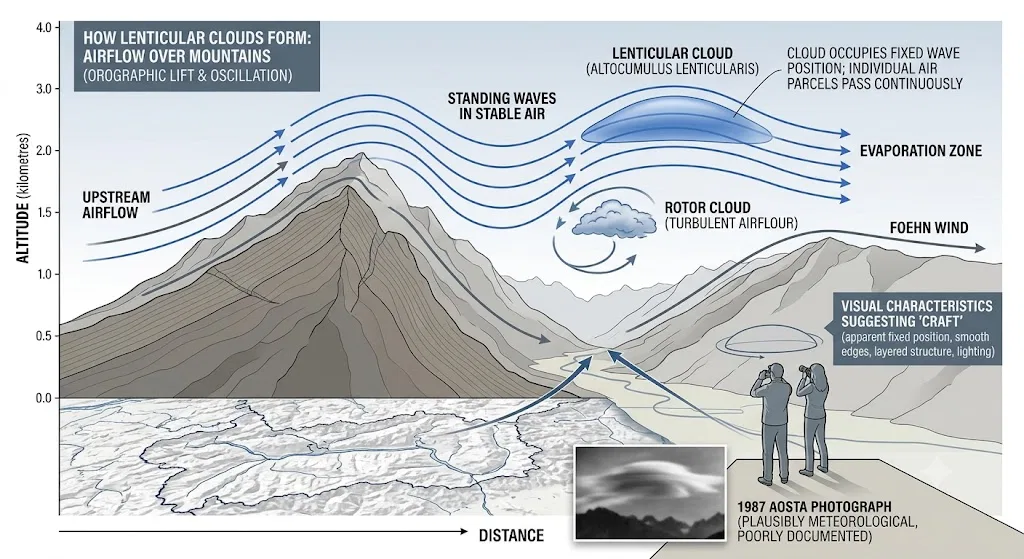
Lenticular clouds are produced by airflow over mountains rather than by an object moving through the sky. When stable air encounters a high ridge, it is forced upwards, then oscillates vertically beyond the summit in a series of standing waves. Moisture condenses into cloud where the rising air becomes cold enough and disappears again where descending air warms. The cloud therefore occupies a fairly fixed part of the wave while individual air parcels pass continuously through it.[National Weather Service]weather.govACSL cloudsNational Weather ServiceAltocumulus Standing Lenticular CloudsWhen sufficient moisture is present above mountain-top level, ACSL clouds d…
That explains their most misleading characteristic: apparent hovering. A normal cloud is expected to drift with the wind, but a standing lenticular cloud may remain over the same ridge or section of sky for hours. Its front edge is constantly forming and its rear edge constantly dissolving. To an observer without visible foreground references—or to someone viewing only a single photograph—the cloud can look like a stationary vehicle resisting a strong wind.[Valle d'Aosta Function Center]cf.regione.vda.itValle d'Aosta Function Center
Aosta Valley’s official meteorological guide calls lenticular altocumulus a typical form of regional orographic cloud. It notes that they are often seen near the highest summits, including Mont Blanc and Grand Combin, but may also develop over the middle and lower valley during foehn weather. Locally, the shape has also been likened to a fish, an indication that residents recognised its smooth, elongated outline long before “flying saucer” became the more culturally charged comparison.[Valle d'Aosta Function Center]cf.regione.vda.itValle d'Aosta Function Center
The regional geography strengthens the effect. Aosta Valley is enclosed by exceptionally high mountain chains, while its long valley system channels winds through passes and around ridges. The regional meteorological service explains that the direction measured inside a valley can differ markedly from the broader airflow above it: during north-westerly foehn, for example, winds near La Thuile may be redirected through the Little St Bernard Pass and recorded as southerly. Such complex flow can create several cloud layers, isolated lenses or stacked formations whose shape differs sharply according to the observer’s position.[Valle d'Aosta Function Center]cf.regione.vda.itValle d'Aosta Function Center
Foehn conditions are especially relevant. Air passing across an Alpine barrier can descend on the sheltered side as a warmer, drier wind, while atmospheric waves continue high above. A regional account describes Aosta Valley as exceptionally favourable for mountain-wave formation because of the height and arrangement of its surrounding ranges and the direction of its prevailing winds. At the crests of these waves, translucent lens-shaped clouds form; lower down, rougher rotor clouds may develop in turbulent circulating air.[vda.it]regione.vda.itRegione VDARivista Environnement…
Several visual forms can suggest a manufactured object:
- A single smooth lens can resemble a classic disc viewed from the side.
- Two or more stacked lenses may suggest a domed craft with separate decks or a bright central rim.
- A dark lower surface and sunlit upper edge can create an apparently metallic body.
- Partial evaporation can leave a compact central patch that looks detached from the surrounding cloud.
- Clouds aligned one behind another may be interpreted as several objects travelling in formation.
These impressions are strongest around sunrise or sunset, when low-angle sunlight emphasises edges and can colour one layer differently from another. Lenticular clouds are well known to vary from subtle oval patches to dramatic, tiered structures, and meteorological guidance explicitly notes that their unusual shape leads to UFO misidentifications.[National Weather Service]weather.govOpen source on weather.gov.
Why mountain light can appear unstable
Not every false saucer impression involves a clearly visible cloud. A distant light seen above an Alpine ridge can also appear to pulse, change colour or move slightly because its light is travelling through uneven layers of air. Atmospheric turbulence continually alters the path of light by small amounts. Astronomers experience the same process as stellar scintillation—the twinkling and apparent jitter of stars. The effect becomes stronger near the horizon because the light passes through a much longer stretch of atmosphere.[nasa.gov]starchild.gsfc.nasa.govOpen source on nasa.gov.
Mountain valleys can add particularly sharp differences in temperature and air density. Sunlit slopes, shaded snowfields, cold valley air and warmer layers above them need not share the same optical properties. Looking along a valley or just over a ridge may therefore mean looking through several disturbed layers at once. A bright star, planet, aircraft lamp or light on a distant slope can seem to shimmer, separate briefly into colours or shift against an indistinct background. Atmospheric refraction is strongest near the horizon and can slightly alter the apparent position and shape of celestial objects.[nasa.gov]pwg.gsfc.nasa.govPower and Water GroupPower and Water Group
Perspective then compounds the problem. A witness standing in the valley may have no reliable way to determine whether a light is hundreds of metres away, above the next ridge or far beyond the mountains. With no known size, distance cannot be calculated from apparent angular size alone. A light that is actually stationary may seem to follow a moving car because nearby trees and slopes sweep across the observer’s field of view. Small involuntary eye movements can also make an isolated point of light appear to wander when there is no fixed reference beside it.
Photography does not automatically settle the issue. A still image removes duration, direction of travel and changes in shape—the very details that might separate a regenerating cloud from a solid object. Older cameras could also introduce motion blur, internal reflections and uncertain exposure, while enlarging a small feature reduces detail rather than revealing the object’s true structure. Without the original negative or file, lens information, sequence of frames and documented viewing direction, interpretations based solely on silhouette are weak.
There are nevertheless useful observational distinctions. A lenticular-cloud explanation becomes stronger when the form:
- remains fixed relative to a summit while its edges slowly change;
- appears during strong cross-mountain winds or foehn conditions;
- is smooth, layered and broadly aligned with a ridge;
- is accompanied by other wave or cap clouds;
- loses definition as sunlight changes rather than departing along a clear trajectory.
Conversely, a meteorological explanation would be less satisfactory if reliable, independent observations established rapid movement against distant terrain, sharp turns, prolonged visibility from widely separated locations or an associated radar track. Shape alone cannot establish those features.
The poorly documented 1987 photograph
A regional UFO retrospective published in 2014 includes a very short entry for 1987: an object photographed at Aosta and described as “lenticular”. That wording is the surviving public clue most relevant to this page, but it is too compressed to show whether “lenticular” was meant as a description of shape, an investigator’s cloud identification or simply a label added by a later compiler. The article supplies no photographer’s name, precise date, viewing direction, weather record, original image provenance or investigative finding.[AostaCronaca]valledaostaglocal.itufo dal 1947 ad oggi circa 80 avvistamenti in valleAostaCronacaUFO: Dal 1947 ad oggi circa 80 avvistamenti in Valle1 Mar 2014 — Il 13 dicembre dello stesso anno, alle ore 19, una luce stra…
Those omissions substantially weaken the case. A photograph cannot be tested properly without knowing where the camera was pointed, whether the object remained in one position, how long it was visible and what the upper-air winds and cloud conditions were. Those details would be especially important in Aosta, where the regional weather service documents frequent mountain waves and lenticular formations near major summits and under foehn flow.[Valle d'Aosta Function Center]cf.regione.vda.itValle d'Aosta Function Center
It would therefore be premature to call the 1987 image either an extraordinary craft or a conclusively identified cloud. The fairest classification is poorly documented and plausibly meteorological. Its apparent lens shape fits a familiar Alpine mechanism, but the accessible account is too thin to demonstrate exactly what was photographed. Later repetition has not strengthened the claim because it has not added the missing primary evidence.
The case also illustrates a wider archival problem in Aosta Valley’s UFO record. A brief caption can preserve the idea that “a UFO was photographed” while losing the circumstances needed to judge it. Once detached from weather, time and location data, an ordinary mountain-wave cloud becomes harder to recognise and easier to reinterpret as a discrete object. Italy’s official reporting procedure is designed to avoid that problem by seeking correlations with natural phenomena and human activity before retaining an incident as unidentified.[Aeronautica Militare]aeronautica.difesa.itAeronautica Militare OVNIAeronautica Militare OVNI

A natural explanation with regional weight
Lenticular clouds do not explain every unusual report from Aosta Valley. They cannot account automatically for lights reported on clear nights, objects said to cross the sky rapidly or incidents involving independently recorded motion. They should be treated as a testable hypothesis, not a universal dismissal.
For daylight discs and stationary oval forms, however, they are one of the first explanations that should be checked. The match is unusually strong in Aosta Valley: the region’s meteorologists identify lenticular clouds as characteristic local formations, explain their connection with sustained high-level winds and show that they can remain apparently fixed for hours. The valley’s steep relief, channelled foehn winds and excellent visibility can make those clouds appear especially isolated and sharply defined.[vda.it]cf.regione.vda.itValle d'Aosta Function CenterValle d'Aosta Function Center
The practical lesson for the region’s UFO history is straightforward. A smooth saucer outline is visually striking but evidentially modest. What matters is whether the form moved independently of the mountain-wave system, whether several observers recorded the same trajectory, whether photographs preserve identifiable landscape references and whether contemporary weather data support or contradict a cloud interpretation. In the absence of those checks, Aosta Valley’s Alpine atmosphere offers a strong, ordinary explanation for many hovering discs—and for the enduring false impression that something solid was parked above the peaks.
Amazon book picks
Further Reading
Books and field guides related to Can Alpine Weather Create Flying Saucer Shapes?. Use these as the next step if you want deeper reading beyond the article.
The Cloudspotter's Guide
Discusses the history, types, and cultural fascination with clouds and explains what they mean in terms of climate and weather.
The Weather Handbook
The third edition of this bestselling book explains how to combine professional weather forecasts with information from websites and apps...
The Cloud Collector's Handbook
Keep your head in the clouds with this whimsical guide to the wonders of the sky from an award-winning science writer. In The Cloud Colle...
Light and Color in the Outdoors
All of science springs from the observation of nature. In this classic book, the late Marcel Minnaert accompanies the reader on a tour of...
eBay marketplace picks
Marketplace Samples
Live-tested eBay searches with available results related to this page.
Selected fromaviation weather poster oneBay.co.uk.
Endnotes
1.
Source: cf.regione.vda.it
Title: Valle d’Aosta Function Center
Link:https://cf.regione.vda.it/uploads/page/45/manuale-bollettino-meteo.pdf
2.
Source: regione.vda.it
Title: Regione VDA
Link:https://www.regione.vda.it/gestione/riviweb/templates/aspx/environnement.aspx?pkArt=950
Source snippet
Rivista Environnement...
3.
Source: weather.gov
Title: ACSL clouds
Link:https://www.weather.gov/abq/features_acsl
Source snippet
National Weather ServiceAltocumulus Standing Lenticular CloudsWhen sufficient moisture is present above mountain-top level, ACSL clouds d...
4.
Source: weather.gov
Title: Mountain lee wave activity
Link:https://www.weather.gov/media/abq/LocalStudies/MountainWavesUpdate.pdf
Source snippet
National Weather ServiceMountain Wave Activity Over the Southern Rockiesby A Vieira · 2005 · Cited by 5 — Crests of standing waves may be...
5.
Source: weather.gov
Link:https://www.weather.gov/media/zhu/ZHU_Training_Page/clouds/forecast_layer_clouds/Layer_Cloud_Forecasting.pdf
Source snippet
National Weather ServiceLayer Cloud ForecastingLenticular cloud: Stationary or quasi-stationary, smooth, lens-shaped clouds which form in...
6.
Source: weather.gov
Link:https://www.weather.gov/media/aly/stormbuster/Spring17SB.pdf
7.
Source: forecast.weather.gov
Title: National Weather Service NOAA’s National Weather Service
Link:https://forecast.weather.gov/glossary.php?word=cl
8.
Source: starchild.gsfc.nasa.gov
Link:https://starchild.gsfc.nasa.gov/docs/StarChild/questions/question26.html
9.
Source: nasa.gov
Title: interesting fact of the month 2020
Link:https://www.nasa.gov/space-science-and-astrobiology-at-ames/interesting-fact-of-the-month-current/interesting-fact-of-the-month-2020/
10.
Source: pwg.gsfc.nasa.gov
Title: Power and Water Group
Link:https://pwg.gsfc.nasa.gov/stargaze/IstarFAQ11.htm
11.
Source: cf.regione.vda.it
Link:https://cf.regione.vda.it/fr/meteo
12.
Source: cf.regione.vda.it
Link:https://cf.regione.vda.it/it/allerta
13.
Source: cf.regione.vda.it
Link:https://cf.regione.vda.it/it/bollettino-meteo
14.
Source: cf.regione.vda.it
Title: regione.vda.it Centro Funzionale Regione Autonoma Valle d’Aosta
Link:https://cf.regione.vda.it/it/
15.
Source: cf.regione.vda.it
Link:https://cf.regione.vda.it/fr
16.
Source: arpa.vda.it
Title: Installata una nuova stazione meteo sul Cervino
Link:https://www.arpa.vda.it/notizie/clima/installata-una-nuova-stazione-meteo-sul-cervino
17.
Source: cf.regione.vda.it
Link:https://cf.regione.vda.it/it/pillole-di-clima
18.
Source: cf.regione.vda.it
Title: regione.vda.it Clima / Resoconto del clima
Link:https://cf.regione.vda.it/it/news/resoconto-del-clima-giugno-2026
19.
Source: arpa.vda.it
Link:https://www.arpa.vda.it/?catid=9&id=1810%3Aqualita-dellaria-in-valle-daosta-pubblicato-il-report-di-novembre-2025&view=article
20.
Source: arpa.vda.it
Link:https://www.arpa.vda.it/temi/aria?catid=9&id=1810%3Aqualita-dellaria-in-valle-daosta-pubblicato-il-report-di-novembre-2025&view=article
21.
Source: arpa.vda.it
Title: Il cielo sulla Valle d’Aosta è velato, di che si tratta?
Link:https://www.arpa.vda.it/notizie/atmosfera/il-cielo-sulla-valle-daosta-e-velato-di-che-si-tratta
22.
Source: arpa.vda.it
Link:https://www.arpa.vda.it/notizie/aria/dalle-foreste-canadesi-alle-alpi-le-polveri-sottili-che-hanno-oscurato-le-nostre-montagne
23.
Source: arpa.vda.it
Title: Polveri sottili dal Canada: cosa sta succedendo in Valle d’Aosta?
Link:https://www.arpa.vda.it/notizie/atmosfera/polveri-sottili-dal-canada-cosa-sta-succedendo-in-valle-daosta
24.
Source: arpa.vda.it
Title: qualita dellaria in valle daosta pubblicato il report di agosto 2024
Link:https://www.arpa.vda.it/contenuti/news/aria/qualita-dellaria-in-valle-daosta-pubblicato-il-report-di-agosto-2024
25.
Source: arpa.vda.it
Title: Polveri sottili dal Canada in Valle d’Aosta: analisi aggiornata
Link:https://www.arpa.vda.it/notizie/aria/polveri-sottili-dal-canada-in-valle-daosta-analisi-aggiornata
26.
Source: arpa.vda.it
Title: qualita dellaria in valle daosta pubblicato il report di maggio 2024
Link:https://www.arpa.vda.it/contenuti/news/aria/qualita-dellaria-in-valle-daosta-pubblicato-il-report-di-maggio-2024
27.
Source: cf.regione.vda.it
Link:https://cf.regione.vda.it/it/news/il-nuovo-sito-del-centro-funzionale-e-online
28.
Source: arpa.vda.it
Link:https://www.arpa.vda.it/contenuti/news/atmosfera/deposizioni-atmosferiche-di-azoto-gli-ecosistemi-di-alta-montagna-osservati-speciali
29.
Source: apod.nasa.gov
Link:https://apod.nasa.gov/apod/ap210210.html
30.
Source: imagine.gsfc.nasa.gov
Title: night sky
Link:https://imagine.gsfc.nasa.gov/ask_astro/night_sky.html
31.
Source: science.nasa.gov
Title: symphony of stars the science of stellar sound waves
Link:https://science.nasa.gov/universe/exoplanets/symphony-of-stars-the-science-of-stellar-sound-waves/
32.
Source: regione.vda.it
Title: Cosa fare in caso di nevicate intense e di elevato pericolo di valanghe
Link:https://www.regione.vda.it/Protezione_civile/cosa_fare_emergenza/valanghe_i.aspx
33.
Source: jpl.nasa.gov
Title: opals boosts space to ground optical communications research
Link:https://www.jpl.nasa.gov/news/opals-boosts-space-to-ground-optical-communications-research/
34.
Source: cosmicopia.gsfc.nasa.gov
Title: qa star
Link:https://cosmicopia.gsfc.nasa.gov/qa_star.html
35.
Source: nasa.gov
Title: A Star That Bursts, Blinks and Disappears
Link:https://www.nasa.gov/universe/stars/neutron-stars/magnetars/a-star-that-bursts-blinks-and-disappears/
36.
Source: ntrs.nasa.gov
Link:https://ntrs.nasa.gov/citations/20110016061
37.
Source: apod.nasa.gov
Link:https://apod.nasa.gov/apod/ap000725.html
38.
Source: regione.vda.it
Link:https://www.regione.vda.it/notizie/details_i.asp?id=40890
39.
Source: cf.regione.vda.it
Link:https://cf.regione.vda.it/en/weather-forecast
40.
Source: regione.vda.it
Link:https://www.regione.vda.it/notizie/details_i.asp?id=86403
41.
Source: cf.regione.vda.it
Link:https://cf.regione.vda.it/it/meteo-comprensori-sciistici
42.
Source: cf.regione.vda.it
Link:https://cf.regione.vda.it/fr/facteurs-dinfluence-climatique-en-vallee-daoste
43.
Source: jpl.nasa.gov
Title: rocks and stars with amy
Link:https://www.jpl.nasa.gov/blog/columns/rocks-and-stars-with-amy/
44.
Source: weather.gov
Link:https://www.weather.gov/source/zhu/ZHU_Training_Page/turbulence_stuff/turbulence/turbulence.htm
45.
Source: weather.gov
Link:https://www.weather.gov/media/zhu/ZHU_Training_Page/turbulence_stuff/turbulence2/turbulence.pdf
46.
Source: weather.gov
Link:https://www.weather.gov/media/zse/newsletter/WeatherWatchFall2016.pdf
47.
Source: forecast.weather.gov
Link:https://forecast.weather.gov/glossary.php?word=A
48.
Source: weather.gov
Title: Meteorological Techniques
Link:https://www.weather.gov/media/zhu/ZHU_Training_Page/Met_Tutorials/Meteorological_Techniques.pdf
49.
Source: arpa.vda.it
Link:https://www.arpa.vda.it/rsa-2021-ambiente-naturale/atmosfera
50.
Source: arpa.vda.it
Link:https://www.arpa.vda.it/temi/clima
51.
Source: youtube.com
Title: Mount Shasta’s neighboring lenticular clouds: explained
Link:https://www.youtube.com/watch?v=oyX2o2nF9UA
Source snippet
Lenticular Clouds...
52.
Source: youtube.com
Title: Lenticular Clouds
Link:https://www.youtube.com/watch?v=KgO7Kyq3q-U
53.
Source: valledaostaglocal.it
Title: ufo dal 1947 ad oggi circa 80 avvistamenti in valle
Link:https://www.valledaostaglocal.it/2014/03/01/leggi-notizia/argomenti/attualita-2/articolo/ufo-dal-1947-ad-oggi-circa-80-avvistamenti-in-valle.html
Source snippet
AostaCronacaUFO: Dal 1947 ad oggi circa 80 avvistamenti in Valle1 Mar 2014 — Il 13 dicembre dello stesso anno, alle ore 19, una luce stra...
54.
Source: meteoswiss.admin.ch
Link:https://www.meteoswiss.admin.ch/weather/weather-and-climate-from-a-to-z/foehn.html
Source snippet
FoehnFoehn occurs wherever strong winds sweep across mountain ranges. One of the major effects of foehn is that it brings warm...
55.
Source: weather.metoffice.gov.uk
Link:https://weather.metoffice.gov.uk/learn-about/weather/types-of-weather/wind/foehn-effect
Source snippet
Met OfficeFoehn effectFoehn events are often accompanied by dramatic cloud formations above the mountains, such as towering lenticular cl...
56.
Source: skyandtelescope.org
Title: Sky & Telescope Observing the Full Moon: Fringe Benefits
Link:https://skyandtelescope.org/astronomy-news/observing-news/full-moon-fringe-benefits/
57.
Source: skyandtelescope.org
Title: Sky & Telescope How to Successfully Beat Atmospheric Seeing
Link:https://skyandtelescope.org/astronomy-equipment/beating-the-seeing/
58.
Source: aeronautica.difesa.it
Title: Aeronautica Militare OVNI
Link:https://www.aeronautica.difesa.it/ovni/
59.
Source: digital.nmla.metoffice.gov.uk
Link:https://digital.nmla.metoffice.gov.uk/download/file/IO_31ea0d19-1cd8-4476-abcd-0c53e045f2a6
Additional References
60.
Source: youtube.com
Title: How Mountain Wave Systems Work, with Lenticular and Rotor Clouds
Link:https://www.youtube.com/watch?v=VhDpoM5k2Qg
Source snippet
Spotted a UFO near the mountains? It was likely a lenticular cloud...
61.
Source: youtube.com
Title: Spotted a UFO near the mountains? It was likely a lenticular cloud
Link:https://www.youtube.com/watch?v=qKqu37x85AU
Source snippet
Mount Shasta's neighboring lenticular clouds: explained...
62.
Source: youtube.com
Title: Bizarre UFO-like cloud hovers over Turkey
Link:https://www.youtube.com/watch?v=C3QiwAuTnCg
Source snippet
How Mountain Wave Systems Work, with Lenticular and Rotor Clouds...
63.
Source: eso.org
Link:https://www.eso.org/public/unitedkingdom/teles-instr/technology/adaptive_optics/
64.
Source: facebook.com
Link:https://www.facebook.com/groups/cloudytimes/posts/2683855718492002/
65.
Source: mountwashington.org
Link:https://mountwashington.org/how-do-lenticular-clouds-form/
66.
Source: sapere.it
Link:https://www.sapere.it/enciclopedia/It%C3%A0lia%2B%28arte%2Be%2Bcultura%29.html
67.
Source: facebook.com
Link:https://www.facebook.com/groups/828178678983076/posts/1092076849259923/
68.
Source: skiresort.info
Link:https://www.skiresort.info/weather/aosta-valley-valle-daosta/
69.
Source: valthorens.com
Link:https://www.valthorens.com/en/la-meteo-par-les-gens-den-haut/