Within Lazio UFO Files
Are Pilots and Military Witnesses More Reliable?
Trained witnesses can make a report more valuable, but radar claims, pilot testimony and military status still require independent documentation.
On this page
- What professional experience can add
- The limits of memory and visual judgement
- When radar or records materially strengthen a case
Page outline Jump by section
Introduction
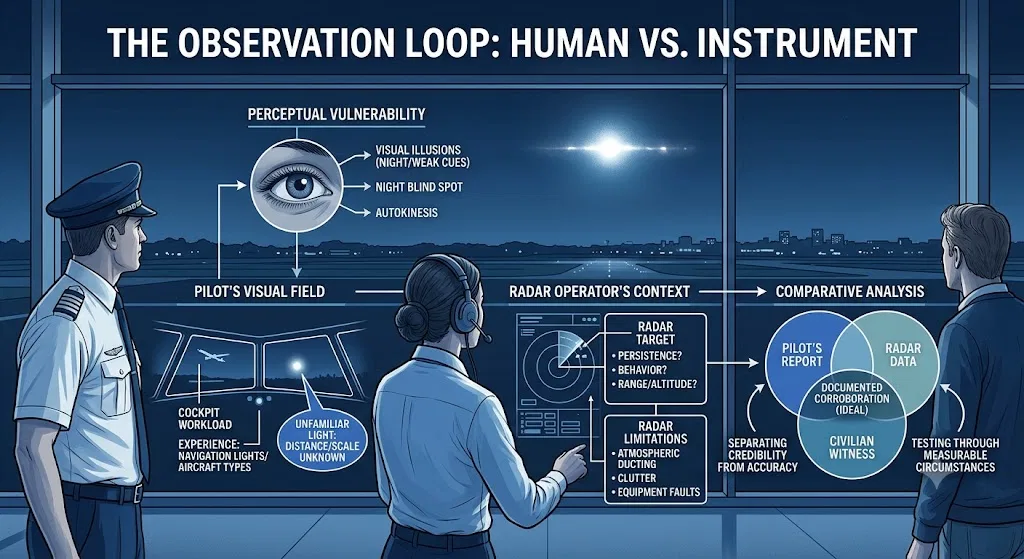
Pilots, radar officers and military personnel can make a Lazio UFO report more valuable, but their professional status does not make the report automatically accurate. Their experience may improve descriptions of aircraft behaviour, headings, weather, cockpit conditions and normal traffic. It cannot remove the basic difficulties of judging an unfamiliar light or object without a known distance, scale or reliable instrument record.
This distinction matters because some of Lazio’s most repeated cases—especially the 1954 reports around Ciampino and Pratica di Mare and the alleged 1973 Alitalia encounter near Latina—derive much of their reputation from claims involving trained witnesses, radar detection or a military response. Yet the publicly available evidence is often a brief catalogue entry or later retelling rather than an original radar plot, flight log, radio transcript or signed contemporary statement. The right conclusion is therefore neither that professional witnesses should be dismissed nor that their testimony settles the case. Their reports deserve attention, but credibility must be separated from corroboration.
What professional experience can add
A pilot is usually better placed than an untrained observer to recognise familiar aircraft, navigation lights, standard manoeuvres and some weather effects. A radar operator may understand how a target appeared on a particular display and whether it behaved unusually compared with routine traffic. Military personnel may also be accustomed to recording time, direction and operational circumstances precisely.
That expertise can strengthen a report in several ways:
- Better recognition of ordinary traffic. An experienced aircrew may be less likely to mistake a nearby airliner’s standard light pattern for something extraordinary.
- Operational context. Pilots can report their own altitude, heading, speed and cockpit workload, giving investigators a clearer geometry than is usually available from a witness on the ground.
- More useful timing. Aviation communications, flight plans and duty records may allow a sighting to be checked against aircraft movements, astronomical objects and weather.
- Independent crew observations. Separate descriptions from a captain, first officer, air traffic controller and ground observer are potentially stronger than a single jointly reconstructed story.
Italy’s official Air Force reporting form reflects the importance of such details. It asks for the exact time, weather, the observer’s position and, where the witness was aboard an aircraft, its type, altitude, route and speed. It also asks whether the object was viewed through glass, spectacles, binoculars or another instrument. Witnesses are instructed to record only details they remember with certainty and may attach photographs or film.[Aeronautica Militare]aeronautica.difesa.itAeronautica Militare
This procedure shows what investigators need from a useful aviation report. It does not assume that military rank or flying experience proves the observer’s interpretation. Instead, it seeks measurable circumstances that can be checked.
Why pilots can still misjudge what they see
Pilots are trained to operate aircraft safely, not to identify every distant or unfamiliar object under all viewing conditions. Aviation authorities explicitly train them to distrust unaided perception in situations where visual cues are weak.
The US Federal Aviation Administration explains that estimates of distance, speed and depth depend on cues such as known size, detail, contrast, relative motion and the relationship between one object and another. A solitary point of light against a dark or featureless sky may provide few or none of those clues. Without knowing its distance, an observer cannot reliably infer its physical size or true speed. A small nearby object and a much larger distant object can produce a similar image on the retina.[Federal Aviation Administration]faa.govFederal Aviation Administration
Night flying introduces further problems. Even pilots with normal vision experience reduced sharpness in low light, while faint objects may disappear when stared at directly because of the eye’s night blind spot. Aviation guidance warns that visual illusions are especially common at night and in poor visibility.[Federal Aviation Administration]faa.govFor individuals with mild refractive errors, these factors.Read moreFederal Aviation AdministrationChapter 13: Night OperationsMarch 8, 2019 — Even pilots with perfect vision find that image sharpness decr…
Several familiar effects can therefore produce an honest but mistaken report:
- A bright planet or star may appear to move when the observer’s eyes shift against a dark background.
- An aircraft viewed nearly head-on may seem stationary before apparently accelerating as its angle changes.
- A light’s brightness may be interpreted as evidence that it is approaching, although atmospheric conditions or a turn could produce the change.
- Motion by the witness’s own aircraft can make a distant light appear to move in an unexpected direction.
- A balloon, cloud reflection, meteor, satellite or aircraft light may look unfamiliar because only part of the object is visible.
Professional status can make the description of the experience more useful, but it does not guarantee that the witness correctly determined distance, size or cause. Aviation’s own safety literature exists precisely because trained pilots remain vulnerable to powerful visual errors.
The Lazio cases gain prestige from job titles, not always from documents
The best-known 1954 Lazio claims illustrate the difference between a promising lead and demonstrable corroboration. A chronology published by the Centro Ufologico Nazionale states that on 17 September an object seen by personnel at Ciampino airport was detected by radar at Pratica di Mare and observed by many people. It also lists a mid-October report from Torvaianica attributed to a radar colonel, citing defence and anti-aircraft authorities.[Centro Ufologico Nazionale]centroufologiconazionale.netCentro Ufologico NazionaleLazio… 1954, 17 settembre ore 17.45 Roma. Un oggetto rosso notato dal personale dell'aeroporto di Ciampino, r…
These details make the reports historically significant. Ciampino and Pratica di Mare were important aviation and military locations, while a radar specialist would be a more relevant witness than an anonymous passer-by. But the online catalogue does not reproduce a radar scope photograph, target track, equipment log, operator statement, weather analysis or full official report. Nor does it show whether the visual and radar observations referred to the same object at precisely the same time.
The phrase “detected by radar” can conceal several unanswered questions:
- Which radar station and equipment were involved?
- Was the return recorded or merely remembered?
- Did it persist across repeated sweeps?
- Was range, altitude or speed calculated?
- Did another radar detect it independently?
- Was known aircraft traffic excluded?
- Were atmospheric propagation, ground clutter or equipment faults examined?
- Were the radar operators’ statements written at the time?
Without those details, the claim remains more interesting than an unsupported visual sighting but much weaker than a documented radar-visual case.
The alleged 1973 Alitalia incident has a similar problem. Later summaries say that an airliner travelling from Rome towards Naples saw a round grey object near Latina and that two Italian Air Force aircraft from Ciampino confirmed the sighting.[Wikipedia]WikipediaUFO sightings in ItalyUFO sightings in Italy The story would be exceptionally important if supported by contemporary records. A commercial crew, military interception and independent confirmation could create several evidence streams.
However, readily accessible accounts generally omit the flight number, firm date, crew names, interception logs, radio exchanges and original investigation file. Repetition of the same brief account on multiple websites does not create multiple independent sources. Until the underlying records are produced, the case should be described as a notable aviation claim with weak public documentation, not as a confirmed encounter.
When radar materially strengthens a case
Radar can move a report beyond testimony because it may supply range, bearing, altitude or radial velocity independently of the witness’s visual impression. But the word “radar” is not itself evidence. The value lies in the preserved data and the ability to reconstruct how the system produced the return.
Radar systems can display genuine aircraft, balloons, birds, weather, surface reflections, electronic interference and spurious targets. Atmospheric conditions can bend radar energy in unusual ways, creating returns from terrain or objects outside the expected radar horizon. Modern processing can reduce some clutter, but interpretation still depends on the equipment, settings, environment and operator. NASA’s independent UAP study concluded that analysis is often hampered by poor sensor calibration, missing metadata, a lack of simultaneous measurements and inadequate baseline data.[NASA Science]science.nasa.govScience Independent Study Team ReportScience Independent Study Team Report
A strong radar-linked Lazio case would therefore require more than a statement that “the object appeared on radar”. Investigators would ideally need:
- The original recording or plot, not a later verbal summary.
- Exact timing, allowing comparison with the visual report, air traffic and astronomical data.
- Radar metadata, including location, mode, calibration and filtering.
- A continuous track, rather than one unexplained return.
- Independent sensor confirmation, preferably from another radar or optical system.
- Known-traffic checks, covering civilian, military and meteorological flights.
- Weather analysis, especially temperature inversions and other conditions that can affect propagation.
- Operator testimony recorded promptly, before press coverage or discussion shaped recollection.
Modern investigators increasingly favour this multi-sensor approach. Scientific proposals for studying anomalous aerial events combine wide- and narrow-field cameras, radar-derived range and motion, radio receivers, acoustic instruments and environmental sensors. The purpose is not merely to collect more observations, but to distinguish physical objects from optical, atmospheric and instrumental artefacts.[arXiv]arxiv.orgOpen source on arxiv.org.
By that standard, the historical Lazio radar stories are intriguing but incomplete. The public versions lack enough technical material to establish what the equipment detected.
Credibility is not the same as accuracy
A witness may be sincere, competent and mistaken at the same time. Credibility concerns whether the person appears honest and had a reasonable opportunity to observe. Accuracy concerns whether the resulting account matches what physically happened. Corroboration concerns whether independent evidence supports it.
These three questions should be kept separate:
Was the witness in a good position to see something?
A pilot in flight or an airport worker may clearly have observed a real light or object. This supports the occurrence of an observation, not necessarily the proposed shape, distance or performance.
Did the witness have relevant expertise?
A radar officer’s judgement about an unusual radar return carries more weight than that of someone unfamiliar with the equipment. A pilot’s description of ordinary aircraft behaviour may also be valuable. Expertise becomes less decisive when the object is distant, unfamiliar or lacks a reference scale.
Can the account be independently tested?
This is the decisive issue. Flight records, radar tracks, meteorological data, contemporaneous reports and separately collected witness statements can either reinforce the claim or reveal an ordinary explanation.
Rank and occupation may also create an authority effect. Readers can be tempted to assume that a military witness could not be wrong, even though aviation safety guidance openly documents perceptual mistakes among trained crews. Conversely, a sceptical investigation should not dismiss a report simply because it sounds strange. The fair approach is to preserve the testimony, identify what the witness was qualified to judge and test every part that can be checked.
Multiple witnesses are strongest when they are genuinely independent
Large witness numbers can sound decisive, particularly in accounts of the 1954 Rome sightings. Yet a crowd does not necessarily provide hundreds of independent measurements. People standing together may discuss what they are seeing, follow another person’s pointing gesture or adopt descriptions already circulating in newspapers.
The quality of a witness cluster depends on how the accounts were gathered. Separate statements taken before discussion are much more useful than retrospective interviews conducted after a story has become famous. Agreement on a broad point—such as “there was a bright object”—is less impressive than agreement on independently recorded bearings, times and motion.
Investigators should also distinguish between confirmation of an observation and confirmation of an interpretation. Ten people may independently see a bright moving light. That strongly supports the claim that a light was visible. It does not by itself show that the light was a structured craft, flew at extraordinary speed or had no conventional explanation.
This is especially relevant to Lazio’s older cases, where public summaries sometimes combine airport staff, crowds, radar personnel and military authorities into a single powerful narrative. Unless the original reports show who observed what, from where and at what time, those elements cannot safely be treated as one coherent multi-witness event.
A practical credibility scale for Lazio reports
Lazio’s aviation-related UFO accounts are best assessed as a spectrum rather than divided into “true” and “false”.
Weak: A later story identifies the witness as a pilot or officer but supplies no name, date, original statement or records.
Potentially useful: A named professional witness gives a prompt, detailed account including time, position, direction and observing conditions.
Moderately corroborated: Several witnesses report the event separately, and investigators can compare their accounts with flight and weather records.
Strongly corroborated: A visual report coincides with preserved radar or other sensor data, with calibration details and known causes systematically excluded.
Resolved: Records identify the object or show that the apparent anomaly resulted from an aircraft, balloon, astronomical source, atmospheric effect or sensor artefact.
Unresolved but limited: The available material does not permit identification, yet it is also too incomplete to support claims of exceptional technology.
Most publicly accessible pilot and radar cases from Lazio fall into the last category. They may preserve real episodes that were puzzling to the people involved, but the evidential record available to modern readers is too fragmentary for a firm conclusion.
The most defensible reading
Pilots and military witnesses should be taken seriously because they may provide disciplined observation, aviation knowledge and access to records unavailable to the general public. Radar can transform a sighting if original data establish an independent, physically consistent track. Neither factor, however, works as a shortcut around documentation.
For Lazio, the recurring references to Ciampino, Pratica di Mare, radar officers and an Alitalia crew explain why several cases remain prominent in regional UFO history. They also expose the central weakness of that history: impressive claims survive more readily than the technical records needed to evaluate them.
The evidence presently available supports a cautious judgement. Professional witnesses probably did report unusual aerial observations in Lazio, and some reports may have prompted military interest. The surviving public documentation does not demonstrate extraordinary aircraft or technology. Until original radar records, flight logs and independently recorded testimony emerge, professional credibility raises the priority of a case for investigation—but not the certainty of its conclusion.
Amazon book picks
Further Reading
Books and field guides related to Are Pilots and Military Witnesses More Reliable?. Use these as the next step if you want deeper reading beyond the article.
The Demon-Haunted World
NEW YORK TIMES BESTSELLER • From the renowned astronomer and author of Cosmos comes a “powerful [and] stirring defense of informed ration...
UFOs: Generals, Pilots, and Government Officials Go on the Re...
NEW YORK TIMES BESTSELLER • Impeccably researched, this riveting journalistic investigation separates fact from fiction, and documents th...
The Believing Brain
Synthesizing thirty years of research, psychologist and science historian, Michael Shermer upends the traditional thinking about how huma...
eBay marketplace picks
Marketplace Samples
Live-tested eBay searches with available results related to this page.
Selected fromaviation poster oneBay.co.uk.
Endnotes
1.
Source: aeronautica.difesa.it
Title: Aeronautica Militare
Link:https://www.aeronautica.difesa.it/wp-content/uploads/2022/11/ModuloUFO-1.pdf
2.
Source: faa.gov
Title: Federal Aviation Administration
Link:https://www.faa.gov/pilots/safety/pilotsafetybrochures/media/spatiald_visillus.pdf
3.
Source: Wikipedia
Title: UFO sightings in Italy
Link:https://en.wikipedia.org/wiki/UFO_sightings_in_Italy
4.
Source: Wikipedia
Link:https://it.wikipedia.org/wiki/UFO
5.
Source: science.nasa.gov
Title: Science Independent Study Team Report
Link:https://science.nasa.gov/wp-content/uploads/2023/09/uap-independent-study-team-final-report.pdf
6.
Source: arxiv.org
Link:https://arxiv.org/abs/2305.18566
7.
Source: Wikipedia
Title: Rome Ciampino Airport
Link:https://en.wikipedia.org/wiki/Rome_Ciampino_Airport
8.
Source: Wikipedia
Title: List of accidents and incidents involving commercial aircraft
Link:https://en.wikipedia.org/wiki/List_of_accidents_and_incidents_involving_commercial_aircraft
9.
Source: Wikipedia
Title: List of reported UFO sightings
Link:https://en.wikipedia.org/wiki/List_of_reported_UFO_sightings
10.
Source: Wikipedia
Title: Aircraft pilot
Link:https://en.wikipedia.org/wiki/Aircraft_pilot
11.
Source: Wikipedia
Title: Pilot (disambiguation)
Link:https://en.wikipedia.org/wiki/Pilot_%28disambiguation%29
12.
Source: Wikipedia
Title: Eyewitness (American TV series)
Link:https://en.wikipedia.org/wiki/Eyewitness_%28American_TV_series%29
13.
Source: nasa.gov
Link:https://www.nasa.gov/wp-content/uploads/2025/11/fy-2025-q4-foia-log.xlsx?emrc=75e66d
14.
Source: ciampino-airport.info
Link:https://www.ciampino-airport.info/
15.
Source: weather.com
Link:https://weather.com/en-GB/weather/radar/interactive/l/Charing%2BCross%2BCity%2Bof%2BWestminster%2BEngland?canonicalCityId=89b9f021a3aa8b760a5771e90b4c56ed
16.
Source: faa.gov
Title: For individuals with mild refractive errors, these factors.Read more
Link:https://www.faa.gov/sites/faa.gov/files/Night_Ops_Ch13.pdf
Source snippet
Federal Aviation AdministrationChapter 13: Night OperationsMarch 8, 2019 — Even pilots with perfect vision find that image sharpness decr...
Published: March 8, 2019
17.
Source: faa.gov
Link:https://www.faa.gov/sites/faa.gov/files/regulations_policies/handbooks_manuals/aviation/airplane_handbook/12_afh_ch11.pdf
Source snippet
Night Illusions Visual illusions are especially...
18.
Source: centroufologiconazionale.net
Link:https://www.centroufologiconazionale.net/avvistamenti/lazio.htm
Source snippet
Centro Ufologico NazionaleLazio... 1954, 17 settembre ore 17.45 Roma. Un oggetto rosso notato dal personale dell'aeroporto di Ciampino, r...
19.
Source: aeronautica.difesa.it
Link:https://www.aeronautica.difesa.it/wp-content/uploads/2023/01/RIV_4_2020_FIN.pdf
20.
Source: aeronautica.difesa.it
Link:https://www.aeronautica.difesa.it/wp-content/uploads/2026/04/BB6A61B407-CME_CTPL-066.26-TD6243176-1.pdf
21.
Source: aeronautica.difesa.it
Title: REPORT AM 2025
Link:https://www.aeronautica.difesa.it/wp-content/uploads/RIVISTE/REPORT/2025/REPORT_AM_2025.pdf
22.
Source: aeronautica.difesa.it
Title: it Capitolato speciale
Link:https://www.aeronautica.difesa.it/wp-content/uploads/2026/03/BAF82C1999_Capitolatospecialeappalto_D003-26.pdf
23.
Source: weather.metoffice.gov.uk
Link:https://weather.metoffice.gov.uk/maps-and-charts/rainfall-radar-forecast-map
24.
Source: nationalcareers.service.gov.uk
Link:https://nationalcareers.service.gov.uk/job-profiles/airline-pilot
25.
Source: dictionary.cambridge.org
Link:https://dictionary.cambridge.org/dictionary/english/pilot
26.
Source: faa.gov
Link:https://www.faa.gov/sites/faa.gov/files/data_research/research/med_humanfacs/oamtechreports/AM78-15.pdf
27.
Source: faa.gov
Link:https://www.faa.gov/sites/faa.gov/files/data_research/research/med_humanfacs/oamtechreports/AM81-06.pdf
28.
Source: faa.gov
Link:https://www.faa.gov/sites/faa.gov/files/regulations_policies/handbooks_manuals/aviation/phak/19_phak_ch17.pdf
29.
Source: faa.gov
Link:https://www.faa.gov/sites/faa.gov/files/about/office_org/headquarters_offices/avs/SD_UAV-EV1.pdf
30.
Source: faa.gov
Link:https://www.faa.gov/sites/faa.gov/files/data_research/research/med_humanfacs/oamtechreports/AM77-12.pdf
31.
Source: faa.gov
Title: AM82 06
Link:https://www.faa.gov/sites/faa.gov/files/data_research/research/med_humanfacs/oamtechreports/AM82-06.pdf
32.
Source: faa.gov
Link:https://www.faa.gov/Air_traffic/publications/atpubs/aim_html/chap7_section_6.html
33.
Source: pilotpen.co.uk
Link:https://www.pilotpen.co.uk/
34.
Source: careers.ba.com
Link:https://careers.ba.com/pilots
35.
Source: discovery.nationalarchives.gov.uk
Link:https://discovery.nationalarchives.gov.uk/browse/r/h/C13442568
Additional References
36.
Source: youtube.com
Title: Former Military Radar Technician Reacts to Newly Declassified UAP Evidence
Link:https://www.youtube.com/watch?v=nbC6dFb35Jo
Source snippet
Inside the Data: What 1,000+ Pilot Reports Reveal About UAP | iConnections Webinar with Ryan Graves...
37.
Source: youtube.com
Link:https://www.youtube.com/watch?v=lTGJt7Gho0w
Source snippet
'UFOs in our airspace': witnesses testify at Congressional hearing...
38.
Source: youtube.com
Title: Former Navy Pilot Who Encountered UFO Weighs In On New Batch Of Pentagon Files
Link:https://www.youtube.com/watch?v=FJ5mW53llH8
Source snippet
Former Military Radar Technician Reacts to Newly Declassified UAP Evidence...
39.
Source: facebook.com
Link:https://www.facebook.com/MatthewSantoroVideos/videos/10-ufo-sightings-that-were-confirmed-by-multiple-governments/2025914504989049/
40.
Source: aaro.mil
Link:https://www.aaro.mil/FAQ/
41.
Source: aaro.mil
Link:https://www.aaro.mil/Portals/136/PDFs/AARO_Mission_Brief_2025.pdf
42.
Source: prospects.ac.uk
Link:https://www.prospects.ac.uk/job-profiles/airline-pilot/
43.
Source: balpa.org
Link:https://www.balpa.org/becoming-a-pilot/
44.
Source: merriam-webster.com
Link:https://www.merriam-webster.com/dictionary/eyewitness
45.
Source: theguardian.com
Link:https://www.theguardian.com/world/series/eyewitness