Within Piedmont UFO Files
What Happens When Piedmont Reports a UFO?
Italian authorities treat UFO reports as aviation and natural-phenomena questions, not as proof of extraterrestrial visitors.
On this page
- How reports reach the authorities
- What the Air Force checks
- What an unidentified result actually means
Page outline Jump by section
Introduction
When someone in Piedmont reports a UFO, Italy does not open an investigation into extraterrestrial visitors. The report enters a national aviation and security process designed to determine whether the sighting matches an aircraft, other human activity, an astronomical object, weather or another natural phenomenon. Since the major Italian sighting wave of 1978, the Italian Air Force has been the institution responsible for collecting, checking and monitoring such reports. The work is now handled by the General Security Department of the Air Force Staff.[Aeronautica Militare]aeronautica.difesa.itAeronautica Militare OVNIpuò farlo utilizzando la seguente modulistica: Dopo averla compilata, dovrà consegnarla alla…
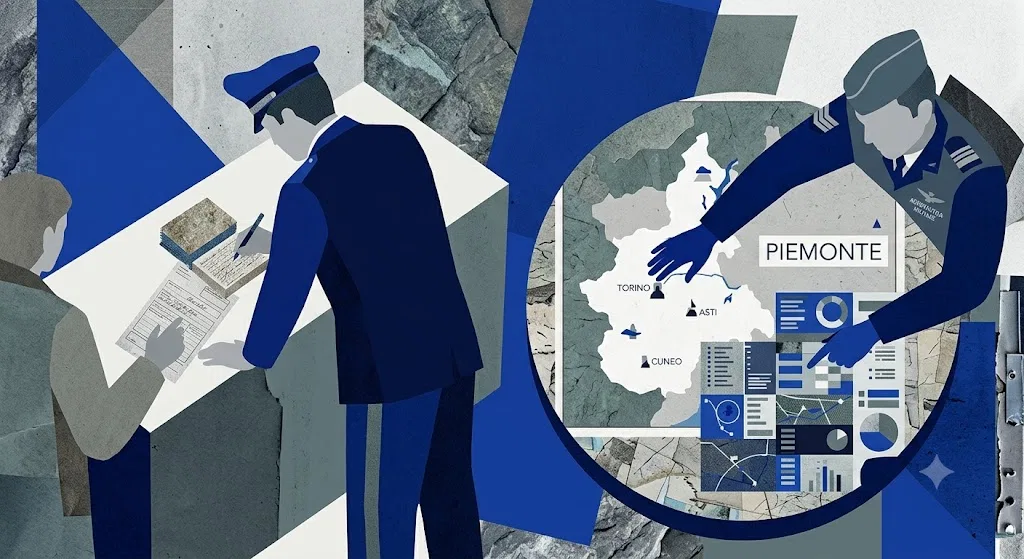
For the witness, the official route is surprisingly traditional: complete the Air Force reporting form and deliver it to the nearest Carabinieri station. The Air Force may then consult other relevant authorities. If no technical or natural correlation can be established, the case can be published in the official archive as an unidentified flying object report. That label records the outcome of the available checks; it does not certify that an extraordinary craft was present.
How reports reach the authorities
The Italian system separates the act of witnessing something unusual from the judgement about what it was. A resident of Turin, Asti, Cuneo or elsewhere in Piedmont does not have to prove that an object was genuinely anomalous before reporting it. The witness supplies observational information, while the authorities decide whether the account can be connected with a known event.
The Air Force’s public instructions set out three basic stages:
- The witness completes the official UFO sighting form.
- The completed form is delivered to a local Carabinieri station.
- The information is passed into the Air Force’s technical assessment process.
This arrangement gives reports a documented law-enforcement route rather than treating them as informal messages sent to a UFO club or newspaper. It also creates a record tied to a named place, date and reporting source. The Air Force says that the purpose is the protection of flight safety and national security, which explains why responsibility lies within a military aviation structure rather than an astronomical research institute.[Aeronautica Militare]aeronautica.difesa.itAeronautica Militare OVNIpuò farlo utilizzando la seguente modulistica: Dopo averla compilata, dovrà consegnarla alla…
The Carabinieri’s role should not be misunderstood. Receiving the form does not mean that officers endorse the witness’s interpretation, nor does every report trigger aircraft interception or a large field operation. The station provides an official point of submission and an institutional chain through which the report can be transmitted and checked.
Timing matters. A prompt report is more useful because aircraft movements, meteorological conditions, astronomical positions and other time-sensitive records are easier to compare with a precise observation. A statement made months or years later may still have historical value, but it is much harder to test.
What the Air Force records
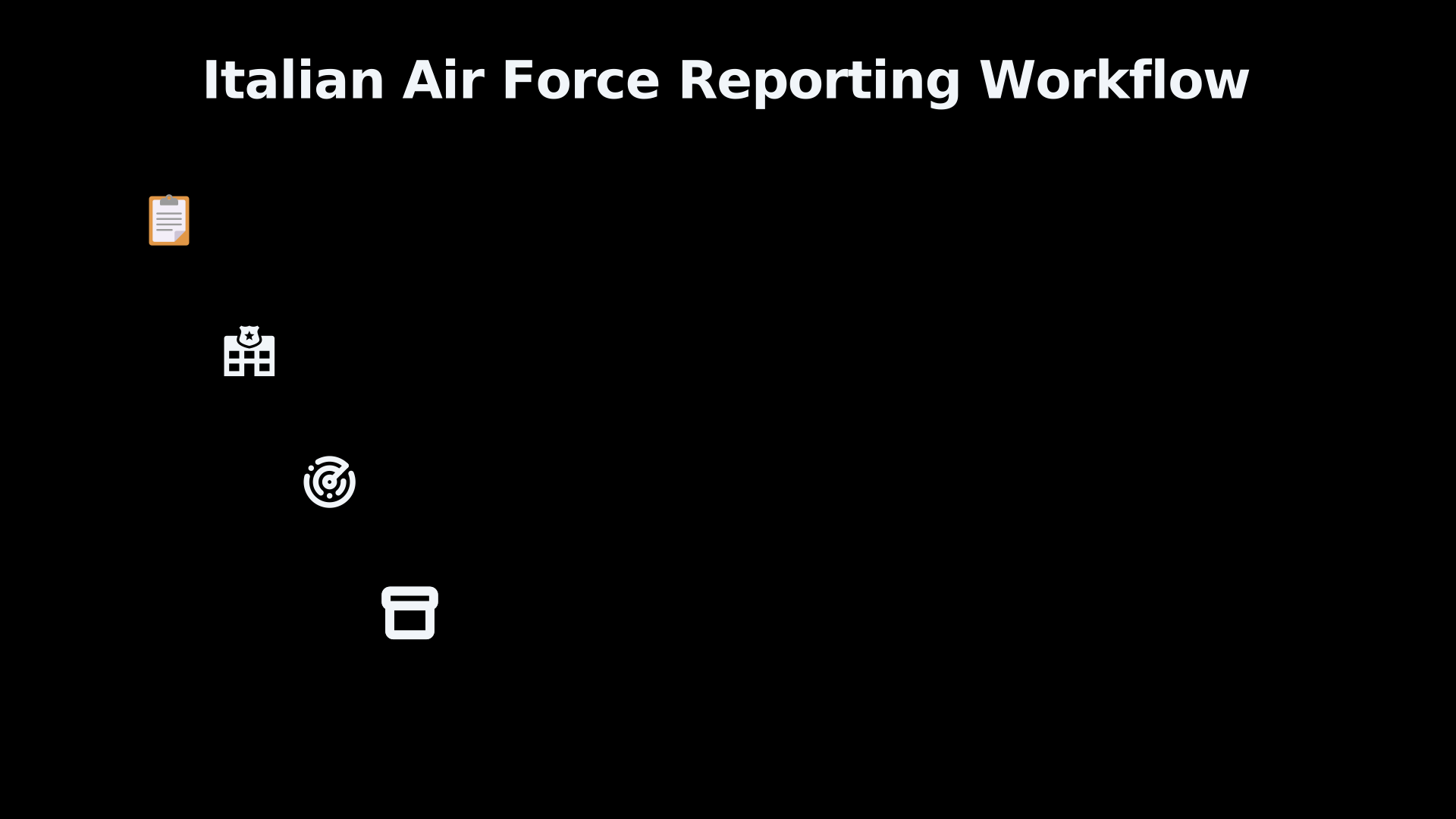
The published Air Force files show that the process depends heavily on structured descriptive information. Archive entries commonly record:
- locality and date;
- approximate time;
- reported shape and colour;
- apparent speed;
- direction and type of movement;
- estimated altitude;
- cloud or weather conditions;
- whether the source was a private citizen, police officer, Carabinieri member or military employee;
- a short summary of the official findings.
These fields address the central identification questions. An apparently stationary light low in the south-west is a different problem from a fast luminous trail crossing the whole sky. A flashing object near an airport must be checked differently from an object described as drifting slowly at low altitude. Weather, viewing direction and duration can be decisive when considering planets, meteors, balloons, aircraft lights or atmospheric effects.
The system nevertheless inherits the weaknesses of eyewitness evidence. People are generally poor at estimating the distance, altitude and speed of an unfamiliar light when there is no visible background or known-size object for comparison. An object described as “1,000 metres high” may simply have looked as though it was at that height. The archive preserves such estimates, but their appearance in an official table does not transform them into instrument measurements.
The public files also vary greatly in detail. Some entries contain a reasonably specific description and a possible correlation. Others retain little more than the witness’s basic account and a standard finding that no connection with a known activity or phenomenon emerged. This means that “officially investigated” can describe anything from checking several operational sources to reviewing a sparse report that never contained enough information for a strong conclusion.
What the Air Force checks
The Air Force describes its task as a technical investigation into possible correlations with human events or natural phenomena. It may involve other competent organisations across Italy when required. Its public webpage does not provide a complete case-by-case checklist, so it would be misleading to claim that every Piedmont report automatically receives radar analysis, astronomical modelling, witness interviews and an on-site inspection.[Aeronautica Militare]aeronautica.difesa.itAeronautica Militare OVNIpuò farlo utilizzando la seguente modulistica: Dopo averla compilata, dovrà consegnarla alla…
In practical terms, the questions implied by the published records fall into several groups.
Was known aviation activity taking place?
Investigators can consider whether the time, direction and behaviour fit civil or military aircraft, helicopters or another authorised aerial activity. Reports close to Turin-Caselle Airport are especially dependent on accurate timing and geometry because normal traffic, approach lights and aircraft seen head-on can produce unusual impressions.
Was another human-made object responsible?
Possible sources include balloons, drones, lanterns, searchlights and other illuminated or airborne objects. Which records are available will depend on the event. A slow oscillating object reported in daylight raises different possibilities from a fast light seen for only a few seconds.
Did the weather or atmosphere affect the observation?
Cloud layers, haze, reflections and unusual propagation conditions can alter apparent brightness or create misleading impressions. Weather information also helps assess whether a reported light could have been seen where the witness placed it.
Was an astronomical object in the same part of the sky?
Bright planets, stars, meteors and astronomical conjunctions are recurring candidates. The official archive demonstrates that such correlations may be noted even when the final entry remains filed under the UFO category.
Do separate reports describe the same event?
Reports from different places can strengthen a case when their times and sightlines agree, but they can also reveal a conventional explanation. A meteor, rocket re-entry or distant astronomical object may generate accounts across several provinces. Multiple witnesses are therefore valuable, but numbers alone do not prove that the source was unusual.
The process is one of elimination and correlation. It asks whether known events fit the report closely enough, not whether an exotic hypothesis can be imagined.
Two Piedmont files show how classification works
The Air Force archive contains useful regional examples because its conclusions are more cautious than the popular meaning of “UFO” suggests.
On 23 February 1999, an observation was recorded from Castelferro in Alessandria province, alongside a report associated with Aviano in Friuli-Venezia Giulia. The phenomenon was described as two parallel white lights of different intensity, apparently moving very slowly at an estimated altitude of about 1,500 metres. The reporting sources included a private citizen and Air Force personnel. The official finding said that checks had not established correlations with known activity or another known phenomenon, apart from an astronomical event involving the conjunction of Jupiter and Venus. The incident was nevertheless catalogued as a UFO.[Aeronautica Militare]aeronautica.difesa.itAeronautica Militare
That wording is revealing. The archive acknowledged a plausible astronomical correlation but did not state that it fully accounted for every feature in the reports. Rather than forcing a definitive identification, the authorities retained the unidentified classification. This is bureaucratic caution, not evidence that Jupiter and Venus were accompanied by an unknown vehicle.
A second report came from San Marzanotto, near Asti, on 3 February 2000. Private citizens described an oblong, silver-coloured luminous object, likened to a partly deflated balloon, moving in an oscillating manner towards the south. The archive lists an estimated altitude of about 1,000 metres and clear skies. It states that information gathered from the relevant Air Force bodies produced no correlation with known activity or another known phenomenon, so the event was catalogued as a UFO.[Aeronautica Militare]aeronautica.difesa.itAeronautica Militare
Here the description itself suggests why no firm conclusion was possible. A balloon-like form and oscillating motion are compatible with a lightweight windborne object, but a witness estimate alone cannot establish its material, distance or actual trajectory. Without recovered debris, photographs, reliable triangulation or tracking data, a plausible explanation may remain unproven. Officially “unidentified” is therefore the defensible result even when an ordinary cause looks possible.
What an unidentified result actually means
In the Italian files, “unidentified” is a residual category. It means that the investigation did not establish a sufficient technical or natural explanation from the information available. The Air Force explicitly states that this is when an incident is classified as a UFO sighting.[Aeronautica Militare]aeronautica.difesa.itAeronautica Militare OVNIpuò farlo utilizzando la seguente modulistica: Dopo averla compilata, dovrà consegnarla alla…
It does not mean that investigators have demonstrated:
- a solid craft rather than a light or perception;
- extraordinary speed or manoeuvrability;
- technology beyond known human capability;
- an extraterrestrial origin;
- a threat to Piedmont or Italian airspace.
The distinction is essential because the strength of unresolved cases varies enormously. One may involve trained aviation witnesses and independent sensor information. Another may be a single brief observation with uncertain direction and no photograph. Both can end with the same administrative label even though their evidential value is very different.
There are at least three common reasons for an unidentified outcome:
The data were too limited. A vague time, uncertain bearing or delayed report can prevent a meaningful comparison.
A conventional explanation was plausible but unconfirmed. Investigators may suspect a balloon, planet or aircraft without having enough evidence to close the case formally.
Available checks found no match. This is more interesting, but it still establishes only the absence of an identified correlation, not the presence of an exotic object.
The 1999 Castelferro entry illustrates how broad the category can be: a recognised planetary conjunction appeared in the official findings, yet the file remained catalogued as unidentified. The label should therefore be read as “not conclusively resolved under this procedure”, not “confirmed mystery”.
Why airport and radar reports are different
Piedmont’s best-known aviation incident, the Turin-Caselle case of 30 November 1973, predates the national arrangement created after the 1978 wave. It is therefore not a model of the present civilian submission process. It does, however, show why reports involving pilots, air-traffic personnel or radar require a more operational form of reconstruction than an ordinary sighting.
In such a case, investigators must establish whether visual observations, aircraft movements and radar returns occurred at the same time and in the same part of the sky. A radar echo and a bright light are not automatically the same object. Clock differences, changing bearings, intermittent returns and later retellings can falsely merge separate events.
That lesson still applies when evaluating a modern Piedmont report near Caselle. The mere mention of radar or an airport does not make the evidence conclusive. What matters is whether records can be synchronised: exact times, sensor positions, aircraft headings, elevations and independent observations. The official Air Force process is designed around flight and national safety, but the summary entries released to the public usually do not provide that full technical record.
This creates an important divide between operational assessment and historical research. Authorities may be able to decide that no immediate safety threat or recognised aircraft correlation was established, while civilian researchers later ask a different question: whether the surviving evidence is sufficient to reconstruct exactly what witnesses saw.
Where the official record is strong—and where it is thin
Italy’s system has several clear strengths. It gives citizens a recognised reporting channel, places responsibility with an aviation authority, preserves standardised details and publishes sighting records over many years. The archive also avoids declaring that unresolved observations are alien spacecraft. Its language stays focused on correlations, technical explanations and natural phenomena.
The limitations are equally important.
First, the published result is normally a summary rather than a full investigative file. Readers may see the observation fields and a brief conclusion without knowing exactly which databases were checked, which specialists were consulted or whether any witness was re-interviewed.
Second, the categories are not a graded measure of evidence. The public archive does not consistently distinguish a high-quality multi-witness case from a poorly specified single-witness report through a transparent reliability score.
Third, there may be a large reporting bias. Only incidents that enter the official channel can be assessed and published. Many people tell local newspapers, post videos online or contact civilian groups without submitting the Air Force form. The official archive is therefore a record of received and processed reports, not a complete census of everything seen over Piedmont.
Fourth, an absence of correlation may reflect missing information rather than genuine anomaly. When no aircraft, natural phenomenon or other activity is matched to an account, the reason may be that the necessary records were unavailable, the witness details were imprecise or the true cause was not one that left a searchable trace.
For regional history, civilian archives can help fill these gaps. Turin-based investigators have preserved press reports, witness correspondence and case material on thousands of Italian sightings. Such collections are not substitutes for military or aviation records, but they can reveal earlier versions of testimony and show how a modest observation later acquired more dramatic details. The central archive of the Italian Centre for UFO Studies in Turin reports extensive holdings of Italian case documentation and press material, making Piedmont unusually well placed for comparisons between official summaries and civilian sources.[CISU - Centro Italiano Studi Ufologici]cisu.orgCentro Italiano Studi Ufologici CISULa biblioteca ospita 670 libri italiani e 1.715 volumi…

How to read a Piedmont investigation responsibly
An official entry is most useful when treated as the beginning of an evidence assessment rather than its end. Readers should ask what was actually observed, what information was recorded and how firmly the stated findings follow from it.
A stronger Piedmont case would normally contain several of the following: prompt reporting, exact time and direction, multiple independent witnesses, long enough duration for careful observation, photographs with original metadata, identifiable reference points, corroborating aviation or sensor records, and a documented effort to test conventional explanations.
A weaker case may still be sincere, but will rely on a single witness, uncertain estimates, a distant point of light, retrospective testimony or images that lack scale and location. Officially unresolved reports of that kind should not be placed on the same evidential level as a carefully documented pilot or airport incident.
The Italian procedure is deliberately narrower than popular UFO culture. It does not attempt to settle every theory surrounding unidentified phenomena. Its practical question is whether a reported event can be connected with something human-made or natural and whether it bears on flight or national safety. When the answer cannot be established, the file remains unidentified.
That restraint is the key to understanding Italy’s official treatment of Piedmont sightings. A UFO classification preserves uncertainty; it does not remove it.
Amazon book picks
Further Reading
Books and field guides related to What Happens When Piedmont Reports a UFO?. Use these as the next step if you want deeper reading beyond the article.
The UFO Experience: A Scientific Inquiry
Cited by the New York Review of Books as "the best brief for visitation," this classic study presents an analysis of UFO reports and conc...
UFOs: Generals, Pilots, and Government Officials Go on the Re...
NEW YORK TIMES BESTSELLER • Impeccably researched, this riveting journalistic investigation separates fact from fiction, and documents th...
The Report on Unidentified Flying Objects
The Report on Unidentified Flying Objects is a book by Edward J. Ruppelt which described the study of UFOs by United States Air Force fro...
UFOs and Government: A Historical Inquiry
Governments around the world have had to deal with the UFO phenomenon for a good part of a century. How and why they did so is the subjec...
eBay marketplace picks
Marketplace Samples
Live-tested eBay searches with available results related to this page.
Selected fromUFO poster oneBay.co.uk.



Current eBay listing
I Want To Believe UFO Poster Giclée Fine Art Heavyweight Print

Current eBay listing
VINTAGE UFO FLYING SAUCERS COMIC ADVERTISING A2 POSTER PRINT
Endnotes
1.
Source: aeronautica.difesa.it
Title: Aeronautica Militare
Link:https://www.aeronautica.difesa.it/wp-content/uploads/2023/05/Archivio_OVNI_periodo1991-2000.pdf
2.
Source: cisu.org
Title: Centro Italiano Studi Ufologici CISU
Link:https://www.cisu.org/page/2/
Source snippet
La biblioteca ospita 670 libri italiani e 1.715 volumi...
3.
Source: news.sky.com
Link:https://news.sky.com/story/ufo-files-latest-new-release-in-us-reveals-reports-of-unexplained-green-orbs-discs-and-fireballs-13543508
4.
Source: cisu.org
Link:https://www.cisu.org/
5.
Source: cisu.org
Title: GEIPA N Archivi
Link:https://www.cisu.org/tag/geipan/
6.
Source: cisu.org
Link:https://www.cisu.org/tag/pierre-lagrange/
7.
Source: aeronautica.difesa.it
Title: Aeronautica Militare OVNI
Link:https://www.aeronautica.difesa.it/ovni/
Source snippet
può farlo utilizzando la seguente modulistica: Dopo averla compilata, dovrà consegnarla alla...
8.
Source: aeronautica.difesa.it
Title: Aeronautica Militare Ufficio relazioni con il pubblico
Link:https://www.aeronautica.difesa.it/ufficio-relazioni-con-il-pubblico/
Source snippet
A seguito dell'ondata di avvistamenti di Oggetti Volanti Non Identificati (OVNI) del 1978...
9.
Source: aeronautica.difesa.it
Title: Aeronautica Militare OVNI
Link:https://www.aeronautica.difesa.it/en/ovni/
Source snippet
Aeronautica MilitareOVNI - Aeronautica MilitareAnyone wishing to report an event related to a U.F.O. can do so using this form. After com...
10.
Source: aeronautica.difesa.it
Link:https://www.aeronautica.difesa.it/wp-content/uploads/2023/01/RIV_4_2020_FIN.pdf
11.
Source: aeronautica.difesa.it
Title: it OVN I Archives
Link:https://www.aeronautica.difesa.it/category/ovni/
12.
Source: aeronautica.difesa.it
Title: it OVN I
Link:https://www.aeronautica.difesa.it/en/2023/01/12/ovni/
13.
Source: aeronautica.difesa.it
Link:https://www.aeronautica.difesa.it/author/redazione-aeronautica-militare/page/2/
14.
Source: esercito.difesa.it
Title: it Rivista Militare n.6
Link:https://www.esercito.difesa.it/comunicazione/editoria/Rivista-Militare/Documents/2024/6RM-2024-abstract.pdf
15.
Source: esercito.difesa.it
Title: it Rivista Militare n.6
Link:https://www.esercito.difesa.it/assets/allegati/6rm-2024-interattivo.2026.02.02.15.06.56.397.pdf
16.
Source: oggetti.com
Link:https://www.oggetti.com/pages/about
17.
Source: Wikipedia
Title: Unidentified flying object
Link:https://en.wikipedia.org/wiki/Unidentified_flying_object
Additional References
18.
Source: youtube.com
Title: The First Ufologist: Alberto Perego
Link:https://www.youtube.com/watch?v=Yf86a9QdfKA
Source snippet
Italian Air Force UFO investigation UFO Mysteries That Defy Explanation | Unidentified: Inside America's UFO Investigation HISTORY...
19.
Source: war.gov
Link:https://www.war.gov/ufo/
20.
Source: facebook.com
Link:https://www.facebook.com/groups/kennedyfans1/posts/999669213047781/
21.
Source: oggetti.com
Link:https://www.oggetti.com/
22.
Source: oggetti.com
Link:https://www.oggetti.com/collections/lighting
23.
Source: academia.edu
Link:https://www.academia.edu/69518005/Proceedings_of_the_Sign_Historical_Group_UFO_History_Workshop
24.
Source: foxnews.com
Link:https://www.foxnews.com/media/rep-burchett-unmasks-deep-state-plot-hide-ufo-truth-two-hour-pentagon-meeting
25.
Source: ibtimes.co.uk
Link:https://www.ibtimes.co.uk/ufo-sighting-over-hawaii-flight-swerves-avoid-mysterious-white-object-airline-denies-claim-1810600
26.
Source: nationalarchives.gov.uk
Link:https://www.nationalarchives.gov.uk/help-with-your-research/research-guides/ufos/
27.
Source: iris.unimore.it
Link:https://iris.unimore.it/retrieve/702aaece-39df-4307-9ef4-3cfe05869bc4/rigenerare-le-aree-militari-dismesse-prospettive-dibattiti-e-riconversioni-in-italia-spagna-e-in-contesti-internazionali.pdf