Within Calabria UFO Files
How Strong Is the Evidence Behind Calabria's UFOs?
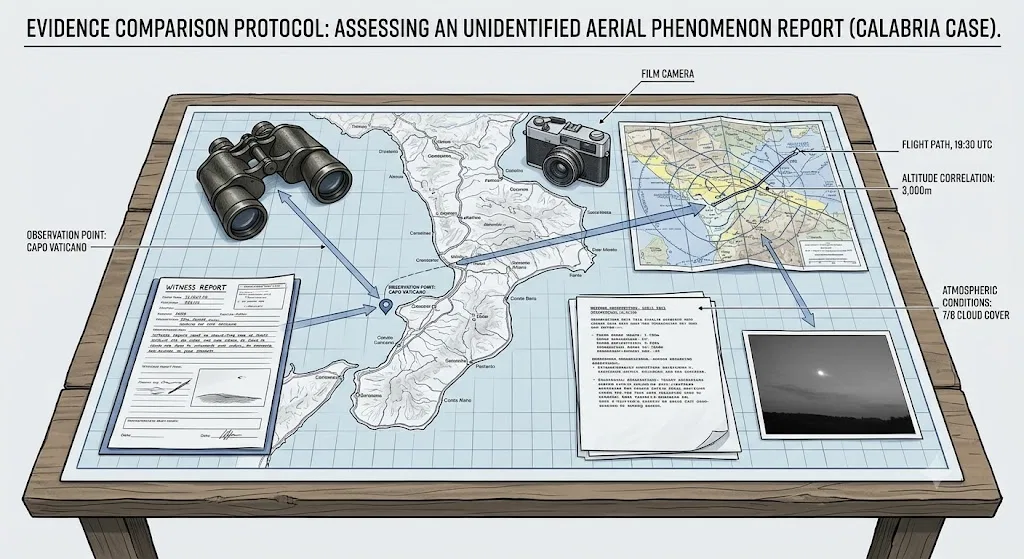
The strongest assessment asks what was recorded, what independent data exists and whether ordinary explanations were properly tested.
On this page
- Witness quality, timing and observation conditions
- Photographs, video, radar and physical traces
- Distinguishing unresolved, weak and explained cases
Page outline Jump by section
Introduction
The strongest Calabrian UFO case is not necessarily the one with the most dramatic witness or the strangest photograph. It is the one that preserves the clearest record of what was seen, fixes the time and place accurately, provides independent data and shows that ordinary explanations were seriously tested. By that standard, much of Calabria’s large UFO archive is historically interesting but evidentially weak.
A useful assessment separates three questions. Was something genuinely observed? Can the observation be reconstructed? Does the surviving evidence require an unusual explanation? A police report may answer the first question without answering the other two. A video may prove that a light appeared on a camera sensor without establishing its distance, size or speed. “Unidentified” should therefore mean only that the available material has not produced a secure identification. It should not be treated as evidence of an exotic craft.
Start with the original record
Before judging what a witness claimed, establish what documentation actually survives. Calabria’s modern regional catalogue contains 1,164 reports, each accompanied by documentary references and assessments of witness reliability and apparent strangeness. That is a valuable research index, but the number counts reported events, not verified anomalies. Entries can originate in contemporary official papers, newspaper articles, private correspondence, later interviews or stories recovered long after the alleged sighting. These sources do not deserve equal weight.[CISU]cisu.orgUFO In CalabriaUFO In Calabria - presentazione e introduzioneUn primo catalogo dei casi ufologici e para-ufologici relativi alla regione Calabria fu…
The first task is therefore to trace a case backwards:
- Is there an original report, or only a retelling?
- Was it written immediately, several days later or decades afterwards?
- Does the archive preserve the witness’s own words?
- Are the date, clock time and viewing location precise?
- Has later writing silently added details absent from the earliest account?
- Do several catalogue entries describe the same event reported through different channels?
Contemporary records are preferable because memories change and later accounts can absorb press coverage, investigators’ suggestions and familiar UFO imagery. A retrospective story may still be sincere, but sincerity cannot restore missing measurements or prove that later details were present in the original experience.
Official status must also be interpreted carefully. The Italian Air Force accepts reports, examines the available information and publishes cases that remain classified as unidentified. Its reporting form requests practical details such as location, time, shape, colour, movement, altitude and weather. That process establishes that a notification entered an official system; it does not by itself establish that radar tracked an extraordinary vehicle or that every conventional possibility was excluded.[Aeronautica Militare]aeronautica.difesa.itAeronautica Militare OVNIChiunque desideri segnalare un evento correlabile ad un O.V.N.I. può farlo utilizzando la seguente modulistica: Dopo averla…Read more…
Witness quality is more than occupation
A report from police officers, pilots or military personnel deserves attention because such witnesses may be trained observers, accustomed to writing reports or familiar with aircraft. Their occupation, however, is not a substitute for good viewing conditions. A skilled observer can still misjudge a distant point of light when there is no visible horizon, known range or fixed object for comparison.
The Calabrian reports from the Italian wave of December 1978 show why this distinction matters. At San Tifeo, Carabinieri personnel reported a low, circular red object at about 3 a.m. moving from north to south. At Corigliano Calabro two days later, Carabinieri recorded a white phenomenon with variable form and movement in a clear morning sky. Both were retained as unidentified in the Air Force archive. Yet the published tables provide no radar correlation, photograph, measured distance or detailed account of how alternative explanations were eliminated. The witnesses give the reports institutional credibility, but the sparse surviving data limit what can be inferred from them.[Aeronautica Militare]aeronautica.difesa.itAeronautica Militare
A sound witness assessment asks about the observation rather than awarding credibility by title:
Duration. A sustained observation normally allows more checking than a glimpse lasting a few seconds. Even so, witnesses often estimate elapsed time poorly unless they checked a clock.
Angular size. Comparisons such as “the size of a car” are almost meaningless without distance. The useful measure is how much of the sky the object covered: smaller than a star-like point, comparable with the Moon, or large enough to obscure known features.
Reference points. Trees, buildings, mountains and the sea horizon can constrain direction and elevation. A light in an empty night sky offers few reliable clues to range or motion.
Viewing conditions. Cloud, mist, glare, twilight, fatigue, windscreen glass and observation through a window can all alter appearance.
Independence. Several witnesses are strongest when they observed from separate positions and recorded their accounts before discussing the event. A crowd repeating one person’s interpretation is not equivalent to several independent observations.
Familiarity. Relevant experience matters only when it matches the circumstances. A pilot identifying aircraft from a cockpit may have useful expertise, but that does not automatically make the pilot an expert in meteors, satellite flares, atmospheric optics or camera artefacts.
Confidence should not be confused with precision. Research on eyewitness evidence shows that confidence is most informative when recorded immediately under controlled, uncontaminated conditions. Later confidence can be influenced by feedback and repeated retelling. UFO interviews are rarely conducted under such controlled conditions, so a witness’s certainty should be recorded but not treated as a measurement.[PubMed]pubmed.ncbi.nlm.nih.govHowever, after more than 30 years of eyewitness-identification research, our understanding of how to properly conduct a lineup has evolve…
Timing and location can make or break a case
Exact time is among the most valuable pieces of information because it allows investigators to compare a sighting with aircraft movements, astronomical objects, satellite passages, meteor activity, balloon releases and weather conditions. “Around ten at night” may be sufficient for a long event; a five-minute error can be decisive when testing a fast meteor, aircraft approach or brief satellite flare.
Location requires similar care. Investigators need the witness’s actual observing point, the direction faced, approximate elevation above the horizon and whether hills or buildings blocked part of the sky. Calabria’s terrain makes this especially important. A light viewed across a valley, along the coast or above a mountain ridge can appear stationary even while travelling towards or away from the observer. Without geometry, claims of hovering, sudden acceleration or very low altitude may be visual impressions rather than measured behaviour.
The 1989 Air Force entry concerning an aircraft crew south-east of Reggio Calabria is a useful example. The crew reported a luminous trail apparently descending towards the sea at about 8,000 metres. An aviation witness and a defined airborne position make the report more useful than an anonymous recollection. Nevertheless, the published summary lacks enough information to decide between an unusual object, a meteor-like event, distant traffic or another luminous phenomenon. The correct verdict from the public material is therefore “unresolved because detail is insufficient”, not “confirmed anomalous aircraft”.[Aeronautica Militare]aeronautica.difesa.itAeronautica Militare
Photographs and video need context, not just clarity
A photograph can confirm that a camera recorded something, but it may say little about what the object was. A sharp image of a tiny feature against empty sky can still lack range, scale and motion. Conversely, a blurred image may look disc-shaped simply because an out-of-focus point source takes the form of the camera aperture or is enlarged by digital processing.
The evidential starting point is the original file, not a screenshot, social-media copy or enlarged news image. Investigators should preserve the native image or video with its metadata, record the device model and settings, and retain an untouched copy. Forensic guidance stresses the importance of the highest-quality native format, associated metadata and a documented chain of handling; compression and repeated copying can remove detail or introduce misleading artefacts.[GOV.UK]GOV.UKDigital investigations: Digital imaging and multimedia procedureDefence Science and Technology Laboratory… PDF (Portable Document Format), 2.06 MB, 46 pagesThis file may not be suitable for users of…
A useful Calabrian image should ideally include landscape or architectural features. These can establish camera direction, reveal reflections, permit angular measurements and allow investigators to revisit the site. A sequence showing the object’s movement is generally more valuable than one isolated frame, provided the sequence is continuous and has not been selectively trimmed.
Important questions include:
- Is the file the original output from the recording device?
- Are date, time and location metadata consistent with the witness’s account?
- Was digital zoom used?
- Was the image taken through glass?
- Are there other frames before and after the published one?
- Does the alleged movement belong to the object, or to camera shake and autofocus?
- Can stars, aircraft lights or landmarks fix the camera’s orientation?
- Have independent analysts reproduced the claimed enhancement?
An attractive enlargement is not new evidence. Sharpening, contrast changes and artificial-intelligence enhancement can make edges easier to see, but they can also invent apparent structure. Any processed version should be presented beside the untouched source and accompanied by a description of every operation performed.
Radar and physical traces require a chain of evidence
Radar evidence is often treated as decisive, yet the word “radar” can hide major differences. A witness saying that an object “also appeared on radar” is weaker than preserved radar data with timestamps, range, altitude, track history and confirmation from operators who can explain the system’s limitations.
For a radar-linked Calabrian case to be strong, the visual and instrumental observations should refer to the same place and time. Investigators would need to exclude normal traffic, weather returns, interference, anomalous propagation and data-processing errors. Ideally, more than one calibrated sensor would track the object independently. NASA’s study of unidentified aerial phenomena emphasised that present investigations are frequently hindered by absent metadata, poor calibration, missing baseline information and a lack of multiple measurements. It identified synchronised, well-characterised sensor data as essential for distinguishing genuine objects from artefacts.[NASA Science]science.nasa.govScience Independent Study Team ReportScience Independent Study Team Report
Claims of landing marks, scorched vegetation, damaged equipment or unusual substances need equally strict handling. The site should be photographed before disturbance, samples should be collected from both the affected area and an unaffected control area, and laboratories should receive properly labelled material. Investigators must also establish when the trace appeared and whether vehicles, farming, fire, animals, weather or human interference could have produced it.
A laboratory finding that soil or vegetation is “abnormal” does not demonstrate that a UFO caused the abnormality. The evidence must link the trace to the observed event and distinguish it from the ordinary environmental variation found at the site.
Ordinary explanations must be tested fairly
A case should not be declared unexplained merely because one investigator could not identify it. Plausible alternatives need to be tested against the reported direction, duration, colour, brightness and motion.
Common candidates in Calabrian cases include:
- aircraft approaching head-on or turning near airports and coastal routes;
- helicopters and drones;
- planets or bright stars seen through haze;
- meteors and re-entering space debris;
- satellites and satellite flares;
- balloons, lanterns and illuminated objects carried by wind;
- lightning-related or other atmospheric phenomena;
- reflections from windows, lenses or internal vehicle surfaces;
- birds, insects and airborne debris close to a camera;
- deliberate fabrication or miscaptioned material.
The explanation should fit the whole account rather than one superficial feature. A meteor is a poor explanation for a light observed hovering for twenty minutes. A planet is unsuitable if independent records show rapid movement across a large part of the sky. By the same standard, an extraordinary interpretation should not be preserved merely because a conventional candidate is imperfectly documented.
Modern official case reviews repeatedly find that seemingly unusual images and tracks can resolve into balloons, birds, aircraft, drones or satellites once flight information, viewing geometry and sensor behaviour are considered. AARO, the United States’ official anomaly-analysis office, has also published examples in which apparent wakes or unusual movement resulted from video compression, viewing geometry or distant aircraft. These examples do not settle any particular Calabrian report, but they demonstrate why reconstruction must precede interpretation.[aaro.mil]aaro.milOpen source on aaro.mil.

Unresolved, weak and explained are different verdicts
The most useful conclusion is not a dramatic yes-or-no judgement but a classification that reflects the quality of the surviving material.
Explained means that a known object or process fits the evidence with reasonable confidence. The explanation should account for the time, direction, appearance and duration, not merely resemble the reported shape.
Probably explained is appropriate when one ordinary cause fits well but a decisive record is missing. For example, a light’s path may closely match an aircraft or satellite, although no original photograph or precise timestamp survives.
Unresolved with good data should be reserved for cases containing reliable timing, independent witnesses or useful instrumental information in which tested explanations remain inadequate. This category is genuinely interesting, but it still does not identify the object as extraterrestrial or technologically extraordinary.
Unresolved because of insufficient data describes many catalogue and official-archive cases. The report may be sincere and accurately preserved, yet too little survives to reconstruct it. This is an evidence gap, not a positive anomaly.
Weak or unreliable applies when the story is retrospective, internally inconsistent, anonymously sourced, repeatedly embellished or supported only by degraded media. The event may have happened, but the public evidence cannot carry a confident conclusion.
Debunked or fabricated should be used only where there is positive evidence of manipulation, false attribution or a known source falsely presented as unknown. Failure to prove a claim is not itself proof of a hoax.
This vocabulary prevents a common error in Calabrian UFO history: treating every unclosed file as if it occupied the same evidential category. The San Tifeo and Corigliano reports have official provenance but sparse public detail. A modern video may be visually striking but lose most of its value if the original file and location are unavailable. A folklore-like historical account can matter culturally while offering almost no testable evidence about an aerial object.
A practical test for Calabrian cases
A reader can make a defensible first assessment by asking five questions in order.
- What is the earliest recoverable source? Give greatest weight to contemporary documents, original recordings and direct testimony.
- Can the event be reconstructed? Look for exact time, viewing position, direction, duration, weather and angular size.
- Is there independent corroboration? Separate witnesses, photographs, radar or flight records should agree in time and geometry.
- Were ordinary causes tested with actual data? An explanation should be checked, not merely named and dismissed.
- Does the conclusion match the evidence level? Missing information warrants “insufficient data”, not an extraordinary claim.
Applied consistently, this method does not erase Calabria’s unexplained reports. It makes the remaining uncertainty more meaningful. A case that survives careful checking deserves more attention than dozens of catalogue entries that cannot be reconstructed. Just as importantly, a case weakened by absent originals, uncertain timing or an obvious conventional match should be described honestly. Calabria’s UFO record is most useful not as proof of a hidden presence, but as a test of how well unusual observations can be documented, challenged and understood.
Amazon book picks
Further Reading
Books and field guides related to How Strong Is the Evidence Behind Calabria's UFOs?. Use these as the next step if you want deeper reading beyond the article.
The UFO Experience: A Scientific Inquiry
Cited by the New York Review of Books as "the best brief for visitation," this classic study presents an analysis of UFO reports and conc...
UFOs: Generals, Pilots, and Government Officials Go on the Re...
NEW YORK TIMES BESTSELLER • Impeccably researched, this riveting journalistic investigation separates fact from fiction, and documents th...
The Demon-Haunted World: Science as a Candle in the Dark
NEW YORK TIMES BESTSELLER • From the renowned astronomer and author of Cosmos comes a “powerful [and] stirring defense of informed ration...
Bad Astronomy
A clever, thought-provoking guide that attacks common astronomical misconceptions What is Bad Astronomy? Anything that accidentally or in...
eBay marketplace picks
Marketplace Samples
Live-tested eBay searches with available results related to this page.
Selected fromUFO poster oneBay.co.uk.

Current eBay listing
VINTAGE UFO FLYING SAUCERS COMIC ADVERTISING A2 POSTER PRINT
Current eBay listing
I Want To Believe UFO Poster Giclée Fine Art Heavyweight Print


Endnotes
1.
Source: cisu.org
Title: UFO In Calabria
Link:https://www.cisu.org/ufo-in-calabria-presentazione-e-introduzione/
Source snippet
UFO In Calabria - presentazione e introduzioneUn primo catalogo dei casi ufologici e para-ufologici relativi alla regione Calabria fu...
2.
Source: cisu.org
Title: ufo in calabria il catalogo dei casi
Link:https://www.cisu.org/ufo-in-calabria-il-catalogo-dei-casi/
Source snippet
UFO in Calabria: il catalogo dei casi13 Sept 2023 — i UFO in Calabria: Si tratta dell'ultimo arrivo fra i cataloghi regionali o provi...
3.
Source: aeronautica.difesa.it
Title: Aeronautica Militare
Link:https://www.aeronautica.difesa.it/wp-content/uploads/2023/05/Archivio_OVNI_periodo1972-1990.pdf
4.
Source: GOV.UK
Title: Digital investigations: Digital imaging and multimedia procedure
Link:https://www.gov.uk/government/publications/digital-investigations-digital-imaging-and-multimedia-procedure
Source snippet
Defence Science and Technology Laboratory... PDF (Portable Document Format), 2.06 MB, 46 pagesThis file may not be suitable for users of...
Published: November 16, 2021
5.
Source: GOV.UK
Title: Digital Imaging and Multimedia Procedure v3.0
Link:https://www.gov.uk/government/publications/digital-investigations-digital-imaging-and-multimedia-procedure/digital-imaging-and-multimedia-procedure-v30
6.
Source: science.nasa.gov
Title: Science Independent Study Team Report
Link:https://science.nasa.gov/wp-content/uploads/2023/09/uap-independent-study-team-final-report.pdf
Published: September 13, 2023
7.
Source: aaro.mil
Link:https://www.aaro.mil/UAP-Cases/Official-UAP-Imagery/
8.
Source: war.gov
Link:https://www.war.gov/News/Transcripts/Transcript/Article/3965734/dr-jon-kosloski-director-aaro-media-roundtable-on-the-fy24-consolidated-annual/
Published: November 14, 2024
9.
Source: nationalarchives.gov.uk
Title: PRONO M | Search by format
Link:https://www.nationalarchives.gov.uk/PRONOM/fmt/41
Published: August 15, 2023
10.
Source: digital.nmla.metoffice.gov.uk
Link:https://digital.nmla.metoffice.gov.uk/download/file/IO_724a79c2-4041-4b0b-af22-95a4c09c83c2
11.
Source: digital.nmla.metoffice.gov.uk
Link:https://digital.nmla.metoffice.gov.uk/download/file/IO_87be9684-2ed3-4fe7-9500-c6187103ad65
12.
Source: cisu.org
Title: divulgazione Archivi
Link:https://www.cisu.org/tag/divulgazione/
13.
Source: cisu.org
Link:https://www.cisu.org/author/grassino/
14.
Source: cisu.org
Link:https://www.cisu.org/pietro-torre/
15.
Source: cisu.org
Title: ufo a messina
Link:https://www.cisu.org/tag/ufo-a-messina/
16.
Source: cisu.org
Title: Libri Archivi
Link:https://www.cisu.org/tag/libri/
17.
Source: cisu.org
Title: 10 anni di ufo museum
Link:https://www.cisu.org/10-anni-di-ufo-museum/
18.
Source: cisu.org
Title: Torino Archivi
Link:https://www.cisu.org/tag/torino/
19.
Source: cisu.org
Link:https://www.cisu.org/page/2/
20.
Source: nasa.gov
Link:https://www.nasa.gov/wp-content/uploads/2025/11/fy-2025-q4-foia-log.xlsx?emrc=75e66d
21.
Source: aeronautica.difesa.it
Title: Aeronautica Militare OVNI
Link:https://www.aeronautica.difesa.it/ovni/
Source snippet
Chiunque desideri segnalare un evento correlabile ad un O.V.N.I. può farlo utilizzando la seguente modulistica: Dopo averla...Read more...
22.
Source: pubmed.ncbi.nlm.nih.gov
Link:https://pubmed.ncbi.nlm.nih.gov/28395650/
Source snippet
However, after more than 30 years of eyewitness-identification research, our understanding of how to properly conduct a lineup has evolve...
Published: March 22, 2017
23.
Source: media.defense.gov
Title: FY24 CONSOLIDATED ANNUAL REPORT ON UAP 508
Link:https://media.defense.gov/2024/Nov/14/2003583603/-1/-1/0/FY24-CONSOLIDATED-ANNUAL-REPORT-ON-UAP-508.PDF?ftag=MSF0951a18
Published: May 1, 2023
24.
Source: pubmed.ncbi.nlm.nih.gov
Link:https://pubmed.ncbi.nlm.nih.gov/42331394/
Published: June 22, 2026
25.
Source: pubmed.ncbi.nlm.nih.gov
Link:https://pubmed.ncbi.nlm.nih.gov/10932793/
Additional References
26.
Source: psychologicalscience.org
Link:https://www.psychologicalscience.org/journals/pspi/1529100616686966/
Source snippet
Association for Psychological ScienceThe Relationship Between Eyewitness Confidence and Identification Accuracy: A New Synthesis - Psycho...
27.
Source: archives.gov
Link:https://www.archives.gov/records-mgmt/uap-guidance
Published: May 8, 2024
28.
Source: defense.gov
Link:https://www.defense.gov/News/News-Stories/Article/Article/3965403/dod-examining-unidentified-anomalous-phenomena/
Published: November 14, 2024
29.
Source: archives.fbi.gov
Link:https://archives.fbi.gov/archives/about-us/lab/forensic-science-communications/fsc/july2001/swgit.htm
Published: July 2001
30.
Source: archives.fbi.gov
Link:https://archives.fbi.gov/archives/about-us/lab/forensic-science-communications/fsc/jan2003/swgitdigital.htm
Published: JANUARY 2003
31.
Source: archives.fbi.gov
Link:https://archives.fbi.gov/archives/about-us/lab/forensic-science-communications/fsc/april2008/standards/2008_04_standards02.htm
32.
Source: loc.gov
Link:https://www.loc.gov/preservation/digital/formats/fdd/fdd000412.shtml
Published: February 27, 2017
33.
Source: loc.gov
Title: JPE G Encoded File with Exif Metadata
Link:https://www.loc.gov/preservation/digital/formats/fdd/fdd000147.shtml
Published: November 6, 2023
34.
Source: cfreds.nist.gov
Link:https://cfreds.nist.gov/
35.
Source: ojp.gov
Link:https://ojp.gov/library/publications/detection-jpeg-double-compression-and-identification-smartphone-image-source
Published: October 1, 2013