Within Tuscan UFO Files
Were Florence's Falling Threads Spider Silk?
Mass spider ballooning offers a natural source for skyborne filaments, but it does not neatly match every detail reported in Florence.
On this page
- How spiders travel on airborne silk
- Why autumn conditions fit the theory
- Which Florence details remain difficult
Page outline Jump by section
Introduction
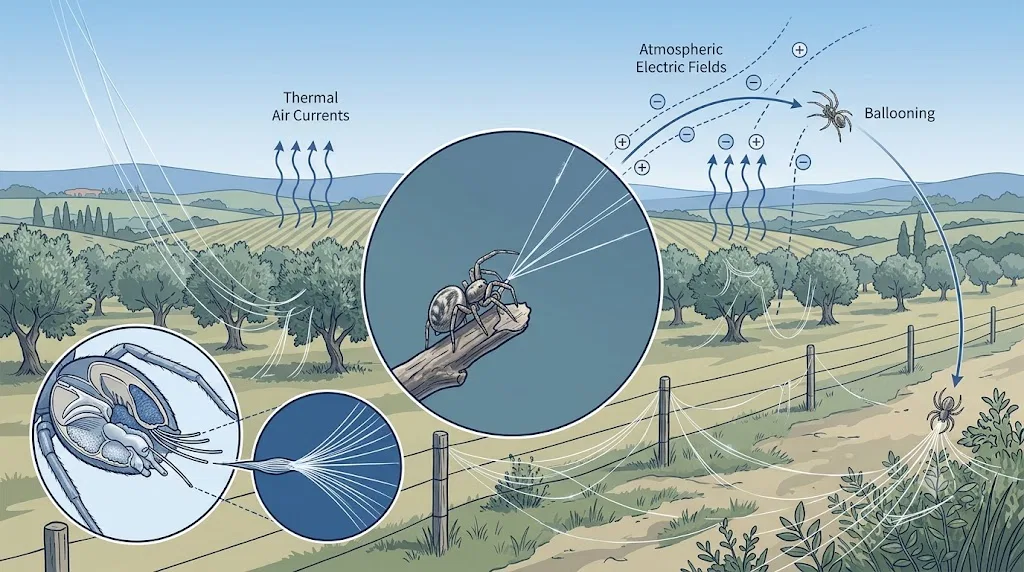
Spider ballooning is one of the strongest natural explanations for the fine white threads reported over Florence on 27 October 1954. In this dispersal behaviour, spiders release extremely light silk fibres that are lifted by gentle air currents and atmospheric electric fields. When large numbers take off or land together, their threads can drift from a clear sky, catch the sunlight and settle across trees, roofs and fields like a thin fall of cotton or snow. Autumn is a recognised peak period for the behaviour, so the date of the Florence incident fits unusually well.[nih.gov]pmc.ncbi.nlm.nih.govThe meteorological conditions that produce non-ideal convection and the greatest dispersal distances are typically attained in conditions…
That does not mean spider silk explains the whole Florence UFO case. It offers a credible mechanism for airborne filaments and perhaps for some distant bright shapes, but it does not reproduce every reported property of the material. Most importantly, the limited chemical analysis attributed to the University of Florence does not read like a straightforward identification of protein-based spider silk. With no preserved sample available for modern examination, the theory remains plausible rather than conclusively proved.
How spiders travel on airborne silk
Ballooning is not powered flight. A spider, commonly a very small juvenile, climbs onto an exposed point, raises its abdomen and releases several fine strands from its spinnerets. The fibres spread into the air until the combined pull is sufficient to lift or drag the animal from its perch. Researchers have observed spiders testing local conditions before launch and taking off when brief upward currents occur within otherwise light winds.[nih.gov]pubmed.ncbi.nlm.nih.govOpen source on nih.gov.
The word “ballooning” can be misleading because there is no inflated balloon. The silk acts more like an exceptionally light sail or parachute. In laboratory and field studies, individual strands have proved fine enough to respond to weak air movements, while bundles of nanoscale fibres provide enough drag for surprisingly large spiders to become airborne. Most ballooners are nevertheless tiny: many are only a few millimetres long and weigh a fraction of a milligram.[PLOS]journals.plos.orgOpen source on plos.org.
Wind is not the only force involved. Experiments have shown that spiders can detect atmospheric electric fields and that charged silk can produce lift even where measurable air movement is minimal. This helps explain historical observations in which silk appeared to rise or spread under conditions that seemed too calm for ordinary wind transport. It also makes the visual behaviour less intuitive to an observer on the ground: fibres may fan out, hang almost motionless or change direction as local air and electrical conditions vary.[arXiv]arxiv.orgarXiv Evidence for nanocoulomb charges on spider ballooning silkarXiv Evidence for nanocoulomb charges on spider ballooning silk
Once the journey ends, loose silk can remain suspended without the spider being visible. The animal may be extremely small, may detach from part of the line, or may land elsewhere while long fibres continue drifting. A person who finds threads on a hedge or rooftop should therefore not necessarily expect to see spiders attached to every strand.
Mass events can be much more conspicuous than ordinary ballooning. Modern examples have covered large areas of Australia and the United States with sheets or clumps of gossamer, producing descriptions of “spider rain” and landscapes that appeared dusted with snow. These events demonstrate that enormous quantities of silk can enter the air at once without any unusual aircraft or atmospheric substance being involved.[nationalgeographic.com]nationalgeographic.com150518 spiders australia silk webs animals environment150518 spiders australia silk webs animals environment
Why autumn conditions fit Florence
The date of the Tuscan incident is one of the spider theory’s strongest points. Ballooning is especially common in late spring and autumn in temperate climates. Studies link successful dispersal to warm or rapidly warming air, relatively low humidity, weak horizontal wind and small rising currents near the ground. Strong, gusty winds are generally less favourable because spiders often delay launching when conditions become too turbulent.[nih.gov]pmc.ncbi.nlm.nih.govThe meteorological conditions that produce non-ideal convection and the greatest dispersal distances are typically attained in conditions…
Late October can provide exactly the required combination: cool nights followed by bright daytime warming, with sunlight creating small thermals over fields, roofs and slopes. Research modelling spider dispersal has found that warm temperatures and light breezes in spring and autumn can carry ballooners farther than either completely still hot air or cool, strongly windy conditions.[PubMed Central (PMC)]pmc.ncbi.nlm.nih.govThe meteorological conditions that produce non-ideal convection and the greatest dispersal distances are typically attained in conditions…
The Tuscan landscape also offers abundant launching points. Agricultural land, river margins, gardens, woodland edges and low vegetation surround Florence and extend towards the hills north and east of the city. A regional emergence or dispersal event need not have begun directly above the stadium. Silk released outside the centre could have been transported towards Florence and become most visible where it crossed open urban sightlines.
The appearance of the threads is also compatible with eyewitness descriptions. Very fine silk is difficult to see until it catches light at a favourable angle. A large airborne sheet can therefore appear suddenly as a shining trail, a pale mass or a succession of silvery fragments. From a distance, folded or tangled material may look solid enough to be interpreted as an object, especially when no scale or background reference is available.
This matters because the Florence reports were not uniform. Witnesses compared what they saw to eggs, cigars, wings, discs and unusual hats rather than agreeing on a single clearly defined craft. A drifting mixture of silk sheets, bright reflections and separate objects could generate inconsistent descriptions of that kind. The theory does not require every witness to have seen precisely the same thing.[The Florentine]theflorentine.netufos 1954ufos 1954
The strongest evidence for the silk theory
The spider explanation rests on more than a superficial resemblance between silk and the reported “angel hair”. Several separate features line up:
- Form: witnesses described fine, pale, cobweb-like filaments rather than heavy fragments or a continuous liquid.
- Distribution: threads were reportedly found across exposed surfaces, consistent with material settling from moving air.
- Season: the event occurred during a recognised autumn ballooning period.
- Sky conditions: silk falls are often most striking under clear or lightly clouded skies, when sunlit fibres are easy to see.
- Impermanence: delicate silk can collapse, break up or become almost invisible when handled, wetted or gathered into a small mass.
- Known comparisons: documented mass ballooning elsewhere has produced extensive white veils and falls that observers likened to snow, cotton or rain.[academie-sciences.fr]comptes-rendus.academie-sciences.frBallooning is thus more important in summer and autumn relative to other time-periods [33]…. This study informs phenological character…
The theory also has explanatory economy. It invokes a real biological behaviour capable of producing airborne threads at the appropriate time of year. No unknown propulsion system, exotic atmospheric chemistry or material generated by a spacecraft is needed.
Italian sceptical investigators associated with the Committee for the Investigation of Claims of the Pseudosciences have therefore treated ballooning as a serious explanation for at least the fibrous fall. Their reconstruction separates the material from the wider aerial display: the falling threads may have been natural even if some bright objects had another cause, such as reflective military radar chaff.[CICAP]cicap.org1954 ufo e bambagia silicea su firenze il cicap propone la soluzione1954 ufo e bambagia silicea su firenze il cicap propone la soluzione
That separation is important. The popular version of the story often presents the lights and the filaments as one event, with craft visibly shedding material. Yet reports that two things occurred close together do not prove that one produced the other. The silk could already have been moving through the atmosphere when attention was drawn upwards by a separate display.
Which Florence details remain difficult
The main obstacle is the reported chemical examination of a collected sample. Accounts attribute the analysis to the University of Florence and state that it detected boron, silicon, calcium and magnesium, with no radioactivity. Spider silk, by contrast, is a biological fibre made chiefly from proteins. Taken literally, the reported elemental list does not provide a clean match.[PubMed Central (PMC)]pmc.ncbi.nlm.nih.govPub Med Central (PMC)The elaborate structure of spider silkPub Med Central (PMC)The elaborate structure of spider silk
This discrepancy is often treated as decisive evidence against ballooning, but the surviving record is too incomplete to support that conclusion. A spectrographic test can identify elements without identifying the complete material from which they came. Soil, dust, glass particles, plaster, vegetation, collection containers and other contaminants could all contribute inorganic elements to a tiny sample gathered from an urban surface. The published retellings also differ over the researcher’s name, the precise procedure and whether the residue was interpreted as borosilicate glass or merely as containing several listed elements.[Wikipedia]WikipediaAngel hair (folkloreAngel hair (folklore
No securely documented specimen survives for modern protein analysis, microscopy or comparison with known ballooning silk. Nor is there a complete laboratory report, an uncontested chain of custody or a set of control samples from the collection site. The chemical evidence is therefore a reason for caution, not a reliable identification of an extraordinary substance.
Some descriptions also present difficulties. The threads were said to be sticky, resistant to twisting or liable to disappear rapidly on contact. Fresh spider silk can adhere to surfaces and an extremely small quantity may seem to vanish when compressed, but “evaporation” is not a normal property of protein silk. Such wording may reflect the collapse of a loose, visible network into an almost invisible speck, although that cannot now be tested.
Another problem is the absence of clearly recorded spiders in the Florence material. In confirmed mass ballooning events, spiders are sometimes discovered among the fibres. Their absence in the surviving accounts weakens a direct identification, although it does not rule one out: the animals may have been microscopic, overlooked, detached or never included in the sample taken for chemical testing.
The theory is also less satisfactory when applied to every reported aerial object. Gossamer sheets could explain slow, pale forms or glittering material, but some witnesses recalled fast movement, abrupt stopping or cigar-shaped bodies. Those claims may involve misperception, memory development or a separate airborne phenomenon. They should not simply be re-labelled as spiders without supporting evidence.
A persuasive partial explanation
The falling-silk theory is strongest when kept within proper limits. It convincingly shows that a clear sky can produce a widespread fall of fine white fibres through an ordinary biological process. The season, appearance and known scale of mass ballooning all make it a better explanation than claims that an unidentified craft manufactured an unknown substance above Florence.
It does not, however, amount to a laboratory identification of the 1954 material. The original sample is unavailable, the chemical account is fragmentary and several reported properties are either ambiguous or imperfectly matched by silk. The most defensible judgement is therefore that mass spider ballooning is a plausible, evidence-based explanation for much of the falling material, but not a demonstrated solution to every detail.
Within Tuscany’s UFO history, that distinction changes how the Florence episode should be read. The filaments are often treated as physical proof that the objects in the sky were solid, unusual machines. Once ballooning is recognised as a credible independent source, that inference becomes much weaker. Florence remains a significant mass sighting, but its celebrated “angel hair” no longer provides secure evidence that anything extraordinary was deposited by a UFO.
Amazon book picks
Further Reading
Books and field guides related to Were Florence's Falling Threads Spider Silk?. Use these as the next step if you want deeper reading beyond the article.
Spider Silk
Spiders, objects of eternal human fascination, are found in many places: on the ground, in the air, and even under water. Leslie Brunetta...
Spiders: Learning to Love Them
"Yet again I was screaming in the night" is the opening sentence in this book. The author decided to deliberately overcome her fear of sp...
eBay marketplace picks
Marketplace Samples
Live-tested eBay searches with available results related to this page.
Selected fromUFO poster oneBay.co.uk.


Current eBay listing
I Want To Believe UFO Poster Giclée Fine Art Heavyweight Print


Current eBay listing
VINTAGE UFO FLYING SAUCERS COMIC ADVERTISING A2 POSTER PRINT
Endnotes
1.
Source: journals.plos.org
Link:https://journals.plos.org/plosbiology/article?id=10.1371%2Fjournal.pbio.2004405
2.
Source: journals.plos.org
Link:https://journals.plos.org/plosone/doi?id=10.1371%2Fjournal.pbio.2004405
Source snippet
Spiders balloon most frequently during late spring and autumn seasons [2,4,30].The influences of microclimates on ballooning—such as temp...
3.
Source: arxiv.org
Title: arXiv Evidence for nanocoulomb charges on spider ballooning silk
Link:https://arxiv.org/abs/1912.02335
4.
Source: arxiv.org
Title: arXiv Ballooning Spiders: The Case for Electrostatic Flight
Link:https://arxiv.org/abs/1309.4731
5.
Source: time.com
Link:https://time.com/4125343/giant-spiderweb-tennessee/
6.
Source: time.com
Link:https://time.com/3882445/raining-spiders-australia/
7.
Source: Wikipedia
Title: Avvistamento di UFO a Firenze
Link:https://it.wikipedia.org/wiki/Avvistamento_di_UFO_a_Firenze
8.
Source: cicap.org
Title: 1954 ufo e bambagia silicea su firenze il cicap propone la soluzione
Link:https://www.cicap.org/articolo/1954-ufo-e-bambagia-silicea-su-firenze-il-cicap-propone-la-soluzione
9.
Source: Wikipedia
Title: Bambagia silicea
Link:https://it.wikipedia.org/wiki/Bambagia_silicea
10.
Source: Wikipedia
Title: Angel hair (folklore)
Link:https://en.wikipedia.org/wiki/Angel_hair_%28folklore%29
11.
Source: Wikipedia
Title: Cabelo de anjo
Link:https://pt.wikipedia.org/wiki/Cabelo_de_anjo
12.
Source: cicap.org
Link:https://www.cicap.org/articolo/articolo.php?id=275998
13.
Source: cicap.org
Title: capelli dangelo indagine in corso
Link:https://www.cicap.org/articolo/capelli-dangelo-indagine-in-corso
14.
Source: Wikipedia
Title: Ballooning (spider)
Link:https://en.wikipedia.org/wiki/Ballooning_%28spider%29
15.
Source: arxiv.org
Link:https://arxiv.org/html/2502.06794v2
16.
Source: pmc.ncbi.nlm.nih.gov
Link:https://pmc.ncbi.nlm.nih.gov/articles/PMC2464704/
Source snippet
The meteorological conditions that produce non-ideal convection and the greatest dispersal distances are typically attained in conditions...
17.
Source: comptes-rendus.academie-sciences.fr
Link:https://comptes-rendus.academie-sciences.fr/biologies/articles/en/10.1016/j.crvi.2016.06.007/
Source snippet
Ballooning is thus more important in summer and autumn relative to other time-periods [33].... This study informs phenological character...
18.
Source: pubmed.ncbi.nlm.nih.gov
Link:https://pubmed.ncbi.nlm.nih.gov/29902191/
19.
Source: pmc.ncbi.nlm.nih.gov
Link:https://pmc.ncbi.nlm.nih.gov/articles/PMC6001951/
Source snippet
The local wind speed and temperature were not measured directly, but the values from the Dahlem weather station (4.5 km distance from the...
20.
Source: nationalgeographic.com
Title: 150518 spiders australia silk webs animals environment
Link:https://www.nationalgeographic.com/animals/article/150518-spiders-australia-silk-webs-animals-environment
21.
Source: theguardian.com
Link:https://www.theguardian.com/australia-news/2021/jun/15/they-look-like-waves-massive-spider-webs-blanket-gippsland-after-victorian-floods
22.
Source: pubmed.ncbi.nlm.nih.gov
Link:https://pubmed.ncbi.nlm.nih.gov/27527898/
23.
Source: besjournals.onlinelibrary.wiley.com
Link:https://besjournals.onlinelibrary.wiley.com/doi/abs/10.1046/j.1365-2664.2003.00844.x
24.
Source: pubmed.ncbi.nlm.nih.gov
Title: Pub Med Ballooning dispersal in arthropod taxa: conditions at take-off
Link:https://pubmed.ncbi.nlm.nih.gov/17389214/
25.
Source: theflorentine.net
Title: ufos 1954
Link:https://www.theflorentine.net/2025/10/22/ufos-1954/
26.
Source: queryonline.it
Title: 1954 ufo e bambagia silicea su firenze
Link:https://www.queryonline.it/2014/11/10/1954-ufo-e-bambagia-silicea-su-firenze/
27.
Source: pmc.ncbi.nlm.nih.gov
Title: Pub Med Central (PMC)The elaborate structure of spider silk
Link:https://pmc.ncbi.nlm.nih.gov/articles/PMC2658765/
28.
Source: theguardian.com
Title: research sheds light on mystery of how spiders take flight
Link:https://www.theguardian.com/science/2018/jul/05/research-sheds-light-on-mystery-of-how-spiders-take-flight
29.
Source: theblackarchive.net
Link:https://theblackarchive.net/en/case/017
Additional References
30.
Source: youtube.com
Title: Spiders that fly using Electricity 🕷️ How it works
Link:https://www.youtube.com/watch?v=YuuZ6CvEJbo
Source snippet
This selection of videos explains the physics and biological mechanisms behind spider ballooning—including electrostatic lift, wind dynam...
31.
Source: cia.gov
Link:https://www.cia.gov/readingroom/document/cia-rdp81r00560r000100010001-0
32.
Source: youtube.com
Title: Spiders Can Actually Fly?! | The Truth About Ballooning
Link:https://www.youtube.com/watch?v=-Bbq5FBJkvs
Source snippet
Ballooning spiders - Spiders: how they move and spin (1/5)...
33.
Source: youtube.com
Title: Ballooning spiders
Link:https://www.youtube.com/watch?v=kYPABcMzbEg
Source snippet
Spiders that fly using Electricity 🕷️ How it works...
34.
Source: youtube.com
Title: Flying Spiders! | Animal Einsteins | BBC Earth
Link:https://www.youtube.com/watch?v=KSG4cFysbGU
Source snippet
Spiders Can Actually Fly?! | The Truth About Ballooning...
35.
Source: reddit.com
Link:https://www.reddit.com/r/ufo/comments/q839es/angel_hair_is_a_phenomenon_barely_talked_about/
36.
Source: reddit.com
Link:https://www.reddit.com/r/UFOs/comments/1d8weo3/angel_hair_is_a_sticky_fibrous_substance_reported/
37.
Source: reddit.com
Link:https://www.reddit.com/r/interestingasfuck/comments/m39y26/although_it_looks_like_snow_this_was_actually_the/
38.
Source: scribd.com
Link:https://www.scribd.com/document/264153635/An-Analysis-of-AngeL-Hair
39.
Source: reddit.com
Link:https://www.reddit.com/r/UFOs/comments/xrhz3c/angel_hair_is_crucial_element_of_the_ufo/