Within Umbria
How Many UFOs Were Really Reported in Umbria?
Different counts may include every initial report, only investigated cases or just those that remained unresolved after review.
On this page
- Competing regional totals
- Notifications, duplicates and selected cases
- What a reliable public dataset would require
Page outline Jump by section
Introduction
Published totals for UFO sightings in Umbria differ because they are usually counting different things. One source may include every newspaper story, online notification and historical witness account. Another may count only reports entered into a particular organisation’s archive. A third may select a handful of investigated or unresolved cases for public discussion. These figures are not interchangeable.
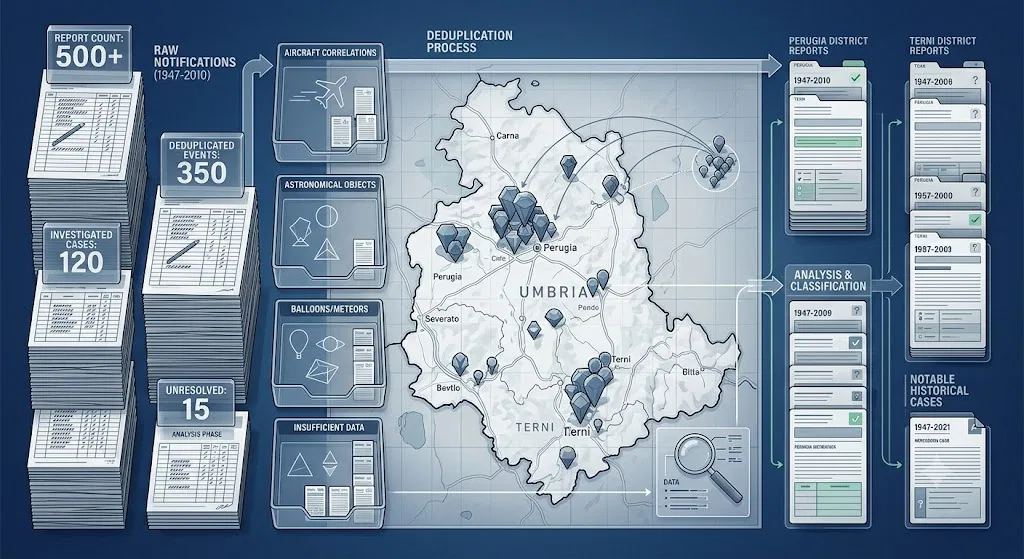
The contrast is striking. In November 2010, reporting linked to the Centro Italiano Studi Ufologici (CISU) put Umbria’s historical total at more than 500 cases over 63 years. Yet coverage of a CISU conference held at the same time highlighted just four documented Umbrian incidents from the preceding three decades. A later regional feature separately listed 40 reports for 2010, 21 for 2011 and 27 for 2012. The difference does not show that hundreds of records vanished. It shows why any Umbrian total is meaningless unless the source explains its date range, admission rules, treatment of duplicates and definition of a “case”.[udine20.it]udine20.itufo oltre 2000 avvistamenti in italia nel 2010Ufo: oltre 2000 avvistamenti in Italia nel 2010 - Udine20…
Competing regional totals
The broadest published figure found for Umbria is more than 500 cases between 1947 and 2010. According to contemporary reporting on the 2010 CISU conference in Terni, around 60 per cent were associated with the province of Perugia and the remainder with Terni. The same report gave approximately 40 cases for 2009 and 25 during the first ten months of 2010.[Udine20]udine20.itufo oltre 2000 avvistamenti in italia nel 2010Ufo: oltre 2000 avvistamenti in Italia nel 2010 - Udine20…
Those numbers appear to describe catalogue entries rather than extraordinary incidents that survived investigation. CISU states explicitly that its regional archives contain the full body of reports about unusual aerial phenomena and that only a small proportion remain unidentified after adequate analysis. Its catalogue can therefore contain stars, aircraft, balloons, meteors and other conventional phenomena if witnesses initially regarded them as unexplained.[CISU]cisu.orgUfo in ItaliaUfo in Italia - CISU - Centro Italiano Studi Ufologici…
The much smaller figure of four sightings in about 30 years came from a local report on presentations at the same Terni conference. The four examples were not presented as a complete census of every call, clipping or unverified observation. They were a selected sequence of cases documented by local investigators: Nocera Umbra in 1977, Badiale in 1998, Polino in 2001 and Orvieto in 2010. One of them, the 1998 Badiale case, had already been attributed to a lightweight solar-powered toy, while the Polino and Orvieto observations were described as unresolved.[Tuttoggi.info]tuttoggi.infoOpen source on tuttoggi.info.
Calling that selection “four sightings in 30 years” was therefore liable to mislead readers. It compressed several different categories—historically memorable, investigated, solved and unresolved—into a headline that sounded like a regional total. In reality, the same conference was also associated with the claim that the Umbrian archive contained more than 500 records.[Tuttoggi.info]tuttoggi.infoOpen source on tuttoggi.info.
A third set of figures comes from a 2021 regional feature, which reported 40 registered sightings in 2010, 21 in 2011 and 27 in 2012, including 12 during August 2012. It also acknowledged that most of the 2012 reports from Perugia and Terni had plausible explanations, while giving greater attention to visually dramatic but uncorroborated accounts near Porano and Tuoro sul Trasimeno.[Real Umbria]realumbria.itReal Umbria Oggetti volanti non identificati: avvistamenti eclatanti in UmbriaReal Umbria Oggetti volanti non identificati: avvistamenti eclatanti in Umbria
Even here, there is an apparent discrepancy: the contemporary 2010 report gave 25 Umbrian notifications during the first ten months, whereas the later article gave 40 for the complete year. The difference might reflect the final two months, reports added retrospectively, a revised catalogue or the use of another dataset. None of the available public pages provides enough case-level information to determine which explanation applies. The responsible conclusion is not to choose one number as definitively correct, but to recognise that the two figures have different cut-off dates and possibly different collection rules.[Udine20]udine20.itufo oltre 2000 avvistamenti in italia nel 2010Ufo: oltre 2000 avvistamenti in Italia nel 2010 - Udine20…
Notifications are not investigated cases
The most important distinction is between a notification and a case conclusion. A notification begins when someone reports an unusual light, object, photograph or experience. It may be incomplete, duplicated or readily explained. An investigated case is one for which researchers have gathered enough information to compare the account with aircraft movements, astronomical objects, balloons, satellites, weather and other possible causes. An unresolved case is narrower still: it remains unidentified after the available checks, which does not mean that an exotic craft has been proved.
CISU’s own description of its national and regional work makes this hierarchy clear. Its archives were built from local catalogues maintained by regional curators, supported by witness information and investigations. The organisation warns that the catalogue comprises all collected reports of unusual aerial phenomena, only a small share of which are classified as unidentified after analysis. It also notes that more than 70 per cent of its historical cases are observations of distant nocturnal lights, a category in which reliable estimates of size, distance and speed are often difficult.[CISU]cisu.orgUfo in ItaliaUfo in Italia - CISU - Centro Italiano Studi Ufologici…
The Italian Air Force operates another, narrower reporting channel. After the national wave of 1978, it was designated as the institution responsible for collecting, checking and monitoring official UFO notifications. Its process asks witnesses to submit a detailed form so that a technical inquiry can look for correlations with aviation, weather-balloon and other known activity. Reports made only to a newspaper, UFO group, social-media page or informal witness network will not necessarily appear in the Air Force statistics.[Aeronautica Militare]aeronautica.difesa.itAeronautica Militare Ufficio relazioni con il pubblicoA seguito dell’ondata di avvistamenti di Oggetti Volanti Non Identificati (OVNI) del 1978, l’allora Presidente del Consiglio Giulio Andre…
This creates several legitimate totals for the same region:
- All located historical reports: potentially includes old newspaper cuttings, retrospective testimony and weakly documented stories.
- Reports received by one organisation: excludes notifications sent elsewhere.
- Annual notifications: counts reports before all investigations are complete.
- Investigated cases: omits entries lacking enough information for meaningful checks.
- Unresolved cases: retains only observations not matched to a conventional cause.
- Selected notable cases: a curated group chosen for a conference, article or historical review rather than a statistical total.
Confusion arises when an article moves between these categories without changing its language. “Reported”, “recorded”, “investigated”, “unexplained” and “notable” may all be reduced to the single word “sighting”, although they describe different stages of the evidence.
One event can produce several records
A regional catalogue also needs a rule for deciding when multiple accounts represent one event. Twelve people watching the same group of lights over Perugia might produce twelve witness statements, one multi-witness incident or several entries if their times and locations differ. A newspaper may publish the story again the following day, while a UFO association receives separate web forms and another group catalogues a video. Unless those records are linked, a single episode can inflate the total.
The reverse problem also occurs. Several observations on the same night may be combined too aggressively because they describe similar coloured lights. That can conceal genuinely separate events or obscure the fact that witnesses were looking in different directions. The 2012 Umbrian accounts illustrate the difficulty: the regional feature described 27 cases during the year and 12 in August, but did not publish a table showing whether each entry represented a unique event, an individual witness or a cluster assembled from related notifications.[Real Umbria]realumbria.itReal Umbria Oggetti volanti non identificati: avvistamenti eclatanti in UmbriaReal Umbria Oggetti volanti non identificati: avvistamenti eclatanti in Umbria
Historical records present further complications. Before organised regional cataloguing, unusual-sky reports were commonly preserved through local newspapers. The 2010 account of Umbrian cases noted that the 1977 Nocera Umbra story came from contemporary press coverage because no dedicated collection centre existed locally at the time. Later researchers therefore had to reconstruct incidents from clippings, sometimes decades after the event.[Tuttoggi.info]tuttoggi.infoOpen source on tuttoggi.info.
A historical newspaper item may consequently be counted when first published, counted again when rediscovered in an archive and linked to a later interview as though it were additional evidence. Proper record linkage should treat the cutting, interview and investigator’s file as sources belonging to one case, not three independent sightings.
Collection effort changes the map
Regional totals do not measure only what happened in the sky. They also measure how actively people searched newspapers, publicised reporting channels and followed up witnesses.
CISU acknowledges that differences between Italian regions are partly produced by variations in the activity of local UFO researchers. A region with an energetic investigator who systematically checks provincial newspapers may acquire a much fuller historical catalogue than a region where reports were collected intermittently. That difference can persist even when the regions have similar populations or observation conditions.[CISU]cisu.orgUfo in ItaliaUfo in Italia - CISU - Centro Italiano Studi Ufologici…
Umbria’s figures are particularly sensitive to this effect because its historical archive appears to combine several collection eras. Early incidents were recovered from print journalism; later cases could be sent directly to civilian organisations; and formal reports could also be submitted through the Air Force procedure. From the late 2000s, digital cameras, online forms and social media lowered the effort required to report a light or upload an image. A CISU representative said in 2010 that internet use had contributed to a sharp increase in incoming material while also lowering the average quality of reports, most of which eventually received conventional explanations.[Udine20]udine20.itufo oltre 2000 avvistamenti in italia nel 2010Ufo: oltre 2000 avvistamenti in Italia nel 2010 - Udine20…
Public attention can generate temporary peaks as well. A widely reported incident, television feature or UFO conference encourages people to reinterpret earlier observations and submit them. Some reports will be new events; others will be delayed memories or multiple responses to the same stimulus. A spike in catalogue entries therefore does not automatically indicate a matching increase in unusual aerial phenomena.
Solved cases do not necessarily disappear
Another source of disagreement is whether explained cases remain in the historical total. For research purposes, retaining them is useful. A solved balloon, satellite or toy shows what witnesses can mistake for an extraordinary object and helps investigators recognise similar reports later. Removing every explained entry would erase information about reporting behaviour and common identification errors.
The Badiale incident demonstrates the point. Two agricultural workers reportedly saw a reflective cylindrical object rise and expand in 1998. Investigators compared the description with a commercially available solar toy—a lightweight plastic envelope heated and lifted by sunlight—and classified it as a non-UFO. Yet the event remained part of the conference’s four-case historical sequence because it was a documented Umbrian report with an investigative outcome.[Tuttoggi.info]tuttoggi.infoOpen source on tuttoggi.info.
A source counting all reported cases would retain Badiale. A source counting only unresolved cases would remove it. A source presenting important investigations might include it precisely because it was solved. None of those choices is inherently wrong, provided the category is stated.
The same principle applies to recent high-volume years. The 2021 regional account said that many of the 27 reports from 2012 had plausible explanations, but it still described them as catalogued sightings. Readers should therefore not treat “27 sightings” as “27 unexplained objects”, much less as 27 pieces of evidence for an unconventional vehicle.[Real Umbria]realumbria.itReal Umbria Oggetti volanti non identificati: avvistamenti eclatanti in UmbriaReal Umbria Oggetti volanti non identificati: avvistamenti eclatanti in Umbria
Source quality matters more than the headline number
A large total may sound impressive, but it says little about evidential strength. Five hundred entries dominated by short descriptions of distant lights are not necessarily more informative than a small group of reports containing precise times, directions, independent witnesses and contemporary documentation.
The reverse is also true: a tiny list of “unresolved” cases may result from severe selection rather than exceptional quality. A report can remain unexplained simply because the witness did not record enough information to identify it. “Unresolved” may mean that checks found no match, but it can also mean that the available data were too poor to reach a conclusion.
For Umbrian reporting, useful questions include:
- Was the report made immediately or reconstructed years later?
- Is the original statement available, rather than only a journalist’s retelling?
- Were multiple witnesses independent of one another?
- Are the date, time, viewing direction and duration recorded?
- Were aircraft, satellites, astronomical objects and balloons checked?
- Does a photograph retain its original file and metadata?
- Has the case been classified as explained, insufficiently documented or genuinely unresolved?
- Is the record linked to related reports so it is not counted twice?
These criteria shift attention away from the seductive question “How many UFOs were there?” towards the more answerable question “How many distinct reports are documented well enough to assess?”
What a reliable public dataset would require
A dependable Umbrian catalogue would not need to declare every case solved. It would need to show clearly what each number represents. At minimum, each record should have a stable case identifier, location, date, approximate time, reporting date, source organisation and current status.
It should also separate three levels that are frequently blurred:
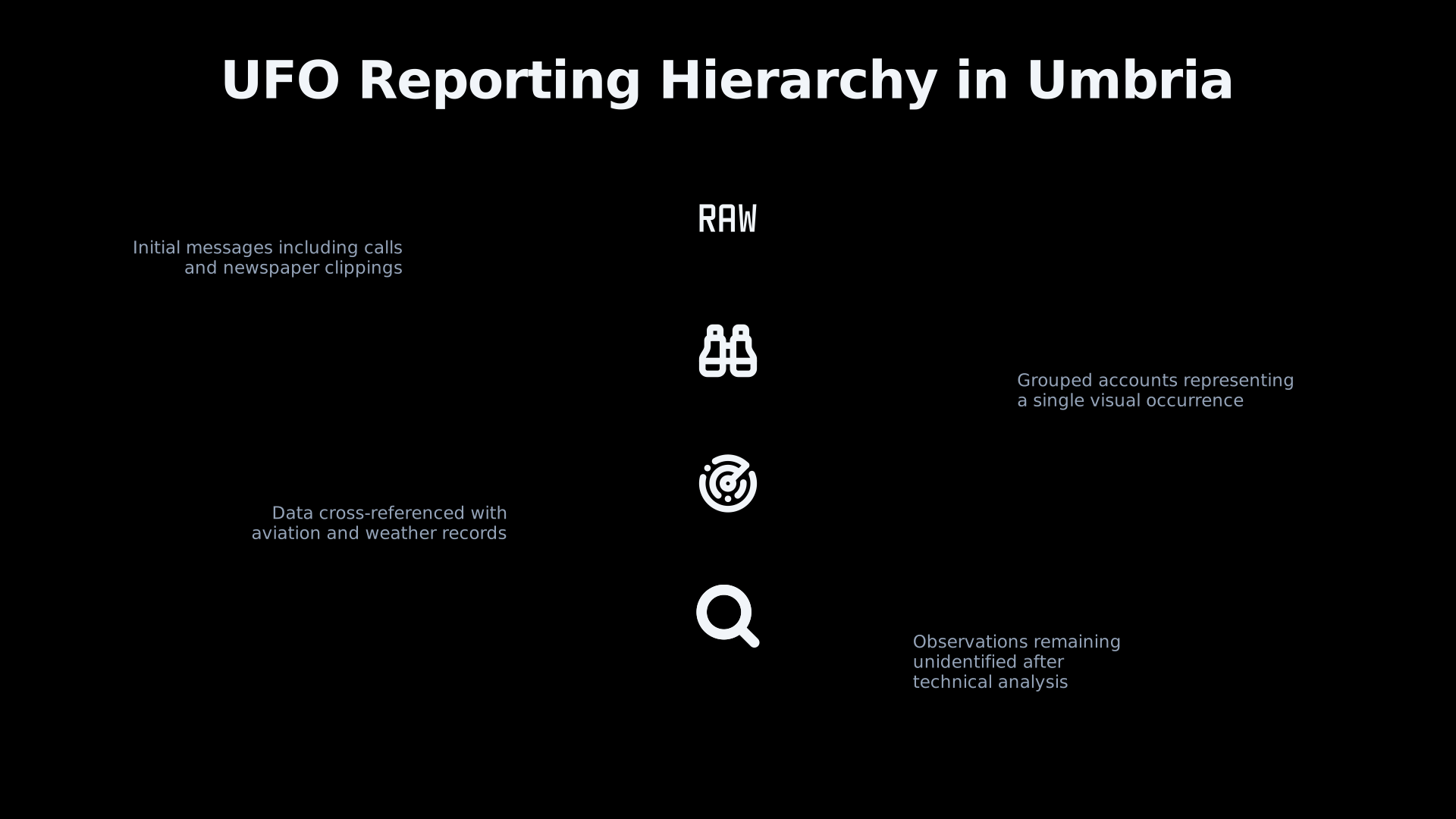
- Raw notifications: every message, call, clipping or submission received.
- Consolidated incidents: notifications grouped when they concern the same event.
- Analytical outcomes: identified, probably identified, unresolved, insufficient information, fabricated or still under review.
The public record should preserve the raw count while publishing a deduplicated incident count beside it. For example, a dataset might report 40 notifications but only 28 distinct events, of which 18 were identified, six lacked adequate data and four remained unresolved. That structure would allow apparently conflicting figures to coexist without misleading the reader.
Source provenance is equally important. Each entry should identify whether it originated with the Italian Air Force, CISU, another civilian association, a local newspaper or an online submission. This would prevent an official total from being mistaken for the complete regional record and would show when several archives contain versions of the same incident.
Revision history would resolve disagreements such as the 2010 count of 25 reports during the first ten months versus the later figure of 40 for the full year. A dated snapshot could show when each record was added, merged, reclassified or removed. Without that audit trail, later totals cannot be reliably compared with contemporary announcements.[Udine20]udine20.itufo oltre 2000 avvistamenti in italia nel 2010Ufo: oltre 2000 avvistamenti in Italia nel 2010 - Udine20…

The most defensible answer
There is no single verified number that answers how many UFOs were “really” reported in Umbria across all periods and reporting systems. The strongest published broad estimate located for the period ending in 2010 is more than 500 catalogue cases since 1947. That figure includes reported unusual aerial phenomena, not 500 unexplained craft. The figure of four cases over roughly three decades was a curated set of documented examples, not a complete census. Annual figures such as 40 in 2010, 21 in 2011 and 27 in 2012 belong to another layer of reporting and cannot be compared directly without the underlying case list.[udine20.it]udine20.itufo oltre 2000 avvistamenti in italia nel 2010Ufo: oltre 2000 avvistamenti in Italia nel 2010 - Udine20…
The wide variation is therefore mostly a classification and record-keeping problem. Different sources count different time spans, intake channels, witness submissions, incidents, investigative stages and outcomes. Until a deduplicated public dataset links those layers case by case, Umbrian totals should be quoted with their definitions attached—and never treated as a direct measure of unexplained activity in the region.
Amazon book picks
Further Reading
Books and field guides related to How Many UFOs Were Really Reported in Umbria?. Use these as the next step if you want deeper reading beyond the article.
The UFO Experience: A Scientific Inquiry
Cited by the New York Review of Books as "the best brief for visitation," this classic study presents an analysis of UFO reports and conc...
UFOs: Generals, Pilots, and Government Officials Go on the Re...
NEW YORK TIMES BESTSELLER • Impeccably researched, this riveting journalistic investigation separates fact from fiction, and documents th...
The Report on Unidentified Flying Objects
The Report on Unidentified Flying Objects is a book by Edward J. Ruppelt which described the study of UFOs by United States Air Force fro...
Passport to Magonia
Over two decades ago, eminent scientist Vallee wrote a provocative book about alleged UFO landings, folklore, and certain unexplained phe...
eBay marketplace picks
Marketplace Samples
Live-tested eBay searches with available results related to this page.
Selected fromUFO poster oneBay.co.uk.

Current eBay listing
VINTAGE UFO FLYING SAUCERS COMIC ADVERTISING A2 POSTER PRINT

Current eBay listing
I Want To Believe UFO Poster Giclée Fine Art Heavyweight Print


Endnotes
1.
Source: udine20.it
Title: ufo oltre 2000 avvistamenti in italia nel 2010
Link:https://www.udine20.it/ufo-oltre-2000-avvistamenti-in-italia-nel-2010/2010/11/16/
Source snippet
Ufo: oltre 2000 avvistamenti in Italia nel 2010 - Udine20...
2.
Source: tuttoggi.info
Link:https://tuttoggi.info/ufo-in-umbria-4-avvistamenti-in-30-anni-i-lavori-del-25-convegno-nazionale-ufologia-terni-video-e-foto-tuttoggi-info/85047/
3.
Source: cisu.org
Title: Ufo in Italia
Link:https://www.cisu.org/ufo-in-italia/
Source snippet
Ufo in Italia - CISU - Centro Italiano Studi Ufologici...
4.
Source: realumbria.it
Title: Real Umbria Oggetti volanti non identificati: avvistamenti eclatanti in Umbria
Link:https://www.realumbria.it/21/04/2021/oggetti-volanti-non-identificati-umbria/
5.
Source: aeronautica.difesa.it
Title: Aeronautica Militare Ufficio relazioni con il pubblico
Link:https://www.aeronautica.difesa.it/ufficio-relazioni-con-il-pubblico/
Source snippet
A seguito dell’ondata di avvistamenti di Oggetti Volanti Non Identificati (OVNI) del 1978, l’allora Presidente del Consiglio Giulio Andre...
6.
Source: aeronautica.difesa.it
Title: Aeronautica Militare OVNI
Link:https://www.aeronautica.difesa.it/en/ovni/
Source snippet
Aeronautica MilitareOVNI - Aeronautica MilitareFollowing the wave of Unidentified Flying Object (UFO) sightings in 1978, the then Prime M...
7.
Source: aeronautica.difesa.it
Link:https://www.aeronautica.difesa.it/wp-content/uploads/2022/11/ModuloUFO.pdf
Source snippet
ISTRUZIONI: Il modulo seguente deve essere utilizzato per la segnalazione dell’avvistamento di un O.V.N.I...
Additional References
8.
Source: youtube.com
Title: UFO Sightings: How Scientists are Trying to Capture More Data
Link:https://www.youtube.com/watch?v=qho0N3vv7Gw
Source snippet
This collection provides analytical perspective on how UFO data, reporting thresholds, and case selection methodologies shape sighting st...
9.
Source: youtube.com
Title: Interview: Mick West, Identifying UFOs
Link:https://www.youtube.com/watch?v=lsMomLDKIz4
Source snippet
UFO Sightings: How Scientists are Trying to Capture More Data...
10.
Source: youtube.com
Title: UFO Data Mining, Part 1: Time Series Models
Link:https://www.youtube.com/watch?v=oaJ-tByZko8
Source snippet
How scientists use math to help explain UFO videos...
11.
Source: youtube.com
Title: How scientists use math to help explain UFO videos
Link:https://www.youtube.com/watch?v=diPXow8zgc8
Source snippet
Are they aliens?...
12.
Source: youtube.com
Title: Are they aliens?
Link:https://www.youtube.com/watch?v=q0HRS_IzTmU
Source snippet
Interview: Mick West, Identifying UFOs...